
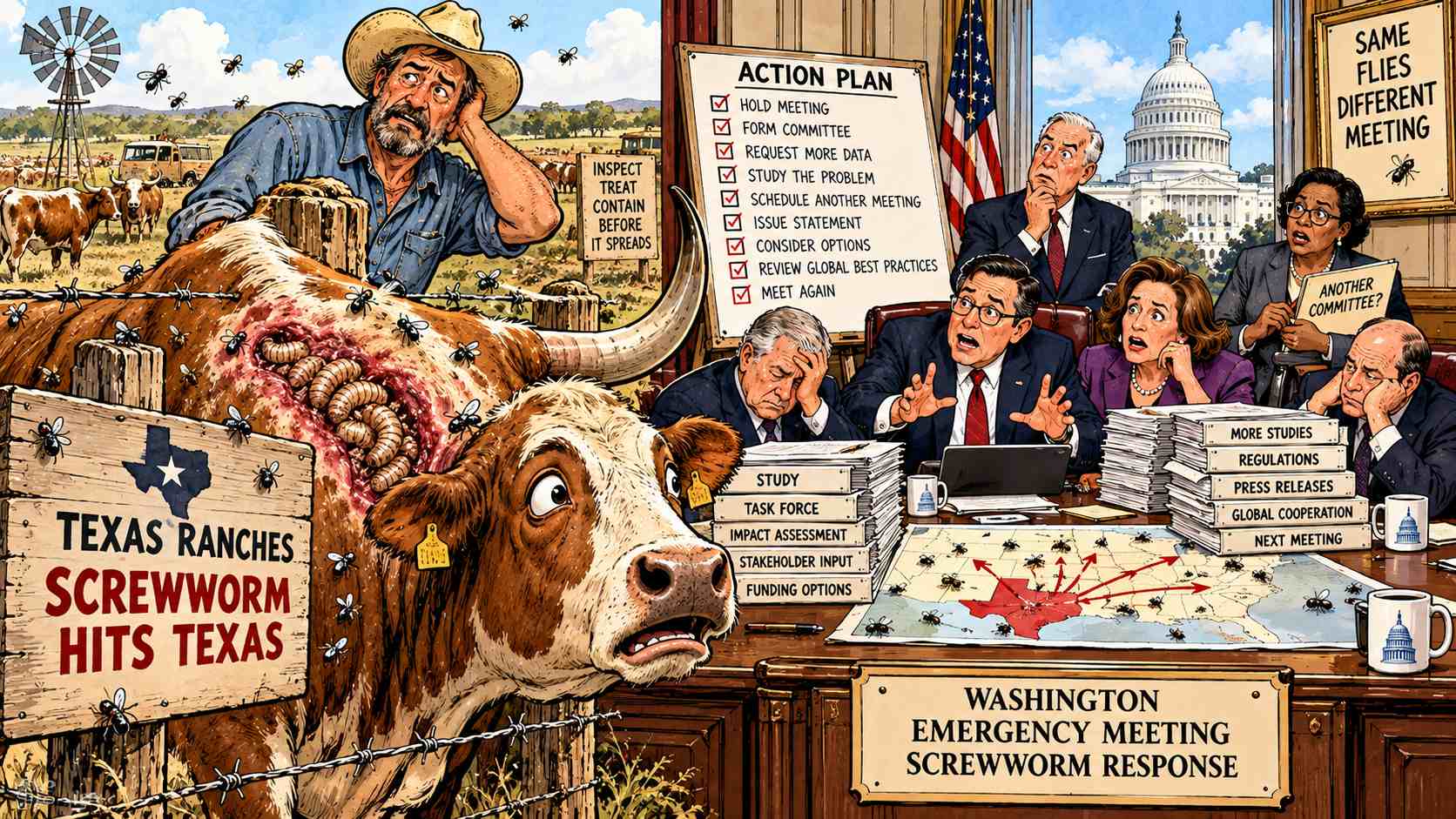
The parasite has never attended one and is doing fine
PECOS COUNTY, TEXAS – The discovery of New World screwworm in Texas wildlife has alarmed ranchers across the Southwest, prompting federal officials to deploy one of Washington’s most reliable defenses against agricultural emergencies: a meeting.
The USDA confirmed screwworm in an elk in Pecos County, while New Mexico animal health officials separately confirmed the parasite in a beef cow in Otero County, as KJZZ reported. The fly’s larvae feed on living animal tissue, making it a serious threat to cattle and wildlife.
Ranchers immediately recognized the danger. Washington immediately recognized the opportunity for interagency coordination. The parasite, which has never attended a meeting, continued behaving with alarming efficiency.
The Federal Government Develops an Emergency Agenda
According to an account of an emergency agricultural conference, federal officials assembled representatives from 14 departments to discuss the threat. The meeting began with introductions. Then came a presentation about the importance of cooperation. Then a presentation about the presentation. Then lunch.
By the time officials reached the section titled “Possible Actions,” one participant had retired and another had accepted a position at the Department of Transportation.
A Texas rancher observing the proceedings expressed concern.
“That thing eats living flesh. Can we hurry?”
A federal consultant allegedly replied, “We’re moving as fast as the stakeholder engagement process allows.”
The rancher suggested allowing the screwworm to eat the consultant. The proposal was referred to the ethics committee.
Ranchers Offer a Simpler Definition of Emergency
For ranchers, the problem requires little philosophical interpretation. A healthy calf has value. A calf suffering a dangerous parasitic infestation needs immediate veterinary attention. A ranch with an escalating outbreak risks serious financial losses.
This is elementary cause-and-effect reasoning, a process Washington occasionally experiments with before commissioning further research.
New Mexico officials established an infested zone around the Otero County detection and imposed animal inspection and treatment requirements for movement within or out of the affected area. The USDA is also using surveillance and sterile insect releases to suppress the pest. These are genuine control measures, developed through scientific work rather than political performance.
Unfortunately, their effectiveness has encouraged a new concern among bureaucrats: They might succeed without an additional advisory council.
Screwworm Flies Fail Their First Congressional Hearing
In a congressional hearing, lawmakers demanded to know why the parasites had ignored existing agricultural regulations. One senator asked whether the flies possessed movement permits. Another asked whether they were complying with livestock transportation standards. A third proposed requiring them to submit environmental impact statements before approaching cattle.
A fly was invited to testify. It failed to appear, citing its complete indifference to representative democracy.
Meanwhile, ranchers continued inspecting animals, contacting veterinarians and monitoring suspicious wounds. Their method lacked PowerPoint slides but possessed a crucial advantage: It addressed the actual problem.
Sterile Insect Technique: The Washington Fix That Actually Worked
The United States eliminated established New World screwworm populations decades ago using sterile insect techniques. The method involves releasing sterile flies that mate without producing viable offspring. It is practical, scientific and impressively direct.
A federal consultant suggested modernizing the operation by replacing sterile flies with sterile committees. The proposal would require fewer aircraft but significantly more coffee.
Texas ranchers remain less interested in government theatrics than stopping the parasite. They welcome surveillance, veterinary expertise and proven eradication methods. They would simply prefer the flies to disappear before another committee reaches its fourth preliminary recommendation.
Because in West Texas, the cattle business still operates according to an old-fashioned principle. When something starts eating your livestock, you deal with it. You don’t invite it to a stakeholder workshop.
The Evidence File
Historical Precedent
The U.S. beat this same pest in the 1966 eradication campaign, back when the government ran its fly program on aircraft, science and a strong aversion to subcommittees. The sterile fly, it should be noted, did not need to attend a single hearing to do its job. Current outbreak details are tracked by the American Farm Bureau Federation.
Statistical Absurdity
Fourteen departments in the room, one fly outside it. That is a ratio of 14 federal agencies to a single pest that hasn’t yet filed a single form. If the flies unionized, they’d still win on efficiency.
Comic Eyewitness Testimony
A hand at a ranch outside Fort Stockton says he watched a federal consultant take notes on the infestation for 40 minutes before asking whether the calf had been “properly stakeholdered.” The calf was treated by a veterinarian in nine.
Sources and Further Reading
Learn more from the USDA Animal and Plant Health Inspection Service, the Texas Animal Health Commission, and Farm Bureau market intelligence. Regional reporting is at KJZZ.
Source: USDA APHIS wildlife detection announcement; New Mexico Department of Agriculture’s October 21 report; USDA sterile insect control guidance.
Humorous Observations
- The meeting started with introductions, then a presentation about cooperation, then a presentation about the presentation, then lunch. That’s not an emergency response. That’s a Sunday at my in-laws.
- Somebody asked if the flies had movement permits. Sir, the fly moves. It’s got a whole set of wings and zero respect for the Department of Transportation.
- Sterile committees. Honestly, that might work. We already have plenty and none of them have ever produced anything.
- The fly was invited to testify and cited “complete indifference to representative democracy.” Finally, a witness with the same voting record as my brother-in-law.
- “You don’t invite it to a stakeholder workshop.” Texas wisdom. Short, accurate, and probably already on a belt buckle.
Last Updated on April 14, 2023 by Alan Nafzger