
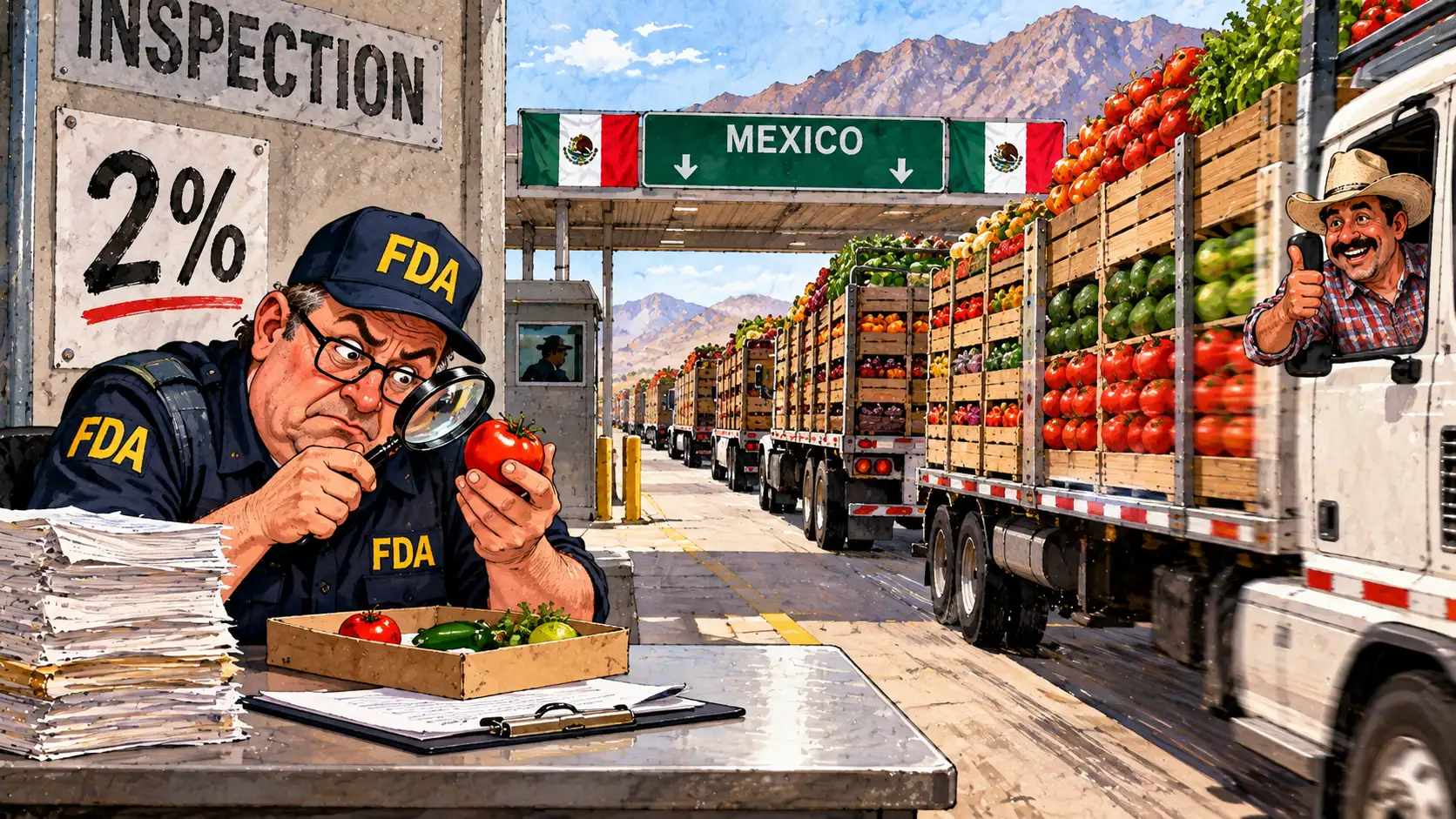
The Inspection That Might Happen Someday
WASHINGTON. American produce growers have discovered the world’s most efficient inspection program: inspect almost nobody, then celebrate the paperwork saved. A recent Washington Post analysis reported that the Food and Drug Administration had inspected roughly 2 percent of Mexican facilities in the major foreign fresh-produce supply network examined since 2009.
Before anybody throws away the salad, the number needs context. It covers inspections of facilities within the analysis, not every shipment or every safety check. The FDA uses other oversight measures, including importer verification, testing and cooperation with foreign authorities. Still, 2 percent is a striking figure for anybody accustomed to watching inspectors examine a domestic farm’s handwashing stations with the solemnity of a moon landing.
Produce is often eaten raw, so nobody can count on the oven to rescue a careless supply chain. Food safety deserves genuine attention no matter which side of the border grew the lettuce. A pathogen, unlike a trade negotiator, doesn’t respect diplomatic protocol.
Food Safety Standards for Domestic and Imported Produce
Domestic growers routinely deal with food safety plans, training records, water assessments and buyer demands under the Food Safety Modernization Act. They understand why safety matters. What irritates them is a system that sometimes seems to require a domestic farmer to document the emotional history of a garden hose while imported produce enjoys a more distant federal relationship.
Farm.FM’s inspection manual proposes a breakthrough: count the actual risks rather than admiring the thickness of the files. Step one: identify where danger enters. Step two: look there. Step three: resist holding a symposium about step two until the lettuce has decomposed.
At a roadside produce stand, a farmer taped a sign to his cooler: “Inspected more often than my cousin’s truck.” He took it down when the county asked whether the sign itself had passed inspection.
The Post’s analysis also reported that foreign inspections remain far below Congress’s long-standing numerical target. Enforcement agencies cite staffing, resources, travel costs and safety constraints. Those are real barriers, not excuses that can be wished away by somebody who has never tried organizing a site visit in a difficult location.
Yet the irony is hard to miss. America can track a package of socks from a warehouse to a doorstep, tell a shopper which aisle has almond milk and determine whether a tractor has crossed an invisible field boundary. Apparently, finding time to visit a produce facility abroad remains a challenge worthy of its own television detective series.
Risk-Based Oversight Without the Theater
The sensible lesson isn’t to punish foreign growers for being foreign or to excuse risky practices at home. Foodborne illness, which the CDC tracks year-round, can affect consumers regardless of origin. The answer is practical oversight calibrated to risk, credible audits, better information sharing and consequences when safety rules are broken.
Think of a barn door. A farmer doesn’t protect livestock by inspecting the prettiest hinge every morning while ignoring the broken latch. Nor does he declare victory after examining two percent of the fence. He checks the weak places and repairs what matters.
The same reasoning applies to produce. Inspect where the hazards are greatest, apply standards fairly and publish enough information to earn public confidence. If regulators need more inspectors, explain what they’d inspect and how success would be measured. Nobody should be asked to trust a percentage simply because it arrived wearing a government seal.
Until that happens, Farm.FM recommends a new national slogan: “Eat your vegetables, but ask who checked the spinach.” It lacks the charm of a cereal mascot, although it may be substantially better for public health.
Documents From the Inspection Desk
Exhibit A: Fine Print on the Federal Inspection Calendar
Facilities scheduled for inspection will be inspected at a time to be determined by the availability of inspectors, vehicles, translators, funding and weather. Facilities not scheduled for inspection may be considered inspected in spirit. A facility inspected in 2009 shall be considered current until further notice. Lettuce is not a party to this agreement.
Exhibit B: One-Star Review of a Cooler Sign
★☆☆☆☆ “Sign said ‘Inspected more often than my cousin’s truck.’ Asked the county. County said the truck gets inspected every year. Did the math. Not impressed. Cantaloupe was fine.” Posted by a customer at a roadside stand.
Exhibit C: Itemized Invoice, Domestic Garden Hose Documentation
| Item | Quantity | Amount |
|---|---|---|
| Hose, 100 ft, with written history | 1 | $41.00 |
| Water test, hose end | 2 | $118.00 |
| Binder, three-ring, for hose | 1 | $9.50 |
| Training hours, how to hold hose | 3 | $75.00 |
| Emotional history of hose, notarized | 1 | $60.00 |
| Total | $303.50 |
Reporting foundation:Washington Post investigation of foreign produce and FDA inspections.
Five Observations About Checking the Spinach
- Two percent. You know what else is two percent? Milk. And even milk gets looked at by somebody. Somebody holds it up to the light and goes, “Yeah, that’s milk.”
- They can track my socks from a warehouse to my porch. The socks have a tracking number. The lettuce has a rumor.
- A farmer has to document his garden hose. His hose has a file. The hose has more paperwork than I do, and I own the hose.
- The inspector says he doesn’t have the staff, the budget or the travel money. Sir, I took a bus to a Sizzler once. You have a government.
- “Inspected in spirit.” That’s what we call a gym membership. I’m in great shape in spirit. I’ve been to the gym in my mind four hundred times.