
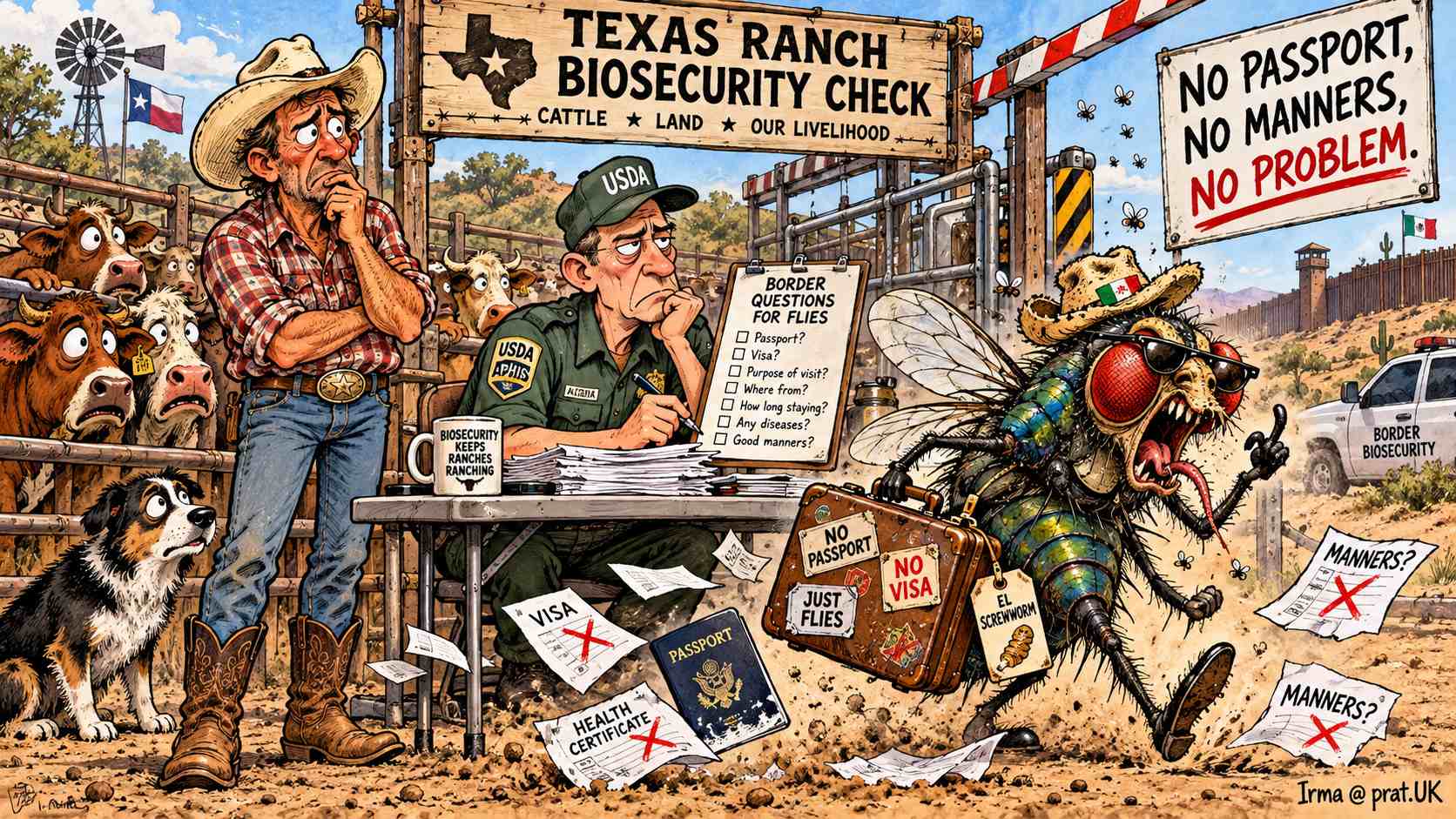
Texas ranchers ask Washington to interview a fly
AUSTIN, TEXAS – Texas ranchers are demanding stronger border enforcement following the return of New World screwworm, an invasive livestock parasite that apparently entered the United States without completing the paperwork required of considerably less troublesome visitors.
The threat is real. New World screwworm larvae feed on living tissue, potentially causing severe wounds and death if animals are not treated. Texas confirmed an infestation in a calf in June, followed by further detections. In October, authorities reported the parasite in a Pecos County elk. New Mexico has also documented cases, and the national count has been climbing as the Texas outbreak expands.
The insect’s appearance has exposed a fundamental problem with modern border administration. Flies do not carry identification. They do not stop at customs. And when asked the purpose of their visit, they tend to remain silent.
Washington Develops a Fly Visa Program
A congressional task force has proposed requiring all foreign screwworm flies to obtain agricultural entry permits. Applicants must submit two photographs, vaccination documentation, proof of financial independence and a notarized declaration that they have no intention of eating American cattle.
Applications would be reviewed within 90 business days.
Texas ranchers welcomed the proposal’s enthusiasm but questioned its practicality.
“You’re gonna interview a fly?”
“Yes.”
“How?”
“With a trained federal interpreter.”
“What language does it speak?”
“That remains under investigation.”
One immigration consultant warned that flies may exploit existing exemptions for visitors arriving without checked baggage. Another observed that requiring them to remove their shoes at airport security would produce limited results.
Ranchers Prefer Biology to Bureaucracy

The USDA’s screwworm control strategy employs sterile insect technology, a method that helped eradicate established screwworm populations from the United States in 1966. The principle is remarkably straightforward. Scientists produce sterile flies and release them into affected regions. When wild females mate with sterile males, the resulting eggs do not hatch. Over time, the pest population declines.
This approach is particularly attractive because it attacks the parasite’s reproductive cycle instead of attempting to negotiate with its representatives.
A congressional committee nevertheless expressed disappointment.
“Where is the enforcement mechanism?”
“The eggs don’t hatch.”
“Yes, but where is the mandatory compliance report?”
“There isn’t one.”
Lawmakers described the lack of paperwork as deeply troubling.
The First National Poll of Screwworm Opinions
A survey commissioned by the Texas Institute of Unwelcome Livestock Visitors asked 500 screwworm flies whether they supported American border regulations. Ninety-nine percent refused to cooperate. The remaining 1% requested agricultural subsidies.
Ranchers demanded an immediate investigation into why a parasite would qualify for farm assistance. Federal officials clarified that no such program existed, although three consultants expressed interest in developing one.
The survey also found that cattle overwhelmingly opposed infestation, with opposition strongest among animals currently enjoying being alive. Researchers described the results as statistically unsurprising.
Texas Offers Washington an Agricultural History Lesson
The United States has fought this parasite before and demonstrated that effective biological control can work. The modern response involves surveillance, reporting suspicious wounds, treating affected animals and deploying sterile flies. That is a more promising strategy than asking an insect to respect a political boundary.
Ranchers know the difference between debating a problem and solving it. They spend their lives dealing with drought, floods, feed prices, market swings, broken equipment and livestock emergencies. They cannot afford to mistake an impressive speech for an effective intervention.
A West Texas cattleman offered one final suggestion to Congress.
“If you want to stop something from multiplying, send those sterile flies to Washington.”
The committee requested a $40 million study. The rancher requested fewer screwworms. Only one of them appeared likely to receive immediate approval.
The Evidence File
Cost-Benefit Analysis
A sterile fly is released from an aircraft and goes straight to work on the problem. A $40 million study is released from a printer and goes straight to a shelf. One of these has a track record dating to 1966. The other has a cover page, and, to anyone’s knowledge, has never once mated with a wild female.
Reductio ad Absurdum
If a fly must apply for entry before it crosses the border, then every cow must apply for exit before it leaves the pasture, every rancher must apply to be inconvenienced, and the Pecos River must file a flood plan. This is how a three-day outbreak becomes a three-year office lease.
Bureaucratic Language, Translated
“Interagency coordination” means 14 people agree to meet again. “Stakeholder engagement” means the calf is still waiting. “Enhanced surveillance” means a rancher is looking at a cow, which, to be fair, is what he was doing already.
Sources and Further Reading
See Texas Animal Health Commission outbreak information, the USDA APHIS detection reports, and Farm Bureau’s market intelligence on the first U.S. cases. For the latest counts, see Fox 7 Austin.
Source: Texas Animal Health Commission outbreak information, USDA detection reports and the USDA explanation of sterile insect technology.
Humorous Observations
- “With a trained federal interpreter.” For a fly. I’d pay good money to watch that guy’s expense report.
- One percent of the flies asked for farm subsidies. That’s the most American thing a bug has ever done. It showed up and asked for a check.
- The committee wants a compliance report from an egg that doesn’t hatch. That’s not oversight. That’s a séance for paperwork.
- “Send those sterile flies to Washington.” Folks, I’ve heard that said at three different county fairs, and each time it got a standing ovation.
- A $40 million study to learn what a rancher knows in four seconds. That’s still cheaper than his divorce, but not by much.
Last Updated on May 13, 2022 by Alan Nafzger