
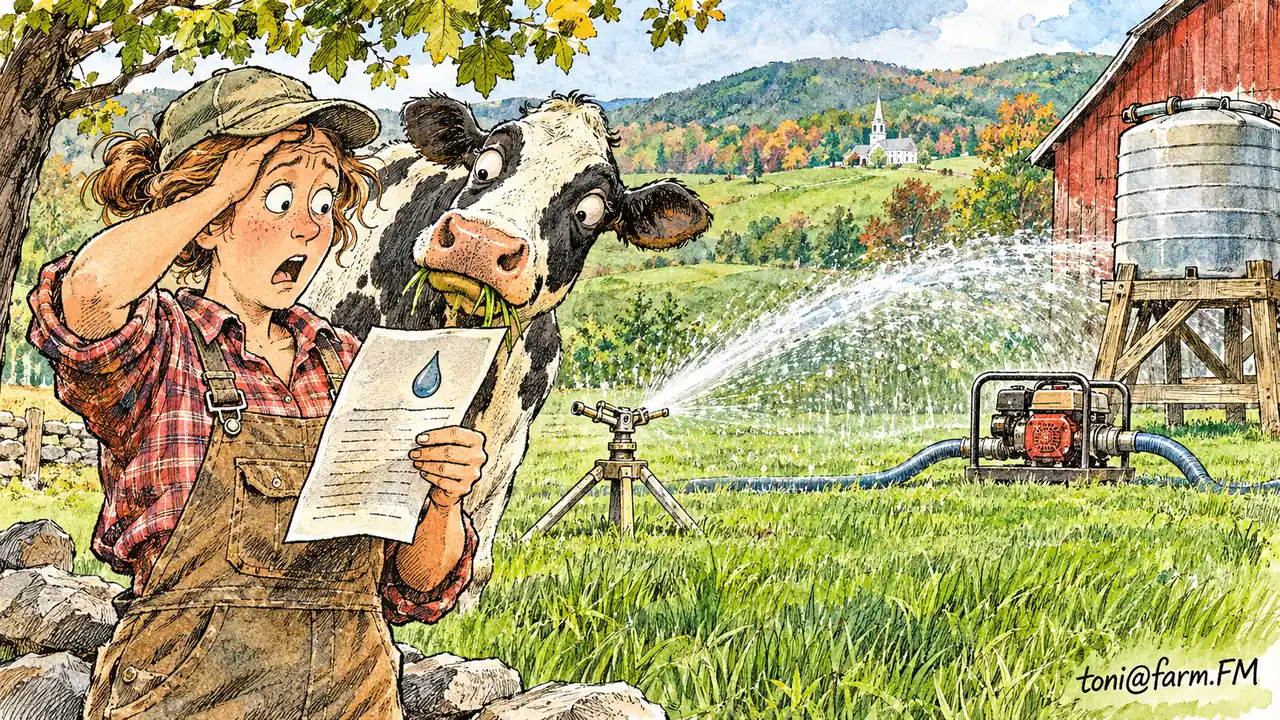
The Free Resource Needs Land, Fence, Water and Seed
BURLINGTON, Vt. (Farm.FM) — A grass-fed dairy farm has discovered that the most aggressively advertised free resource in American agriculture requires land, fencing, water, seed, lime, labor and a maintenance budget substantial enough to send a financial adviser into the woods.
Owner Owen Porter announced that his cows would eat under the open sky. A visitor congratulated him on eliminating feed costs. Owen smiled the way farmers smile when someone offers to explain farming in a sentence.
“Grass is free,” the visitor said. “So is rain,” Owen replied, pointing at an irrigation pump connected to a power meter. “Would you like to pay that bill on behalf of the clouds?”
Free Grass Has an Itemized Invoice
A grass-fed dairy farm relies on forage resources that still require management. Product claims also have specific definitions that should be verified, rather than assumed to mean identical practices on every farm. Pasture can reduce reliance on some purchased feeds, but land, seasonal growth and the nutritional demands of lactating cows remain stubbornly real.
Penn State Extension advises measuring pasture yield because forage availability shapes feed budgets, stocking decisions and expected returns. It is difficult to manage what hasn’t been measured, especially when cows have an established habit of converting yesterday’s pasture into today’s manure.
Owen held a budget hearing near the fence line. The fencing contractor charged money for wire. The water system charged money for water. The veterinarian advised against feeding wet optimism as a substitute for a balanced ration. The cows offered no useful comments, having already destroyed the meeting’s sample grass plot.
The Weather Has Declined a Subscription
Pasture growth changes with precipitation, temperature, fertility and season. Penn State’s rotational grazing guide describes pasture recovery periods that can stretch considerably during hot, dry weather. That means a pasture-based herd may need additional acreage, stored forage or supplemental feed when growth slows.
A consultant proposed a weather-management subscription featuring personalized drought notifications. Owen said he could identify drought by looking at the field, though he appreciated that an app would allow him to be disappointed in two locations simultaneously.
The marketing department suggested that every package of milk carry a photograph of a smiling cow standing in knee-high grass. Owen suggested showing the electric bill next to it. Marketing called that “off brand.” Accounting called it “the product.”
The practical arithmetic is straightforward: compare forage dry matter produced with forage actually eaten, calculate feed costs including land and machinery, protect water supplies, monitor cow condition and milk components, and carry a plan for seasonal shortages. Labels cannot photosynthesize on behalf of a field.
By sunset, the visitor had decided that grass was less free than expected. Owen walked the paddocks checking water troughs while the herd finished dinner.
The cows remained enthusiastic about the business model. After all, somebody else was paying for the grass, and nobody had yet presented them with the fence-repair invoice.
Editorial disclaimer: Farm characters, conversations and events are satirical; linked agricultural research and regulatory requirements are real. This story is entirely a human collaboration between two sentient beings, the world’s oldest tenured professor and a philosophy major turned dairy farmer.
Owen can tell that visitor the grass is free right up until the irrigation pump starts talking to the power meter. My Holsteins would like a word with whoever advertised pasture as a complimentary buffet. I keep the watering and forage notes from dairy herd management taped by the pump, mostly so I remember the clouds do not pay the electric bill.