
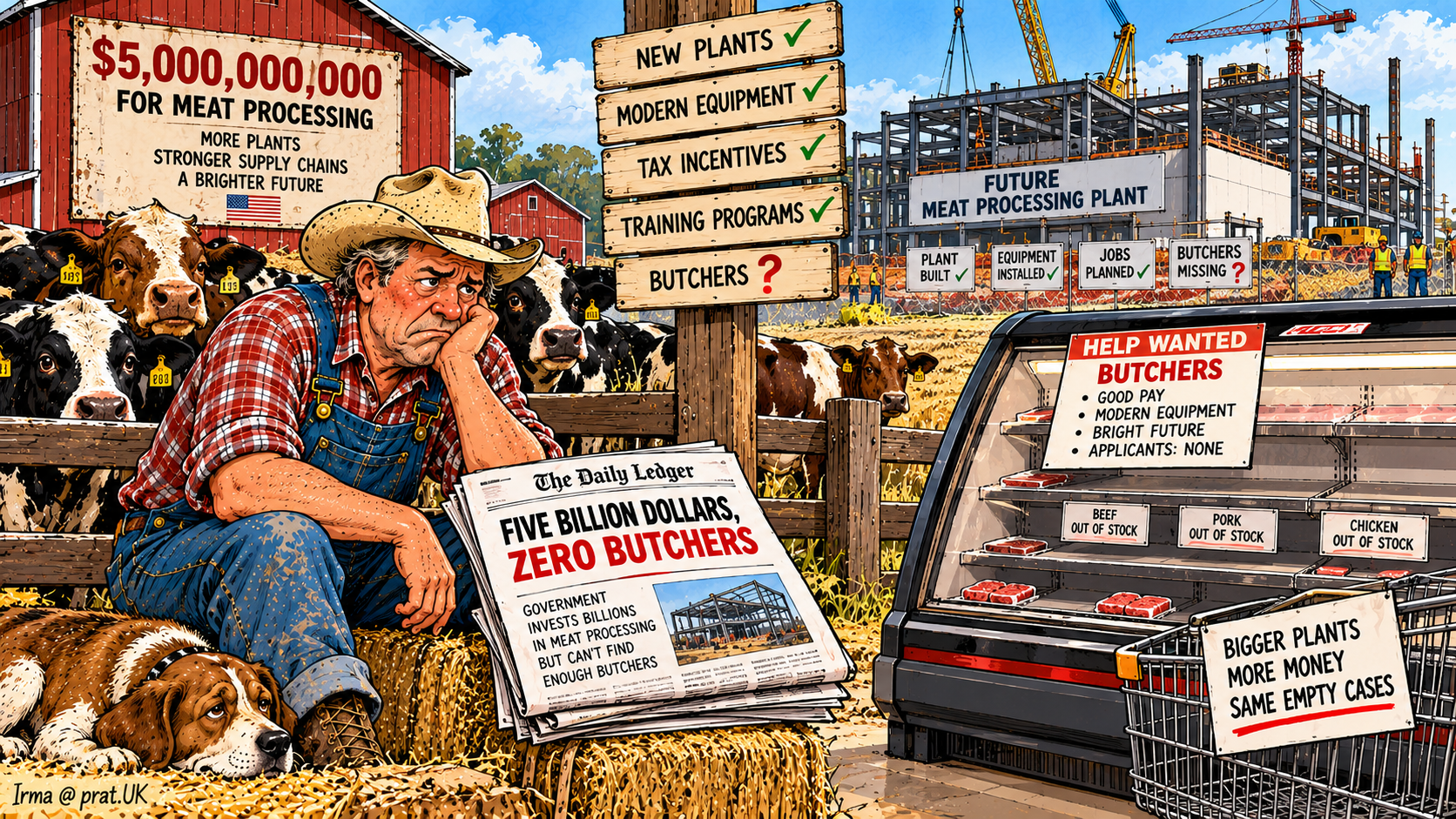
USDA offers processing loans and ranchers ask who buys the cattle
AMARILLO, TEXAS – The United States Department of Agriculture has announced at least $5 billion in guaranteed loan financing for meat, poultry and seafood processors, raising hopes that American ranchers may someday be able to sell cattle without first navigating an industrial meatpacking system more complicated than international diplomacy.
The USDA’s October 23 announcement expands opportunities for independent and regional processing businesses. The Strengthening Processing for U.S. Ranchers program, known as SPUR, offers qualified borrowers access to commercial loans backed by a 90% federal guarantee, as laid out in the USDA press release. Ranchers welcomed the initiative but expressed concern that a program named SPUR might eventually require a program named SADDLE, followed by a federal investigation into the availability of HORSES.
Washington Discovers the Missing Butcher
For generations, American ranchers have mastered the art of raising cattle. They select breeding stock, manage grazing, maintain fences, provide veterinary care and somehow persuade several thousand pounds of livestock to cooperate with economic reality. Then comes the complicated part: selling the cattle.
Meat processing requires expensive facilities, skilled workers, inspection systems, refrigeration and reliable transportation. Without adequate competition or available capacity, ranchers can face fewer marketing options.
A Texas rancher summarized the predicament.
“I’ve got the cows. I’ve got the land. I’ve got the feed. I’ve got the customers.”
“What’s missing?”
“Somebody between the cow and the hamburger.”
Washington immediately proposed creating the Department of Between.
The $5 Billion Loan Program, Explained Without a Free Butcher
The SPUR initiative offers loans rather than direct grants. Financing can reach $175 million per borrower, with the government guaranteeing 90% of qualifying loans to lenders. Some loans may allow deferred principal and interest payments for two years.
A financial consultant explained the arrangement.
“The government isn’t giving processors five billion dollars. It’s helping financial institutions lend the money.”
“So the processors still owe it?”
“Yes.”
“With interest?”
“Generally.”
“And the taxpayers?”
“They’re standing behind much of the risk.”
The rancher nodded.
“Somehow I knew the bank would get involved.”
The National Meatpacking Survey
A survey of 500 ranchers asked what would improve their cattle businesses. Seventy-three percent requested more competitive buyers. Fifteen percent requested lower operating expenses. Ten percent requested greater processing access. Two percent wanted a federally certified cow capable of driving itself to the slaughterhouse.
One respondent suggested replacing cattle with government consultants because consultants were already exceptionally skilled at consuming public resources.
Big Meatpacking Meets Small-Town Competition
Independent processors can strengthen rural communities by offering extra outlets for livestock, creating jobs and potentially shortening some transportation routes. But building viable plants involves much more than getting financing. Facilities must satisfy inspection requirements, find workers, secure livestock supplies and attract customers. A $175 million loan does not automatically produce a profitable processing business. Ranchers understand this. Washington occasionally struggles.
A congressional analyst recommended measuring success by counting how many loan applications were submitted. The ranchers suggested counting how many cattle actually reached competing buyers.
The Rancher’s Final Request
Greater processing capacity could improve competition and give family ranches and regional businesses meaningful opportunities. The ultimate test will be whether financed projects can operate profitably and give livestock producers better market choices.
A West Texas rancher offered a final statement.
“Five billion dollars sounds fine.”
He looked at his cattle.
“But I’d be happier with three buyers bidding on the same steer.”
A banker suggested he apply for a loan. The rancher suggested the banker purchase a cow. Both agreed that somebody should eventually make money from beef. Preferably somebody who had raised it.
The Evidence File
Historical Precedent: SPUR’s Earlier Chapter
This is the second SPUR. In June, USDA launched a separate SPUR program of up to $500 million in payments for eligible beef processors, a move critics at Beef Magazine called a drop in the bucket against roughly $78 billion in annual fed-cattle revenue. The new program is loans. The acronym is the same. The cattle remain unconsulted.
Statistical Absurdity
USDA says the four largest beef packers control nearly 85% of the market. That means when a rancher says he wants more buyers, he’s asking for something roughly the size of the remaining 15%. In other words, the entire independent-processing sector is a rounding error with a refrigeration problem.
Follow the Money
Who pays? The borrower, with interest. Who bears risk? The guarantee covers 90% of the loan, so the lender sleeps well and the Treasury sleeps with one eye open. Who takes credit? Everyone with a podium.
Sources and Further Reading
Program details are in the USDA announcement, with lender instructions at USDA Rural Development. Trade coverage is available from RFD-TV.
Evidence: USDA’s October 23 SPUR announcement and Rural Development program requirements.
Humorous Observations
- A “Department of Between.” That’s the only government agency name that’s also an accurate description of every government agency.
- SPUR, then SADDLE, then HORSES. By next spring we’ll have an acronym that’s just the sound a rancher makes when he opens the mail.
- A $175 million loan doesn’t guarantee a profitable plant. Right. Same way a $175 million wedding doesn’t guarantee a marriage, but at least the cake’s good.
- A federally certified cow that drives herself to the slaughterhouse. That’s a Tesla with a moral dilemma.
- Three buyers bidding on the same steer. That’s all he wants. A competitive auction for his own animal. Meanwhile I can’t get two plumbers to call me back.
Last Updated on January 14, 2025 by Alan Nafzger