
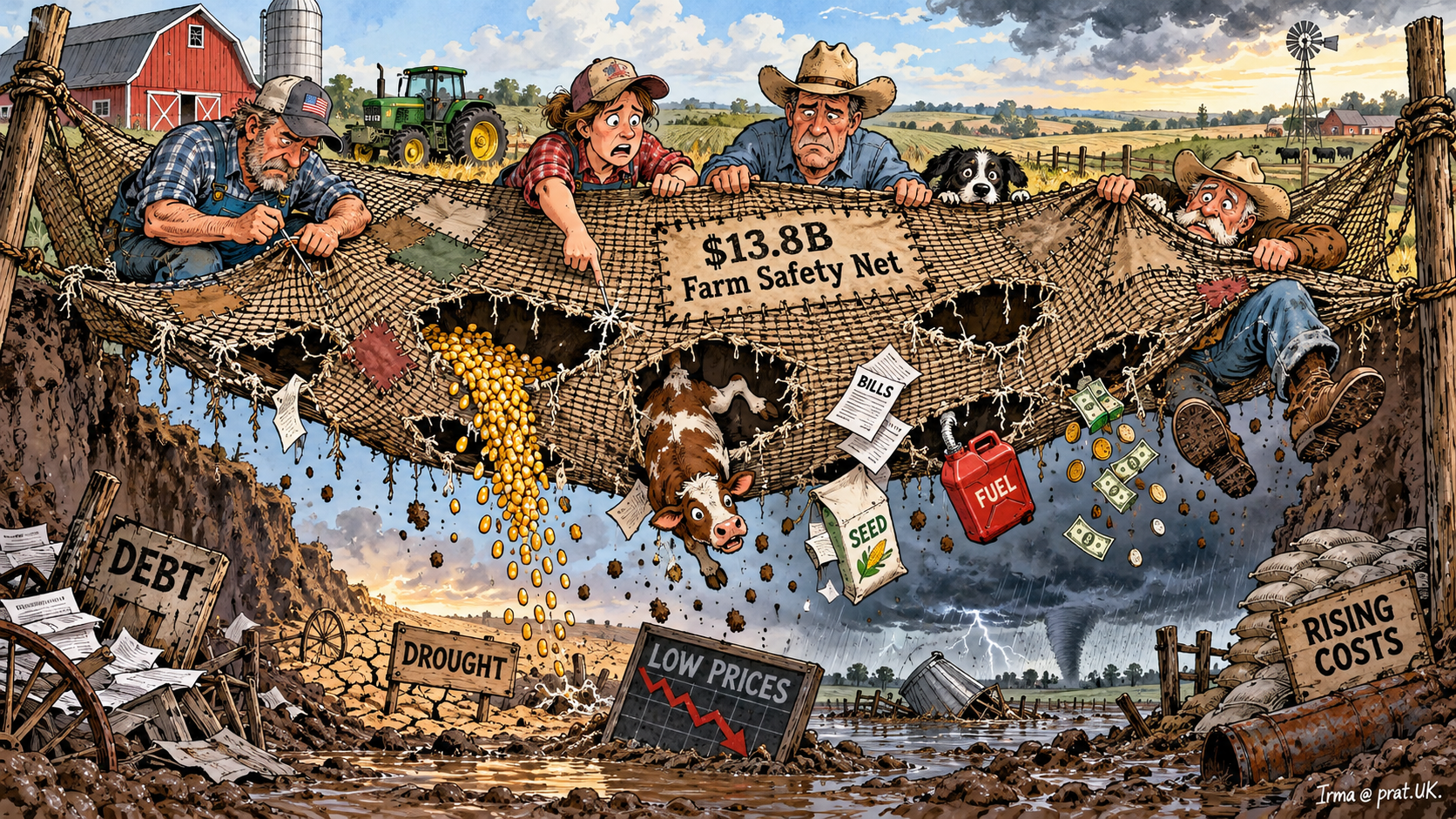
Farmers wonder when farming becomes safe
MANHATTAN, KANSAS – America’s farm safety net has reached a record $13.8 billion, leaving agricultural producers wondering when the actual safety is scheduled to arrive.
The USDA announced the historic payout through its Agriculture Risk Coverage and Price Loss Coverage programs, designed to protect eligible producers when crop revenues or prices fall below specified thresholds, as Global Agriculture reported. The programs provide essential financial assistance during difficult market conditions.
Unfortunately, the word “safety” has created considerable confusion among people who operate combines beside drainage ditches at midnight.
The Government’s Definition of Safe
According to the USDA, ARC and PLC programs form part of the agricultural safety net. According to farmers, a safety net traditionally catches something before it hits the ground.
A Kansas farmer named Dale Hardluck described his recent experience.
“First, the corn price fell. Then the tractor broke. Then the irrigation pump quit. Then the insurance company called to explain my deductible.”
He paused.
“Now the government says I’m protected.”
Asked whether he felt safer, Hardluck replied, “I’d feel safer if somebody fixed the irrigation pump.”
The farmer has nevertheless welcomed the payments, recognizing that financial assistance can be valuable even when the program’s name promises more than any government can deliver.
Researchers Examine the Agricultural Safety Problem
Farming involves several distinct kinds of risk. Production risk includes drought, storms, pests and disease. Market risk includes volatile prices. Financial risk includes debt and interest expenses. Operational risk includes equipment failures, labor shortages and the peculiar tendency of livestock to become sick on holidays.
ARC and PLC primarily address specified revenue and price risks for covered commodities, not every hazard associated with farming.
A university research team attempted to calculate the amount of safety available per federal dollar. They divided $13.8 billion by the number of agricultural disasters farmers had experienced. Their calculator requested medical leave.
Researchers concluded that the term “safety net” was best understood as a financial metaphor rather than a guarantee against bad things happening.
The National Farmer Safety Survey
A survey asked 600 producers when they last felt completely safe. Thirty-five percent answered, “Before buying the farm.” Twenty-eight percent answered, “Before checking commodity prices.” Twenty percent answered, “While the tractor was still under warranty.” Seventeen percent answered, “During a dream.”
A second question asked whether farmers supported federal assistance during severe market downturns. An overwhelming majority supported it, provided the government did not require 14 separate forms proving the farmer was still farming.
The proposed solution was to require only 13 forms. Washington described the reduction as historic deregulation.
The Safety Net Receives a Safety Inspection
Congress established ARC and PLC through the 2014 Farm Bill, with later legislation modifying payment rules. For the 2025 crop year, eligible producers generally receive the higher applicable payment calculated under ARC-County or PLC, regardless of their program election.
USDA also announced improvements to reference prices and payment limits. These provisions can help farmers withstand difficult economic conditions. But they cannot make farming risk-free.
A banker may still demand repayment. The weather may still refuse to cooperate. A combine may still break down during harvest. And a 1,400-pound cow may still decide that the safest place to stand is the middle of the county road.
A Practical Proposal for Actual Farm Safety
Farmers have proposed expanding the definition of agricultural protection to include reasonable input costs, functioning markets, competitive financing and the ability to sell crops profitably.
A Washington adviser objected.
“If farmers become consistently profitable, how will we demonstrate the importance of our assistance programs?”
The farmer responded, “You could celebrate our success.”
The adviser requested a moment to process the concept.
The $13.8 billion payments represent meaningful support, especially for producers facing financial pressure. But the ultimate goal should be an agricultural economy in which emergency assistance is a backup rather than a routine financial strategy.
A Kansas farmer summarized the matter.
“Give me decent crop prices, a reliable tractor and enough rain, and I’ll show you what a safety net looks like.”
Then his cellphone rang. It was the bank. The safety net had another hole.
The Evidence File
Bureaucratic Language, Translated
“Safety net” means a program that pays after the fall. “Risk coverage” means somebody else’s covers the risk and yours covers the paperwork. “Historic” means the old number was smaller. A safety net that catches only after the hit is, in plain English, a trampoline that sends a bill.
Statistical Absurdity
If one federal dollar of the $13.8 billion were assigned to each reported farm disaster and the calculator crashed on the first one, then the actual coverage per disaster is “Please call back.” The AgWeb breakdown of per-acre payments offers a more serious accounting.
Comic Eyewitness Testimony
A witness at a Riley County elevator reports watching a farmer read the payout announcement aloud to his pickup. The pickup, he says, did not react. The farmer, he adds, took this as an improvement over the last time.
Sources and Further Reading
See the USDA Farm Service Agency for program rules, Global Agriculture, AgWeb and USDA.gov.
Source: USDA FSA’s October 7, 2026, announcement and official explanation of the ARC/PLC programs.
Humorous Observations
- “Before buying the farm.” That’s not a survey answer. That’s the complete financial plan of every man in my family since 1912.
- Seventeen percent felt safe “during a dream.” That’s the most expensive nap in the American economy.
- The calculator requested medical leave. Finally, a federal employee who knew when to say no.
- They cut the paperwork from 14 forms to 13 and called it historic deregulation. That’s like losing one pound and calling it a diet.
- “The safety net had another hole.” In Kansas we don’t call that a hole. We call it a feature, and the bank is the feature.
Last Updated on April 26, 2022 by Alan Nafzger