
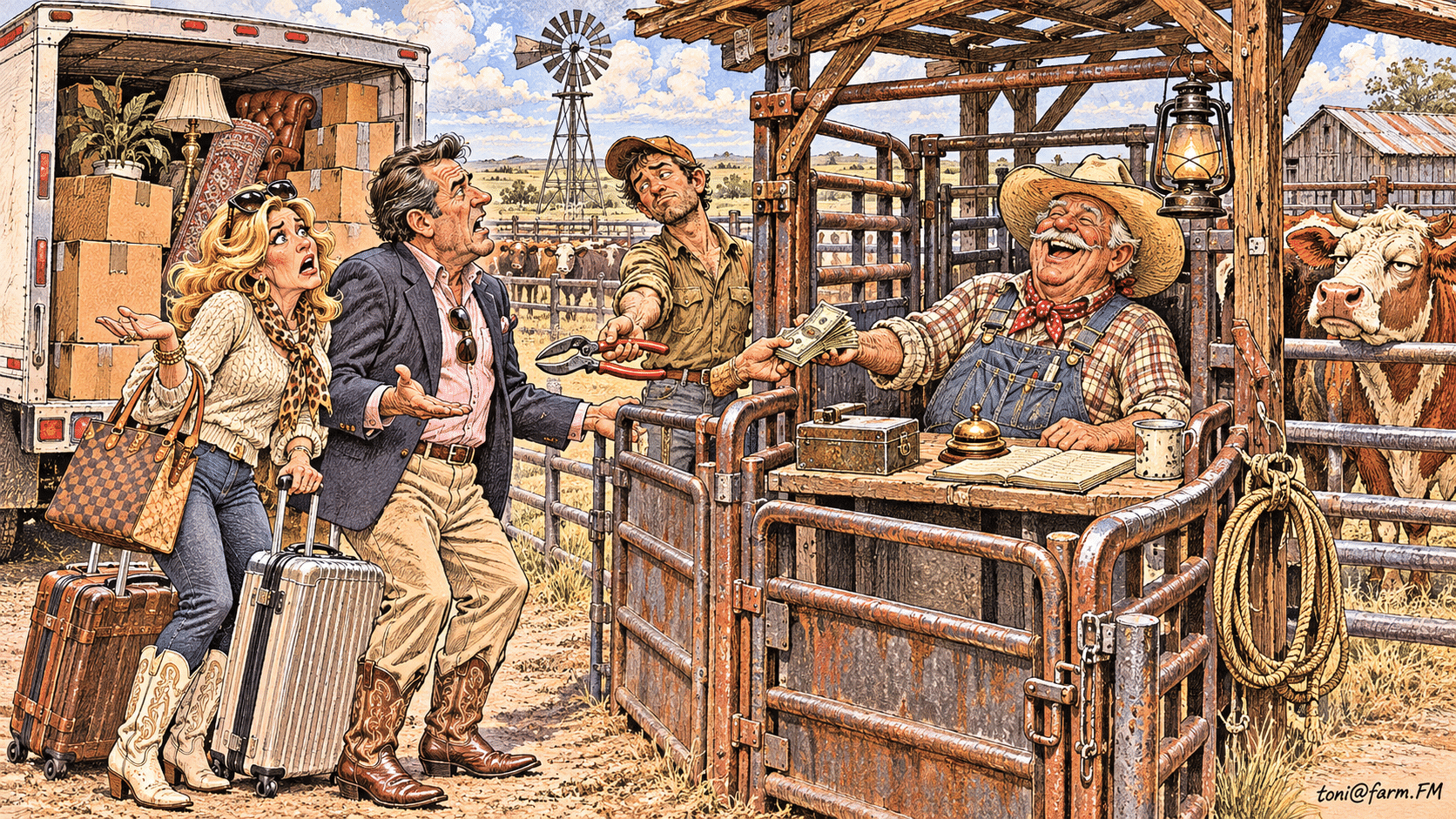
WICHITA FALLS, TEXAS — Texas ranchers have discovered an exciting new agricultural commodity: Californians fleeing the political consequences of their previous relocation.
Following the Democratic wave in Texas’s 2026 elections, some conservative California transplants are considering moving again, apparently having misunderstood the difference between purchasing real estate and purchasing a permanent political majority.
According to reporting by the Los Angeles Times on California transplants and the Texas election, one relocation specialist is contemplating Oklahoma or Florida.
This has excited ranchers across the Southern Plains, who haven’t seen this much demand for an agricultural product requiring absolutely no feed since somebody invented bottled water.
Oklahoma Ranchers Introduce Political Refugee Grazing Permits
The proposed system is simple.
A Californian arrives at an Oklahoma ranch, explains that Texas has become too liberal, and requests political asylum.
The rancher checks the applicant’s qualifications.
“Can you weld?”
“No.”
“Drive a tractor?”
“Not really.”
“Fix a fence?”
“I have an app.”
“Then what exactly are you escaping?”
“Government interference.”
The rancher points toward a broken irrigation pump and explains that government interference would actually be welcome if somebody could persuade it to come out and repair the thing.
Political refugees would receive temporary sanctuary in unused barns, provided they understand that the accommodations include spiders, dust, intermittent plumbing and absolutely no complimentary oat milk.
Ranchers Discover a More Profitable Livestock Alternative
The economics look promising.
According to the Texas Department of Agriculture’s agricultural statistics, Texas had 230,662 farms and ranches covering approximately 125.5 million acres in the 2022 agricultural census.
Those farmers spend fortunes maintaining livestock, machinery, fences and water systems.
A political refugee, by contrast, can survive on bottled water, anxiety and an uninterrupted internet connection.
The estimated profitability is extraordinary.
A cow requires grass, veterinary care, minerals and winter hay.
A California transplant requires somewhere to park a moving truck and assurance that no progressive will become county commissioner before the next mortgage payment.
And unlike cattle, political refugees frequently volunteer to leave.

One practical complication has emerged: the newcomers expect their political opinions to increase the value of their property automatically.
Ranchers have explained that acreage is normally priced according to location, improvements, water access and productive capacity.
“You mean it isn’t worth more because I voted Republican?” asked one prospective buyer.
“Only if your ballot can pull a hay baler,” came the reply.
Political Climate Insurance Becomes America’s Newest Agricultural Product
Texas real estate agents are exploring an innovative insurance product called Electoral Drought Protection.
For a modest annual premium, homeowners would supposedly be compensated whenever their chosen political party loses an important election.
Unfortunately, actuaries immediately rejected the idea after discovering that American voters have a habit of electing politicians the policyholders dislike.
One proposed alternative would cover only serious disasters, such as droughts, tornadoes and being seated next to someone from Austin at a cattle auction.
Texas ranchers have proposed an optional provision guaranteeing that election results will not affect the actual performance of a combine harvester.
This is particularly valuable for newcomers who have never owned a combine harvester but have strong opinions about its freedom.
Oklahoma Establishes a Fence-Line Immigration System
Under the proposed sanctuary arrangements, anyone seeking political protection would have to pass an agricultural citizenship test.
Applicants must correctly identify a heifer, explain why hay costs money, and understand that an electric fence is not a metaphor for government oppression.
Failure would result in an immediate assignment repairing the electric fence.
The test’s most difficult question asks whether the applicant has ever attempted to grow food without subsidies, favourable weather, cheap diesel, affordable labour or an operating loan.
So far, the only people answering correctly are farmers, who are too financially exhausted to migrate anywhere.
The Political Refugee Economy Expands
The U.S. Census Bureau’s state-to-state migration research confirms that the California-to-Texas route was already a major American migration corridor years before the election.
Now the satirical agricultural forecast predicts a second wave, with Oklahoma taking delivery of Californians who previously took delivery of Texas houses.
This could make moving boxes the only agricultural commodity with guaranteed repeat customers.
Farm economists are delighted by the possibilities.
Unlike corn, boxes don’t require fertiliser. Unlike cattle, they don’t need hay. And unlike machinery, they become more valuable each time somebody loses an election.
An Oklahoma farmer offered the final assessment:
“I don’t particularly care whether they’re Democrats or Republicans. If they’re willing to pay $400 an acre to sit in my pasture complaining about politics, I’ll even provide lawn chairs.”
The economic lesson is unmistakable.
Farmers have spent generations trying to make money growing things that stay put. Apparently, the real profit was in people who refuse to.
More on the Great American Political Migration
For another angle on the same election and migration story, read Prat.uk’s British examination of political asylum for election losers and Bohiney.com’s political climate insurance and real estate satire. The three reports examine the rural, British and American political sides of the same moving-box boom.