
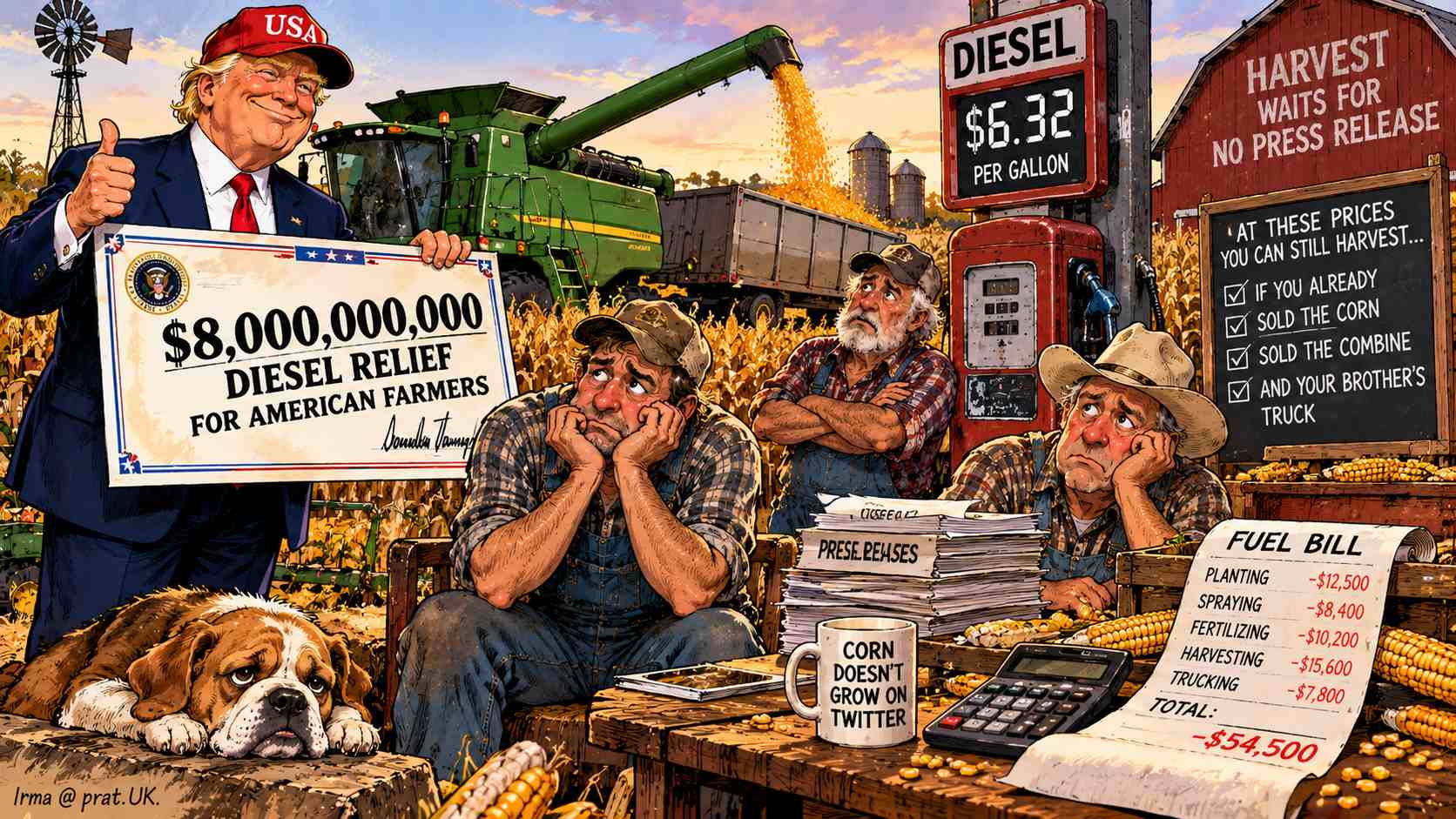
$8 Billion Diesel Relief Arrives After Harvest
Washington learns corn can’t be harvested with a press release
PARK CITY, Kansas, October 26, 2026. President Donald Trump has announced $8 billion in diesel relief for American farmers, an emergency intervention welcomed across the countryside by people who have recently begun treating a full fuel tank as an heirloom. The announcement, reported by The Hill, arrives with diesel near $6.32 a gallon, compared with approximately $3.63 a year earlier, according to the U.S. Energy Information Administration’s weekly diesel price data. At that price, a farmer can still afford to run a combine, provided he has already sold the corn, the combine, and his youngest brother’s truck.
- Diesel is so expensive now that farmers check their credit score before they turn the key. That’s not a tractor, that’s a mortgage with a seat.
- Trump announces $8 billion in farm relief, and the farmers are thrilled. They might finally fill both tanks on the combine. Both! Like a rich person!
- Washington has just figured out that tractors run on diesel. Not speeches. Not promises. Not “deep concern from both sides of the aisle.” Diesel. It’s in the name of the tractor. Practically.
- The system works like this: the farmer grows the food, the consumer pays the bills, and the government hands out the apologies. Everybody gets something. Only one of them can eat it.
- Diesel is $6.32 a gallon. For another dollar, the guy at the pump will say he appreciates your service. Eight dollars and he’ll walk you to the truck.
Diesel Fuel Costs Are Now the Most Expensive Crop on the Farm
Consider a farm burning 5,000 gallons of diesel over a stretch of heavy work. At $3.63 a gallon, that fuel costs $18,150. At $6.32, it costs $31,600. That’s an additional $13,450, without buying one extra seed, harvesting one extra ear, or acquiring the sort of comfortable leather seats normally associated with a machine that costs this much to operate. A farmer facing that arithmetic does not need a Washington economist. He needs a defibrillator and a cheaper pump.
Trump Farm Relief Announced at a Kansas Campaign Rally
Trump announced the $8 billion program at a Kansas campaign rally for Senator Roger Marshall. This has caused renewed optimism among rural voters, who have learned that the most reliable crop in an election year is federal attention. Corn requires sunshine, soybeans require rain, and government promises require a competitive Senate race.
The president deserves credit for acknowledging the diesel squeeze and putting a substantial proposal on the table. Farmers already underwater on fuel bills are hardly going to send the money back out of ideological purity. But they would also like politicians in both parties to understand a minor agricultural principle: you cannot campaign your way through a soybean field without a machine that starts.
An unofficial survey conducted at a Kansas coffee counter found that 100 percent of farmers favor lower operating costs, 100 percent dislike unannounced paperwork, and one elderly rancher believes the nation’s economic problems began when a cup of coffee stopped costing a quarter. The margin of error was one spilled biscuit. The survey produced more agreement than Congress has managed in fifteen years.
USDA Harvest Fuel Relief Payments: Eight Billion Dollars Sounds Better Before You Open the Fuel Bill
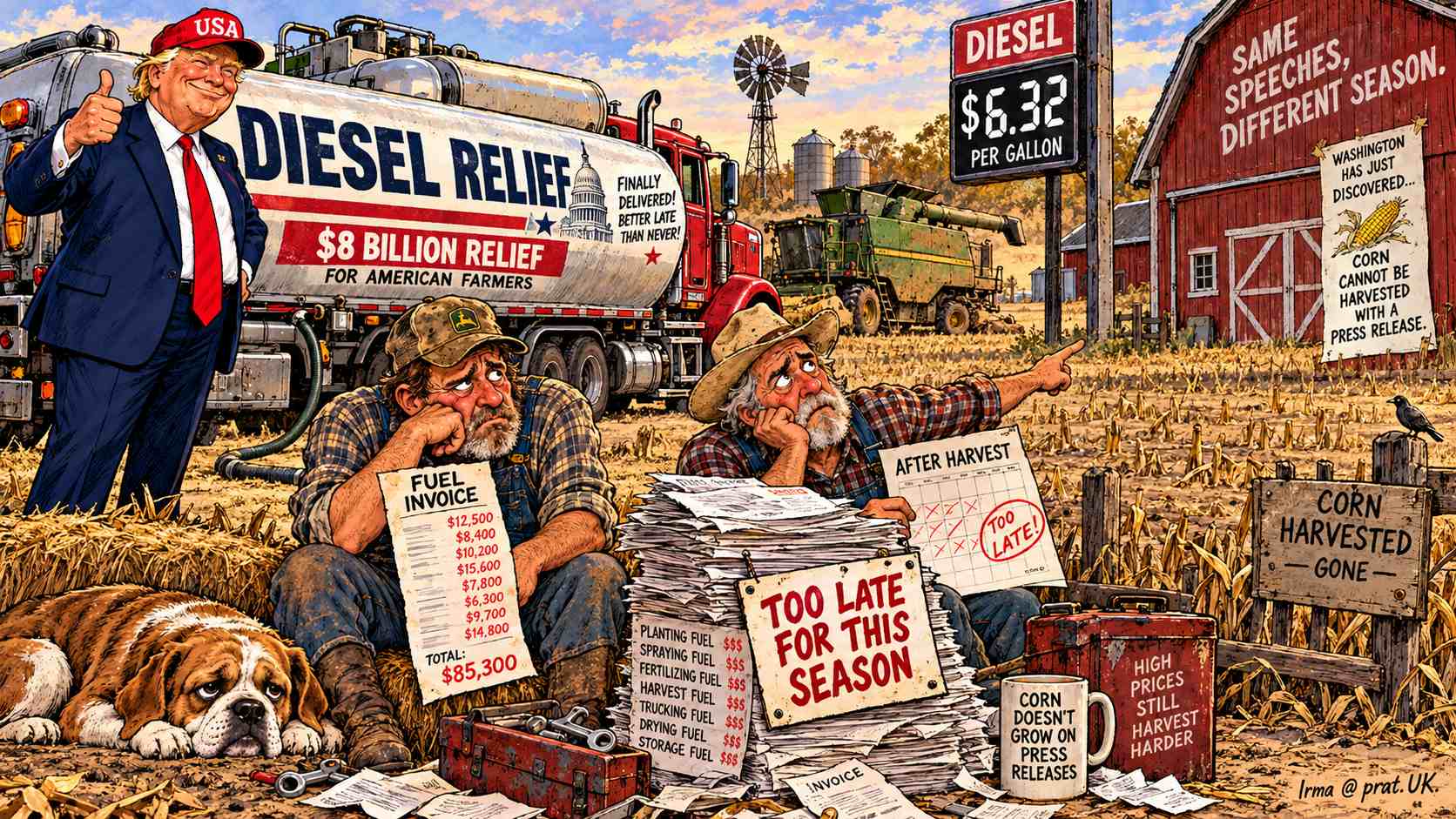
The USDA’s Harvest Fuel Relief announcement explains that payments will be distributed through the Farm Service Agency, using reported planted acreage and economic models to apportion relief. Commodity-specific rates are expected in November, while further details for some other producers will come later. According to industry reporting, checks are expected in January. This is an efficient system if the farm equipment agrees to postpone harvest until the administrative calendar is comfortable.
Farmers, unfortunately, operate under a competing timetable called autumn. Corn does not consult Login.gov before drying down. Soybeans do not wait for the agency to determine a modeled national loss average. A combine requires fuel today, which is a revolutionary scheduling concept that federal programs have yet to incorporate into their mission statements.
A farmer named Earl tried explaining the payment process to his wife. “We spend the money in October,” he said, “find out the rate in November, and get paid in January.” She nodded thoughtfully and asked when they would eat. Earl said the Department of Agriculture had not released the dinner methodology.
Exhibit A: The Fine Print
Payment amounts are estimates derived from reported acreage and a modeled national average, and may differ from the amount of diesel a producer actually burned, purchased, spilled, or lent to a neighbor. Receipt of this notice does not constitute receipt of payment. Receipt of payment does not constitute receipt of fuel. The Agency makes no representation that any tractor will start. Producers should retain all fuel receipts, including those written on napkins, until the heat death of the universe or the next audit, whichever comes first.
Red Diesel Tax Relief: A Scientific Breakthrough Involving the Color Red
Earlier this month, Trump signed an executive order providing emergency diesel tax relief, intended to temporarily expand access to tax-favored red-dyed diesel on highways and defer certain fuel-tax obligations. This matters to farmers and truckers, and every cent saved is worth keeping. It also exposes an extraordinary American regulatory achievement: the government successfully taught two containers of diesel to have different tax personalities because one of them was red. The IRS excise tax guidance on dyed fuel runs long enough to qualify as a second harvest.
The White House estimates its diesel measure could save some truckers more than $100 per refill. That is useful money, certainly. At today’s prices it is also roughly what a large machine consumes while the operator listens to a podcast explaining why American agriculture needs greater resilience.
Exhibit B: One-Star Review, Posted at a Highway Fuel Stop
★☆☆☆☆ “Pulled in with a half-empty tank and a full set of plans. Left with a half-empty wallet and no plans. Pump asked if I wanted a receipt. I said yes so I’d have something to frame. Clerk asked if I wanted to round up for charity. I told him I was the charity. Would not recommend. Would, however, return tomorrow, because there is nowhere else to go.” — Posted by Dale, 41 reviews, 38 of them about fuel
USDA Farm Payments Forecast: America’s New Cash Crop Is Government Assistance
The USDA’s own financial outlook, as reported by DTN’s analysis of the $8 billion farm relief program, projected approximately $47.4 billion in government payments to farmers during 2026, including previous assistance programs, a figure that sits comfortably inside the USDA Economic Research Service’s farm income forecasts. That number ought to make every taxpayer and agricultural economist uncomfortable, although for different reasons. A nation capable of harvesting astonishing quantities of food should not require a financial rescue operation each time its farmers check the price of the fuel needed to gather it.
Exhibit C: Dispatch Log, Park City Co-Op, Monday Morning
6:02 a.m. Caller reports diesel price on the sign is “a typo.” Informed it is not.
6:19 a.m. Caller asks if the $8 billion has arrived. Informed checks are expected in January. Caller asks if January is a farm term.
6:41 a.m. Second caller wants to know if the government will cover fuel for the drive to the co-op to ask about the government covering fuel.
7:05 a.m. Third caller asks whether red diesel can be used in a white pickup. Told to consult an attorney.
7:30 a.m. Coffee pot empties. Staff declines to discuss coffee prices.
Farm Groups Want a Fuel Policy That Lasts Longer Than a News Cycle – Diesel Relief
The National Corn Growers Association has thanked the administration for acknowledging high fuel costs while urging durable, bipartisan solutions. Other farm organizations, including the American Farm Bureau Federation, have similarly welcomed short-term help and pressed for longer-term changes. This makes perfect sense. A farmer facing a broken irrigation pipe appreciates a bucket of water but would eventually like somebody to fix the pipe.
Washington, on the other hand, is better at naming buckets than repairing infrastructure. A temporary bridge payment is followed by a temporary fuel payment, then a temporary emergency adjustment to an earlier temporary intervention. Give the system enough years and the country will have an entirely permanent Department of Temporary Relief.
The economics are not partisan. A farmer who pays too much for diesel does not find the gallon cheaper because a Republican signed the order, and a combine does not stop consuming fuel when a Democrat says the market needs oversight. The machine belongs to the stubborn political movement known as combustion. It votes exclusively for gallons.
Exhibit D: Itemized Fuel Invoice, Earl, Park City
| Item | Amount |
|---|---|
| Off-road diesel, 1,200 gallons at $6.32 | $7,584.00 |
| Fuel surcharge (4 percent, applied to fuel) | $303.36 |
| Delivery fee | $85.00 |
| Hazardous materials handling (the diesel, not Earl) | $42.50 |
| Convenience of being invoiced | $19.95 |
| Federal excise tax (exempt, dyed red) | $0.00 |
| Federal Harvest Fuel Relief applied to this invoice | $0.00 (pending January) |
| Total due | $8,034.81 |
At Last, an Agricultural Policy the Farmer Can Understand Diesel Relief
There is still a basic reason the $8 billion matters. Relief can keep an otherwise viable farm operating through a nasty cost spike. Farmers are not demanding that politicians turn diesel into free lemonade. They are asking for enough breathing room to finish a season without spending next year’s profits before next year’s seeds are purchased.
The best long-term farm policy would be boring. Energy markets that function. Rules that are intelligible. Freight that moves. Export customers who buy. Insurance against disasters rather than a recurring paperwork festival. Most of all, a chance for farmers to make their living by selling food instead of periodically demonstrating distress to a federal committee.
Back in Kansas, Earl finally got his combine running. His wife asked if he had enough diesel to finish harvest. Earl looked at the gauge, looked at the market, and said he had enough to reach the far fence, assuming nobody in Washington scheduled another press conference before lunch.
10 Observations on Trump’s $8 Billion Diesel Relief for Farmers
- The relief comes after the calculations, the applications, the administrative reviews, and, possibly, the farmer’s retirement. Plan accordingly. Retire early.
- Farmers used to worry about drought, bugs, and hail. Now they won’t leave the tractor idling to open a gate. You’d get out faster if the thing were on fire. Cheaper, too.
- Congress thinks $8 billion will restore confidence in agriculture. Farmers would settle for a business model where selling the corn pays for planting the corn. That’s it. That’s the dream.
- They call it a one-time payment. Great. Nobody told the diesel company. They keep charging every time.
- Washington discovered red-dyed diesel. So now the farmers are standing in the shop wondering if painting the combine red does anything. Don’t laugh. Somebody’s tried it.
- USDA economists calculate farm losses with complicated formulas. Farmers use a calculator, a fuel receipt, and a word I can’t say here.
- A guy can own $900,000 in equipment, work 2,000 acres, and still need the government’s help to drive to the other end of the field. That’s not a farm. That’s a very expensive long-distance relationship.
- Politicians visit rural America every election season. The farmers appreciate it. They just wish somebody would come during planting season, with a wrench.
- Farming is the only business where a great year is a bumper crop so big it bankrupts you. “Congratulations, you grew too much.” Thanks. I’ll put it on the pile.
- American farmers don’t ask Washington to make them rich anymore. They just want to finish harvest without a second mortgage on the diesel tank. Low bar. Still too high.
Produced as an entirely human collaboration between two sentient beings: the world’s oldest tenured professor and a philosophy major turned dairy farmer, each of whom believes a tractor should produce more bushels than tax forms.
Reporting drawn from The Hill’s October 20 article, the USDA’s October 19 announcement, the White House executive order,

Last Updated on October 26, 2026 by Alan Nafzger