
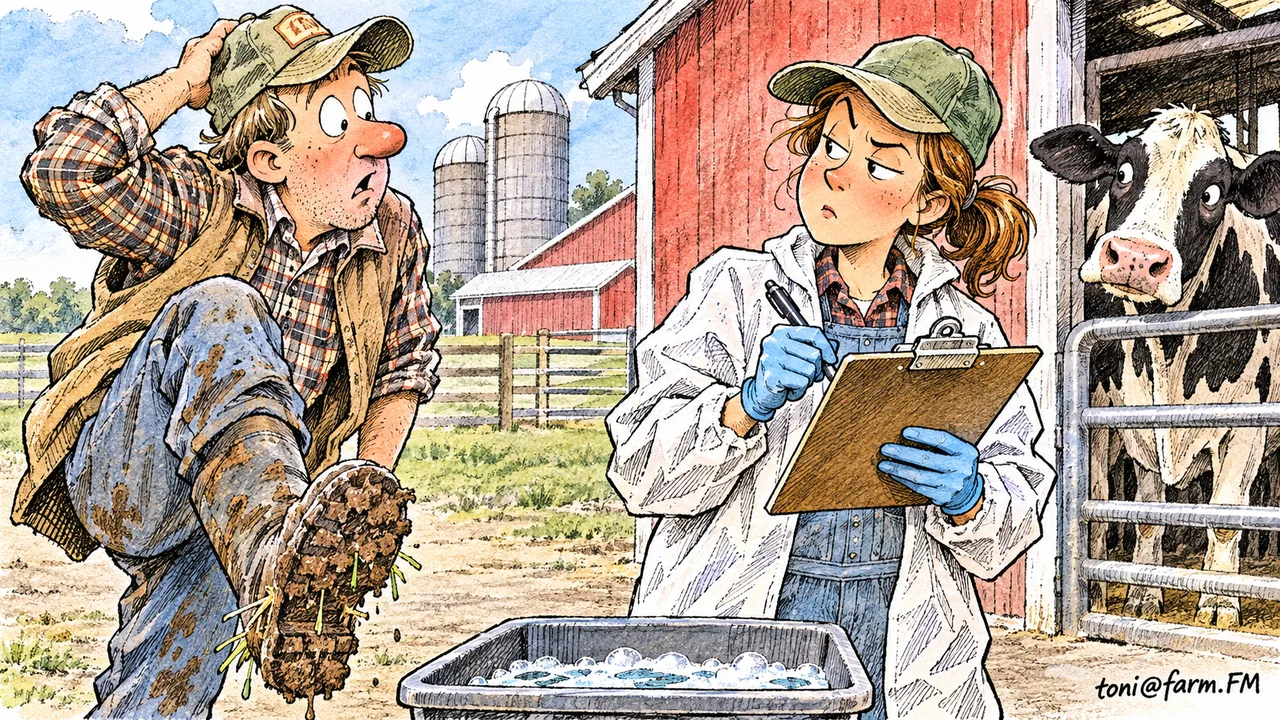
Visitors Must Explain Where Their Boots Have Been
BOISE, Idaho (Farm.FM) — A dairy farm biosecurity plan has introduced a new entrance question for every visitor: “Where have your boots been, and why do they look like they have an alibi?”
The policy began after a feed salesman walked into the barn wearing boots that appeared to have visited three farms, two auctions and an archaeological excavation. The owner stopped him at the gate, pointed toward the cleaning station and asked whether the mud came with a travel itinerary.
“I sell minerals,” the salesman protested. “Wonderful,” said the farmer. “Today you’re learning about soap.”
Your Boots Are Not Authorized to Tour the Country
Dairy farm biosecurity means using practical measures to reduce the likelihood that infectious agents enter a herd or spread between animals and farms. It includes controlling visitors, equipment, vehicles and animal movements, along with cleaning and disinfection. It is not a personality test for people who happen to own muddy footwear.
The reason is serious. Highly pathogenic avian influenza H5N1 has affected U.S. dairy cattle, making disease prevention an urgent concern alongside longstanding problems such as respiratory disease and other infectious threats.
In guidance updated September 29, 2026, USDA APHIS urged farms to limit unnecessary visitors, keep guest records, provide protective footwear and disinfect equipment and vehicles. The agency also emphasizes healthy animals, clean facilities and reducing opportunities for germs to move between locations.
The feed salesman asked whether he needed a passport. The farmer replied that a clean pair of boots would be enough for a start, but the man’s wheel wells were being treated as international arrivals.
Every Visitor Becomes a Border Crossing
The dairy’s new sign-in book asked for a name, reason for visiting, recent animal contact and whether the visitor had equipment that needed cleaning. A neighbor who stopped by to borrow a wrench was shocked to discover that his social call had a sanitation protocol.
An enthusiastic consultant suggested fencing off the entire property, adding three biometric checkpoints and requiring each cow to memorize a password. One Holstein immediately chose “Moo123,” demonstrating why cybersecurity should not be assigned to livestock.
The realistic approach is simpler: establish controlled entry points, maintain farm-specific protective clothing or footwear, clean shared equipment, isolate and monitor new or returning animals as appropriate, track movements and work with the herd veterinarian on a written disease-prevention plan. Procedures must fit the actual operation and applicable rules. In a real suspected outbreak, veterinary and animal-health officials should direct the response.
USDA’s Secure Our Herds program also provides information about surveillance and producer support. None of these precautions requires accusing a visitor’s boots of committing a felony.
The salesman eventually passed inspection, sold his mineral supplement and left through the designated exit.
A cow stood by the fence, observing that humans had finally learned an important lesson from livestock: the best way to avoid trouble is to keep strangers out of your feed.
Editorial disclaimer: The salesman, security dialogue and cow commentary are satirical. USDA animal-health guidance is real. This story is entirely a human collaboration between two sentient beings, the world’s oldest tenured professor and a philosophy major turned dairy farmer.