
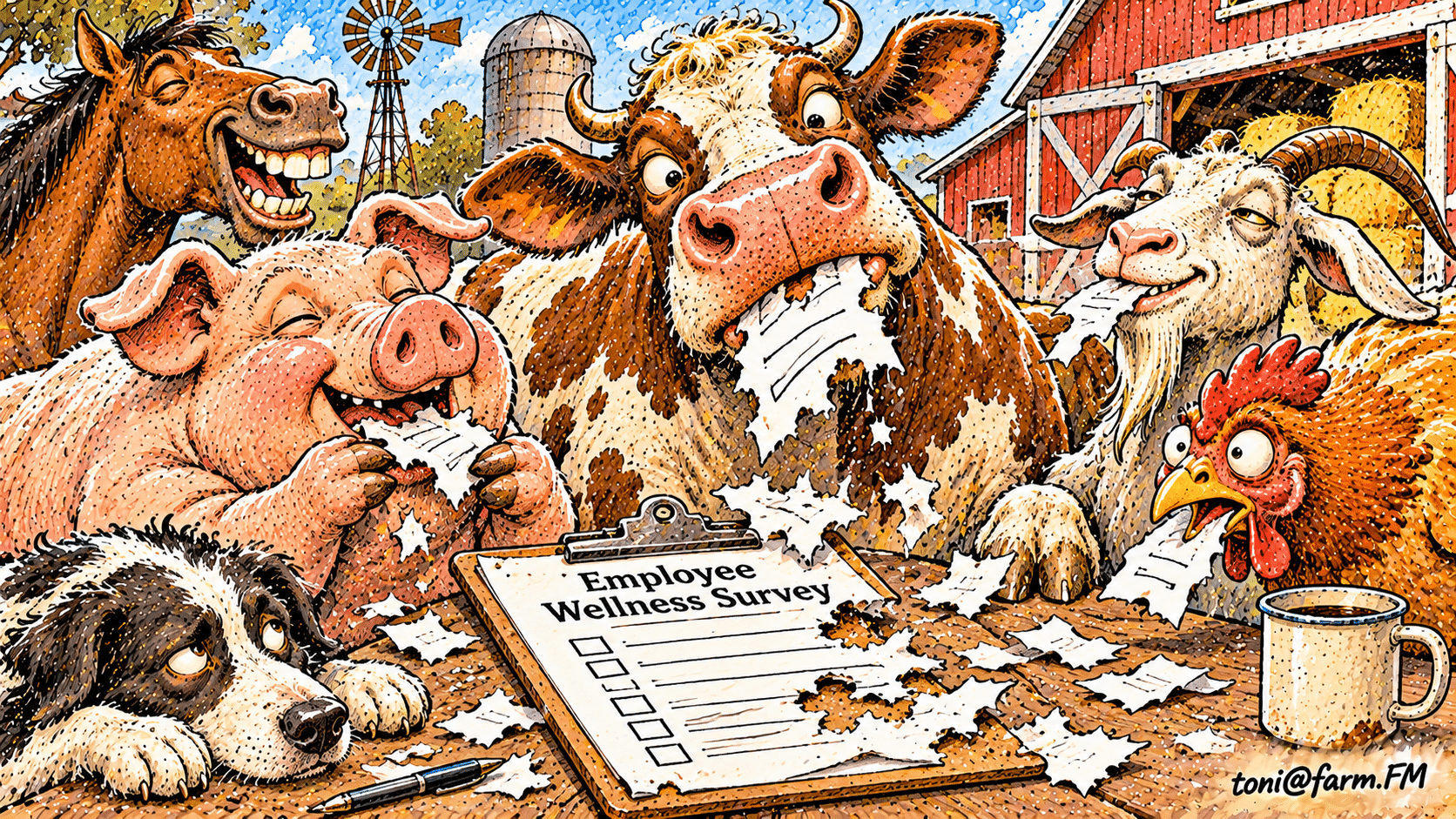
The Livestock Reject Human Resources and Eat the Form
LINCOLN, Nebraska (Farm.FM) — Farm animals at a Nebraska livestock operation have failed a corporate employee wellness assessment after the goats consumed the questionnaire, the cows walked away during the focus group, and a rooster responded to every inquiry by shouting at the sun.
An agricultural consultant wanted to boost livestock productivity with a better workplace culture.
“We thought livestock might benefit from clearer communication,” said consultant Marissa Dale. “Unfortunately, the sheep keep interpreting ‘teamwork’ as standing together in the exact place we need them to move.”
Farmer Pete Holloway said he could have explained that for free. His cattle have never responded to a quarterly mission statement, but all of them understand the grain truck.
Farm Animals Reject the Annual Performance Review
The survey’s first question asked whether employees feel psychologically safe expressing opinions. The lead goat ate the answer sheet. Dale interpreted this as a commitment to confidentiality.
The second question asked whether management promotes work-life balance. A dairy cow lay down. The consultant marked her response strongly favorable before noticing she had been lying there all morning.
A rooster was asked to identify his strengths. He listed punctuality, vocal leadership, and announcing that morning had arrived whether anyone wanted it or not.
Holloway said the rooster was the only creature on the property that volunteered for a management position.
The broader livestock industry has legitimate science behind animal behavior, stress, housing, nutrition, and welfare. But professional animal care is not the same thing as conducting human-style office surveys. The CDC’s current guidance on farm animals also emphasizes that animals can bite, kick, or scratch, and that people should handle them safely and supervise children around them.
The consultant suggested replacing the farm’s practical signs with inspirational posters. Holloway asked whether any poster had ever convinced a bull to respect a broken gate.
Human Resources Discovers the Barn Has Its Own Rules
A new employee recognition program awarded Gold Star status to whichever animal had caused the fewest operational disruptions. The barn cat won by sleeping through the ceremony, which management classified as impeccable attendance.
The pigs objected to the cafeteria offerings, despite having eaten nearly everything they encountered. The ducks filed a noise complaint against the rooster, while the rooster announced the complaint at 4:57 a.m.
Dale proposed a retreat where every animal could learn to appreciate the contributions of others. Holloway said a retreat involving livestock was usually called an escape, and he already spent too many evenings managing those.
In 2026, the USDA forecast anticipates lower inflation-adjusted farm profits, giving producers plenty of genuine management problems without adding an organizational-culture committee for poultry.
By Friday, the consulting firm released a six-page report declaring the barn “rich in stakeholder diversity but challenged by accountability.”
Holloway placed the report beside the feed sacks.
The goats ate that too.
The consultant called it an encouraging example of staff engagement. Holloway called it lunch.
Disclaimer: The wellness survey, characters, animal responses, and quotations are satirical. CDC animal-safety guidance and USDA economic context are real. This story is entirely a human collaboration between two sentient beings: the world’s oldest tenured professor and a philosophy major turned dairy farmer.