
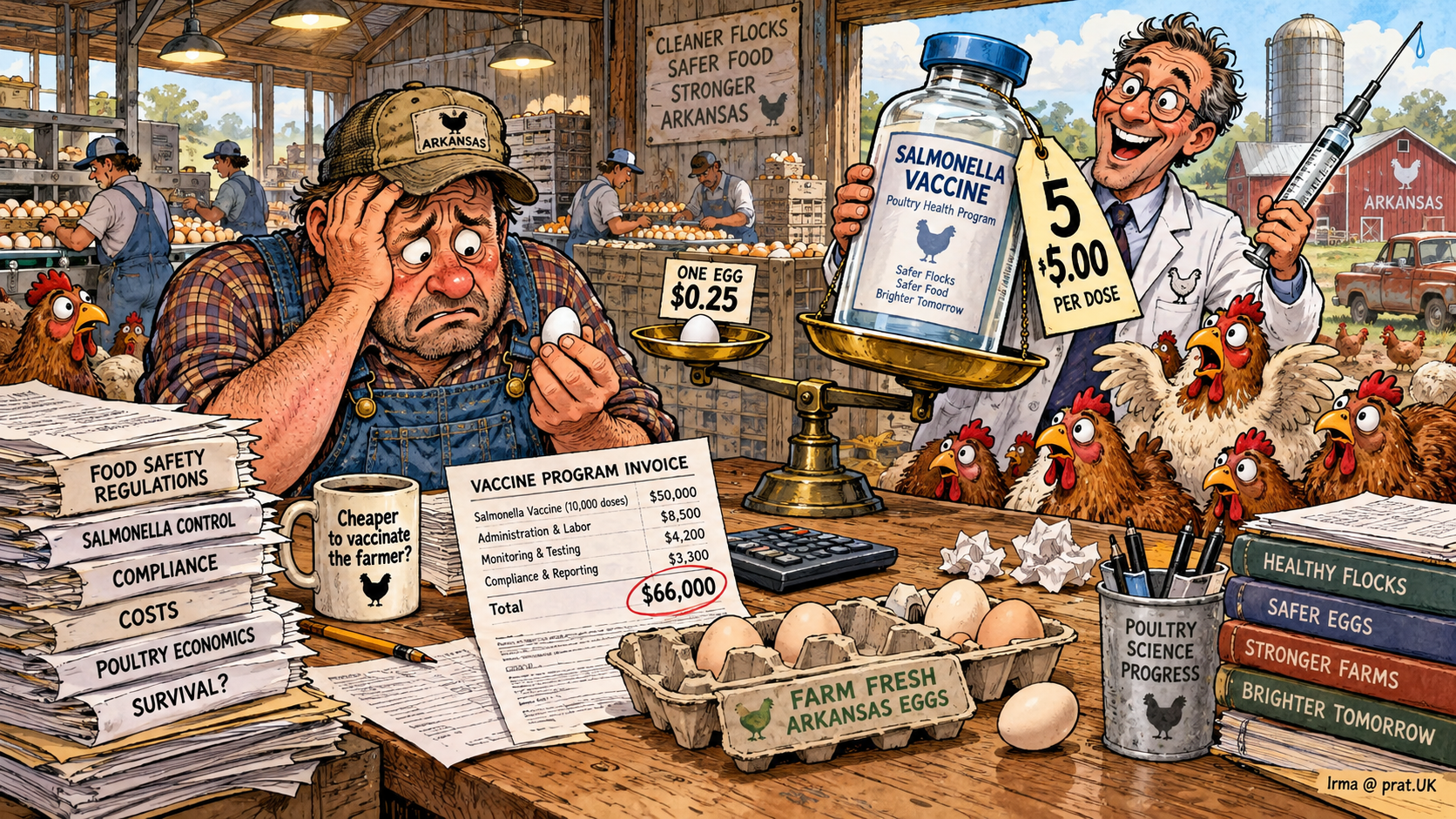
Arkansas salmonella breakthrough meets poultry economics
FAYETTEVILLE, ARKANSAS – American poultry producers are welcoming new salmonella vaccine research from the University of Arkansas while asking the question that determines whether nearly every agricultural innovation reaches the farm: how much does it cost?
The Arkansas Agricultural Experiment Station’s October 21 report describes a DNA-based vaccine enhancement technology that has produced encouraging results against salmonella. Scientists believe the approach could eventually strengthen animal vaccines. Unfortunately, a promising treatment costing approximately $1 per dose would be difficult to deploy economically across large poultry populations, and researchers say the cost must fall substantially, potentially to pennies, before broad poultry adoption becomes practical. Chickens responded by demanding universal healthcare.
America’s First Poultry Insurance Exchange
A government consultant has proposed the National Chicken Health Insurance Marketplace. Under the plan, every chicken would receive an insurance identification number, a deductible and access to a federally approved network of veterinarians. Premiums would depend on age, breed, location and whether the chicken engaged in dangerous recreational activities such as crossing roads. Roosters would pay higher premiums because of aggressive behavior, and hens would receive discounts for maintaining regular egg production.
An Arkansas chicken farmer questioned the proposal.
“I raise thousands of chickens. Who fills out the forms?”
“The chickens.”
“They can’t write.”
“Then perhaps your operation needs better workforce training.”
The Economics of Chicken Medicine
Poultry producers often manage huge flocks, which makes even small per-bird costs significant. Consider a hypothetical operation vaccinating 100,000 chickens. At $1 per dose, the vaccine alone would cost $100,000, before application expenses. At five cents per dose, the same quantity would cost $5,000. That is a $95,000 difference.
These are illustrative calculations, not reported vaccine prices or recommended treatment protocols. They show why lowering production costs matters.
Professor Carlton Pennyfeather, an agricultural economist, praised the calculations.
“The chicken is small, the flock is large, and the accountant is very nervous.”
He recommended that researchers also invent a chicken capable of paying its own medical bills. Scientists considered that outside the scope of molecular biology.
Poultry Farmers Demand Useful Innovation
A poll of 500 poultry producers asked what mattered most when evaluating new animal-health technology. Seventy-eight percent wanted demonstrated effectiveness. Sixteen percent emphasized affordability. Six percent requested the invention of chickens that voluntarily clean their own houses.
A separate poll asked poultry whether they supported vaccination. Most chickens declined to comment, preferring to investigate spilled grain. A rooster demanded that all interviews begin after sunrise.
Seven Years of Scientific Work
The University of Arkansas team spent roughly seven years advancing the technology. Its approach uses engineered DNA structures to help vaccine antigens interact with immune cells. The results are scientifically encouraging, but further development is needed to determine whether the technology can be manufactured economically and deployed effectively.
The underlying principle is familiar to farmers. A product must work. It must be safe and practical. And its economic value must justify the expense. That last requirement frequently surprises people who have never operated a farm.
Washington Announces the Chicken Affordability Task Force
In a congressional hearing, lawmakers proposed subsidizing premium health insurance for every bird. A poultry producer recommended supporting research that could make effective vaccines affordable. The committee responded that affordability was a complicated concept requiring further investigation.
One senator suggested assigning each chicken a personal physician. Another requested annual wellness screenings. A third proposed mandatory mental health counseling for roosters experiencing low self-esteem. The producer explained that chickens primarily required good management, suitable veterinary care and sensible disease prevention. The committee appointed a subcommittee.
The Chicken’s Final Medical Bill
If the technology progresses through further research and becomes financially practical, it could benefit poultry production and food safety. That would be a meaningful scientific achievement. The farmers will appreciate it, consumers may benefit, and the chickens will remain blissfully unaware of the complicated molecular science protecting them.
An Arkansas farmer reviewed the latest research.
“Great news. They may have a better vaccine.”
His accountant asked the price.
“Still working on that.”
The accountant closed the folder.
“Call me when the chicken can afford it.”
The chicken laid an egg. It was the operation’s most immediate contribution to cash flow.
The Evidence File
Mathematical Calculation, Backyard Edition
A hen lays roughly one egg a day at the high end, and a dozen eggs at grocery-store prices are a few dollars. Put a $1 vaccine on a hen and you’ve spent the equivalent of several eggs’ worth of revenue before she has done any laying at all. The hen is not in a position to negotiate, but if she were, she’d want the dollar.
The Obvious Question Nobody Asks
Who benefits if the vaccine works? Consumers eat safer chicken, processors face fewer contamination problems, and the farmer pays for the shot. That’s not a market failure, exactly. That’s a market that hasn’t yet had a long talk with the farmer.
Real Numbers on the Public Health Side
The CDC estimates salmonella causes about 1.35 million U.S. infections a year, and a USDA NIFA project summary notes chicken consumption remains a major source of human infection. The stakes are real, which is exactly why affordability matters.
Sources and Further Reading
Research details come from the University of Arkansas Division of Agriculture, with background at the Arkansas Agricultural Experiment Station and the USDA Food Safety and Inspection Service.
Research basis: University of Arkansas Division of Agriculture, October 21, 2026. Cost estimates and preliminary research status are grounded in the university’s account.
Humorous Observations
- The chicken needs a deductible. I can’t get my own deductible under control, and I’ve only got the one body and no feathers.
- Mandatory counseling for roosters with low self-esteem. Look at that bird. He yells at the sun every morning. That’s the most confident animal in America.
- “The chicken is small, the flock is large, and the accountant is very nervous.” That’s the whole poultry industry in one line, plus a Christmas bonus.
- Seven years of research, and the answer to “does it work” is “yes, but it’s a dollar.” The science was easy. It’s the dollar that’s got a PhD.
- The chicken laid an egg. Only employee in the building who produced something that day, and she hasn’t had a raise since the Eisenhower administration.
Last Updated on March 23, 2025 by Alan Nafzger