
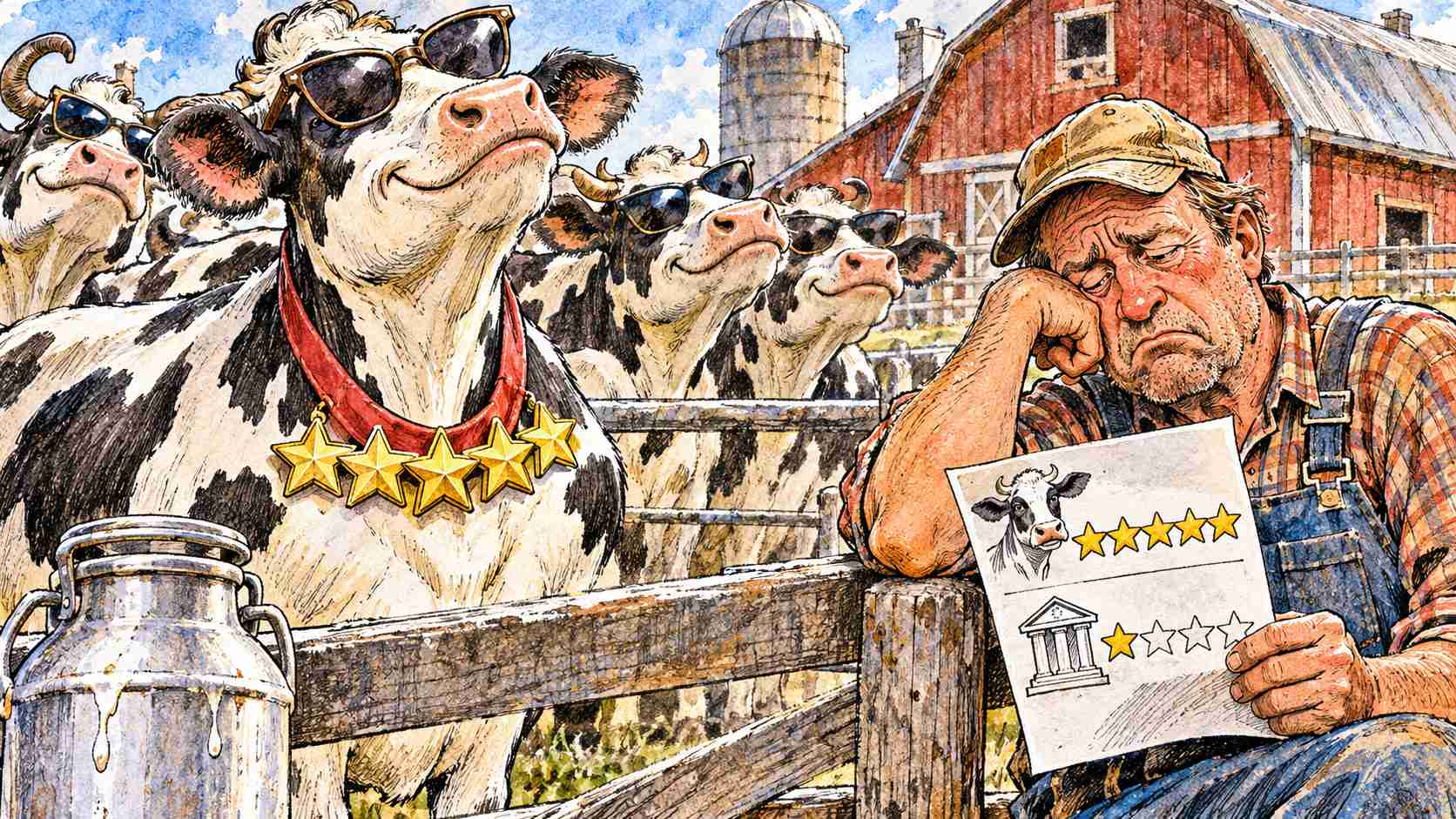
Five Stars for the Milk, Fewer for the Bank Account
LANCASTER, Pa. (Farm.FM) — A dairy farm milk quality report has awarded the herd five stars for cleanliness, careful milking procedures and an excellent somatic cell count, while assigning the owner’s bank account one star and suggesting that financial hygiene needs improvement.
The owner had an overdraft notice and three invoices described as urgent.
Farm manager Ruth Delaney asked whether the bank could be tested for bacteria. The technician said the lab handled milk, not the financial system.
Clean Milk, Dirty Accounting
Dairy farm milk quality is serious work. Mastitis, poor equipment cleaning or careless handling can damage product quality and cow health. Producers monitor somatic cell counts, bacterial indicators, equipment sanitation and milking procedures. Nobody on a real dairy makes milk cleaner simply by giving a cow a gold star, although the cow might appreciate the attention.
Penn State Extension’s March 2026 milk-quality guidance explains that somatic cell count helps indicate udder health. It cites the U.S. Grade A regulatory bulk-tank limit of 750,000 cells per milliliter and notes that an individual-cow count above 200,000 can signal infection. Those are different measures, not interchangeable targets, and staying far below a legal ceiling is generally preferable.
Ruth’s imaginary five-star report celebrated the herd’s careful routines. Her accountant said the fifth star should be exchanged for cash. The quality technician replied that stars are not legal tender, which explains several longstanding problems with the hospitality industry.
The Cows Passed. The Checkbook Needs Treatment.
At a dairy meeting, a consultant explained how proper milking preparation, equipment maintenance and rapid response to high somatic cell counts can improve quality. Ruth agreed, then asked whether there was a comparable protocol for invoices that multiply after opening.
The consultant offered a useful idea: track quality premiums or deductions alongside the actual costs of producing cleaner milk. Premium programs and contracts differ, so the farmer must understand which standards affect the milk check. Excellent quality can prevent losses, support cow health and sometimes earn premiums. It does not repeal the electricity bill.
An unofficial barn survey found that every cow favored clean bedding and consistent routines. One animal attempted to vote twice by turning around in the holding pen. Election officials certified the result anyway because the milk sample remained excellent.
There is a practical lesson behind the nonsense. A dairy farm should keep written milking protocols, verify wash cycles, maintain liners and equipment, investigate infection patterns and compare quality results with financial outcomes. Good records help identify costly problems before the bulk tank becomes a courtroom exhibit.
The final report gave the cows another five stars. Ruth taped it to the office wall beside the latest loan statement, which still showed a single star and a considerably less encouraging number.
She said at least one part of the operation was in excellent condition. The cows, having heard enough, went back to work.
Editorial disclaimer: Ruth, the star ratings and reported conversations are satirical. Penn State Extension milk-quality standards are real. This story is entirely a human collaboration between two sentient beings, the world’s oldest tenured professor and a philosophy major turned dairy farmer.