
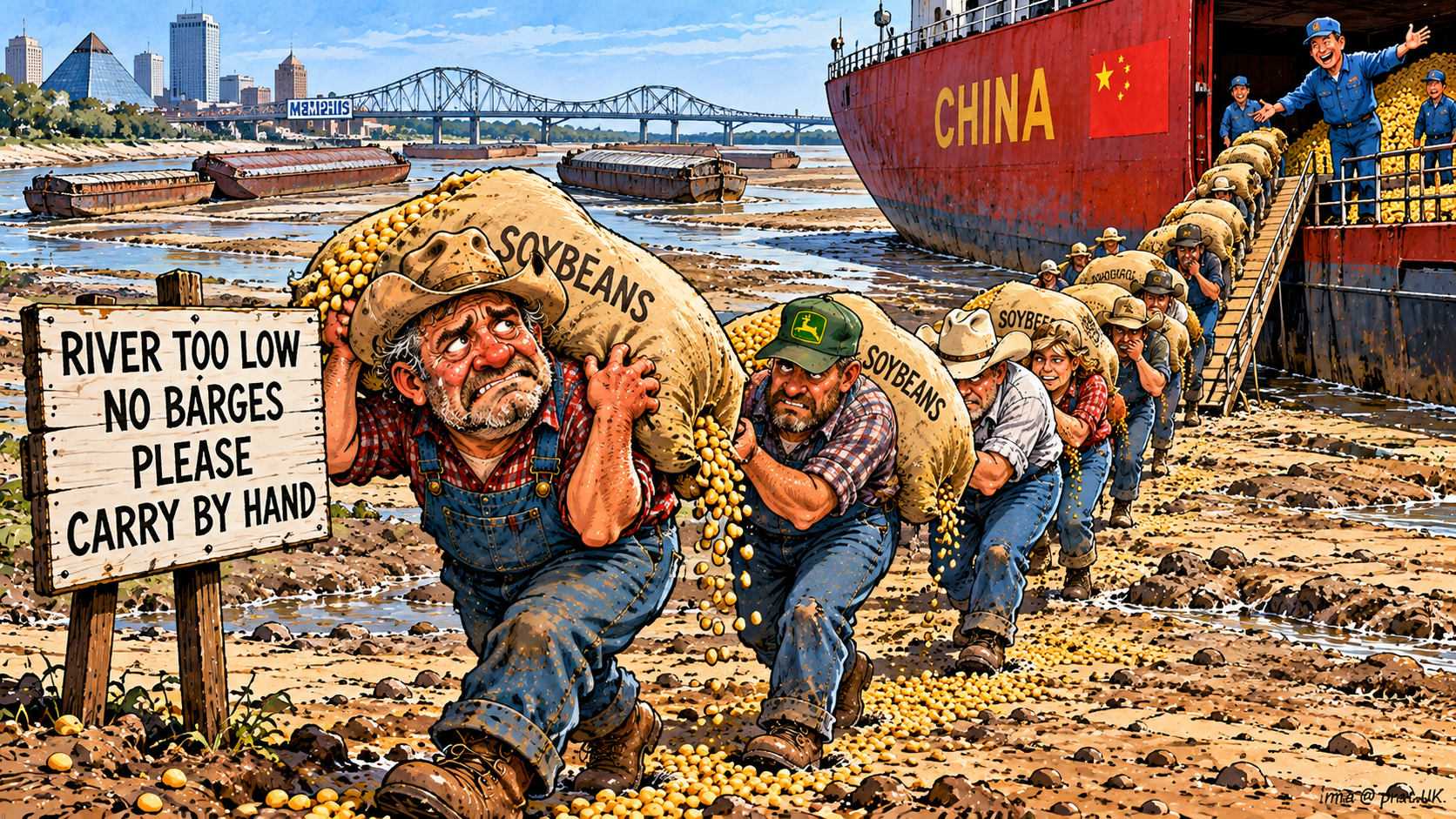
Mississippi River runs low as export season arrives
MEMPHIS, TENNESSEE – The Mississippi River has announced an inconvenient reduction in its water supply during America’s autumn grain-export season, prompting agricultural economists to investigate whether farmers can simply carry their soybeans to China.
The University of Arkansas Division of Agriculture reported October 21 that falling water levels at Memphis threatened to complicate barge transportation during a crucial export period. The river stood around five feet on the Memphis gauge October 19, with projections indicating it could fall into negative gauge readings in early November.
Negative gauge readings do not mean the river has run out of water. They reflect levels below the gauge’s reference point. Explaining that technical distinction has done nothing to improve the transportation situation.
Low Mississippi River Levels Threaten Grain Exports

The Mississippi is an essential transportation route for American corn and soybeans moving toward Gulf Coast export terminals. Farmers grow the crops. Elevators purchase the grain. Barges carry it downstream, and ships take it to foreign buyers. The system works beautifully until the river begins behaving like a politician confronted with a difficult question: shallow, evasive and increasingly difficult to navigate.
Professor Chester Shallow, director of the National Institute of Agricultural Water Management, proposed an emergency solution.
“Farmers should simply load soybeans into their pickup trucks and drive them to China.”
When informed that China was across the Pacific Ocean, Shallow requested an additional transportation grant.
The First National Soybean Carrying Competition
Under a congressional proposal, producers would receive federal incentives for personally transporting grain to international buyers. Farmers carrying 50-pound bags would qualify for mileage reimbursement. Those transporting grain by bicycle would receive environmental recognition. Participants reaching the Pacific Ocean would be eligible for a certificate of international agricultural achievement.
An Arkansas farmer examined the program.
“How many bushels can I carry?”
“Approximately one.”
“How many do I need to move?”
“About 80,000.”
“Can I borrow a barge?”
“Unfortunately, that’s what we’re studying.”
Mississippi River Grain Export Numbers Tell the Real Story
University of Arkansas agricultural economist Scott Stiles reported that approximately 1.5 million metric tons of grain moved through Mississippi Gulf export channels during the week ending October 15. About 65% of those shipments were soybeans, and nearly 60% of the exported soybeans were destined for China.
That is substantial commercial activity dependent on navigable water. Low river levels can restrict barge loading, disrupt schedules and raise transportation costs, and farmers may then receive weaker grain bids.
A survey of 500 Southern farmers found that 94% preferred rivers containing sufficient water for boats. Four percent preferred rain. Two percent requested that Congress stop commissioning studies of gravity.
Washington Proposes a National River Depth Coordinator
Federal officials proposed appointing a National River Depth Coordinator. The coordinator would manage a staff of 70 consultants, 14 communications officers and one employee responsible for locating actual water. Their first report would recommend making the river deeper. Their second would suggest additional rainfall. Their third would request another fiscal year of funding.
Farmers proposed allowing engineers and navigation authorities to continue practical river-management work. The committee described the suggestion as insufficiently ambitious.
Farmers Want Practical Help Moving Grain to Market
Reliable transportation is essential to agricultural profitability. Maintaining navigation, monitoring water levels and strengthening freight alternatives offer more practical assistance than celebrating export agreements that grain cannot economically reach.
An Arkansas farmer offered a final observation.
“Washington keeps telling me the whole world wants American soybeans.”
He looked toward the Mississippi.
“Wonderful. Now somebody get the beans to the world.”
The river declined to comment. It was busy going down.
The Evidence File
Eyewitness Testimony From the Wheelhouse
Captain Lyle Draft, a towboat pilot with thirty-one years on the lower river, was asked to describe conditions near Memphis. “When I started, I asked how deep it was,” he said. “Now I ask whether it’s still there.” He added that the Memphis gauge had been reading “about the same as my checking account, only the river has a chance of coming back.”
The Math Nobody Requested
A bushel of soybeans weighs 60 pounds, so a pickup carrying a ton and a half hauls roughly 25 bushels per trip. Moving 80,000 bushels takes about 3,200 trips. Memphis to the Pacific coast is around 1,800 miles each way, which means 11.5 million miles of round-trip driving. At a steady 65 miles an hour with no stops, the project finishes in a little over 20 years, and the beans still haven’t crossed an ocean. A standard covered hopper barge moves roughly 1,500 tons of grain at once, which is why the freight industry has never once suggested pickup trucks.
Follow the Money
When barge rates climb, somebody pays, and it is rarely the person who bills by the hour for explaining why. A University of Arkansas study reported by Farm Progress estimated that record-low water in 2022 reduced the value of the Arkansas soybean crop by anywhere from about $17 million to as much as $293 million, depending on the scenario. The River Depth Coordinator’s proposed budget, by contrast, has no range at all. It is simply “more.”
What the Real Sources Say
The Mississippi is the largest export channel for U.S. corn and soybeans, handling more than half of export shipments according to Stiles, as reported by the Arkansas Democrat-Gazette. The USDA’s weekly Grain Transportation Report tracks barge rates, the National Water Prediction Service publishes the Memphis river forecast, and the Army Corps of Engineers Memphis District handles navigation on this stretch of the river.
Sources: University of Arkansas System Division of Agriculture, October 21, 2026; Farm Progress; Arkansas Democrat-Gazette; NOAA.
Humorous Observations
- Memphis is the only city where the river can go negative and nobody on the news says the word “recession.”
- A “negative gauge reading” means the river is lower than the ruler. Somebody bought a ruler for a river, and now it’s the river’s fault.
- Carry soybeans to China. I can’t carry groceries in from the car in one trip, and nobody’s ever offered me a certificate.
- The River Depth Coordinator is the guy whose whole job is to look at water and say, “Yep. Less.”
- A barge holds as much as a few dozen semis, which makes the river basically the world’s slowest interstate, and it’s the only one where the road is the thing that goes missing.
Last Updated on April 11, 2025 by Alan Nafzger