
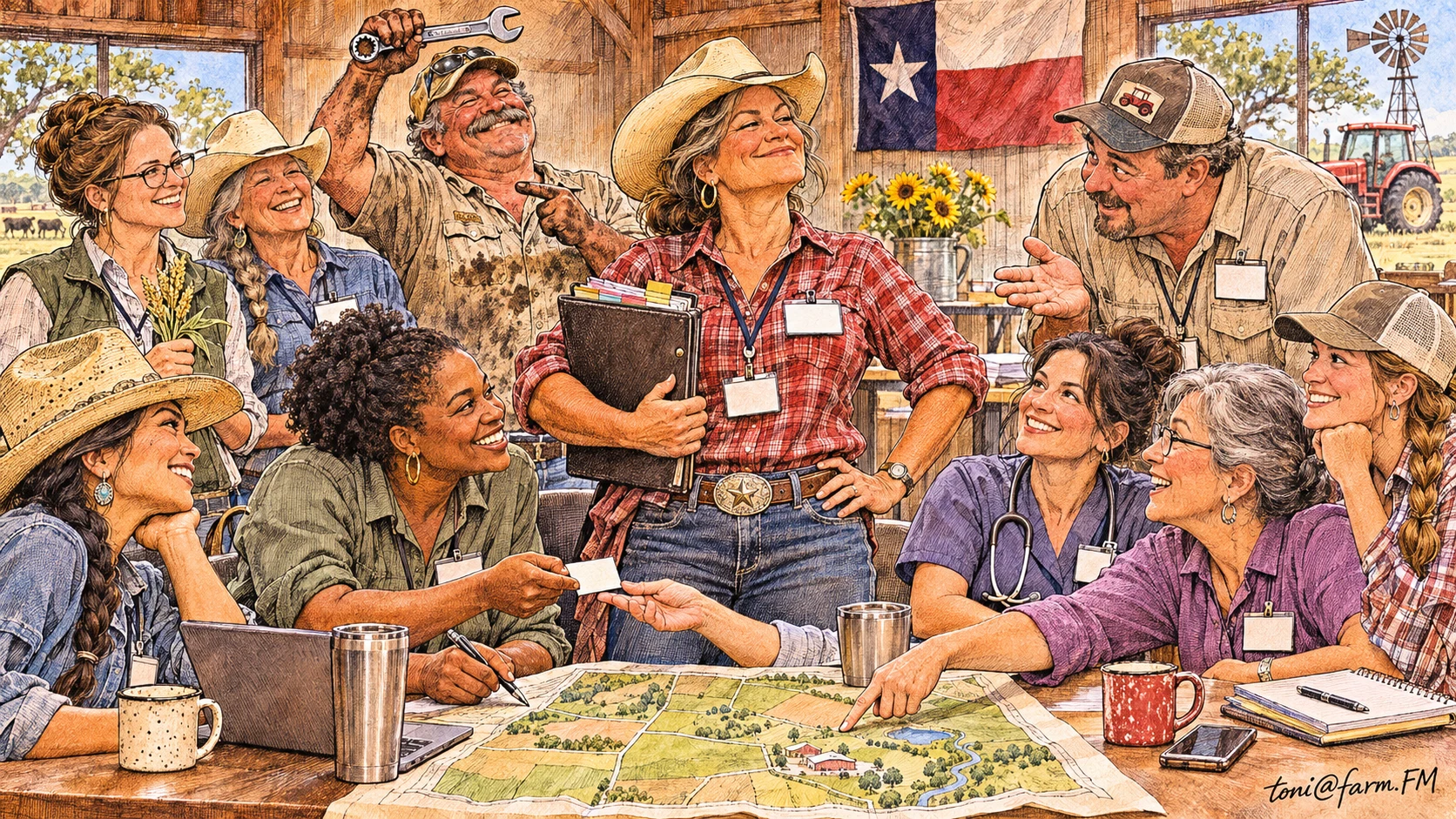
WICHITA FALLS, Texas — A Women in Agriculture meeting identified the county’s actual farm boss Tuesday after three men asked Linda Shaw whether her husband would be joining the discussion.
Linda said he would arrive after finishing the task she had assigned him.
The meeting brought together farmers, ranchers, agronomists, veterinarians, lenders, mechanics and agricultural educators. The registration table offered name tags with a blank for occupation. Linda wrote “owner-operator.” A supplier glanced at it and asked whether she handled the farm’s bookkeeping.
“Yes,” Linda said. “Also planting, payroll, marketing, cattle and people who don’t read name tags.”
She opened the Women in Agriculture professional-resource network to compare guides, organizations and state contacts across farm ownership, livestock, crops, finance, technology, safety and career development. Her husband, Ray, texted to ask where she kept the 15/16-inch wrench.
Linda replied, “Where I put it after you lost it.”
Women in Agriculture Skip the Introduction
USDA’s 2022 Census of Agriculture counted 1.2 million female producers, representing 36% of all U.S. producers. More than half of farms had at least one female producer, and farms with female producers accounted for 41% of agricultural sales.
Linda read the figures aloud.
Ray’s cousin Dale asked whether “producer” meant somebody who helped with decisions.
Linda said yes.
Dale nodded. “So you’re basically management.”
The room observed a respectful silence while Dale unknowingly discovered fire.
County Extension educator Maria Santos redirected the conversation toward risk management. She asked each participant to name one decision waiting on the farm.
Linda needed to choose between repairing and replacing a loader tractor. Maria was evaluating a livestock-handling workshop. A young agronomist named Priya was negotiating her first land lease. Dale was waiting for the room to forget his previous sentence.
The Equipment Dealer Requests a Husband
Linda described calling for a hydraulic pump quote. The parts clerk asked whether he could speak with “the man who runs the equipment.”
She handed the phone to Ray.
Ray listened for 20 seconds and handed it back. “He needs the serial number, pressure reading and failure code.”
Linda supplied all three.

The clerk then addressed her as “ma’am” with the solemnity of a man updating his entire operating system during business hours.
Other women shared similar stories. One rancher had been mistaken for the bookkeeper at her own cattle sale. A veterinarian had been asked when the doctor would arrive. A grain merchandiser had received a careful explanation of basis from a customer whose contract she had written.
The group did not object to explanations. Agriculture depends on sharing knowledge. They merely suggested confirming who needs the explanation before beginning a lecture with diagrams.
Networking Performs Actual Work
The meeting divided into small groups. Nobody practiced “empowerment” as a noun. They exchanged grazing contacts, lender questions, childcare strategies, land-lease clauses, safety resources and the name of a mobile mechanic who answered messages.
This was described as networking, though it looked suspiciously like fixing six businesses before lunch.
Priya asked Linda how to prepare for the lease negotiation.
“Know the acres, water, access, improvements, term, termination and who pays for what,” Linda said. “Then write it down before everybody remembers a different handshake.”
Maria added that professional networks work best when they lead to specific next steps. They wrote action items and contacts on cards. Dale wrote “listen first,” a pilot program scheduled for immediate field testing.
The Panel Finds Its Expert
The afternoon panel concerned machinery costs. The moderator had invited a dealer, a lender and “a local farm wife.” Linda approached the table carrying five years of repair records and ownership-cost comparisons.
The dealer discussed resale value. The lender discussed capital. Linda explained downtime during planting, the cost of an unreliable loader and the difference between equipment a farm could finance and equipment the farm could profitably own.
The audience directed most questions to her.
Ray arrived late with grease on his shirt and sat in the back. Someone asked whether he was Linda’s husband.
“Yes,” he said proudly. “I work for the actual farm boss.”
Linda clarified that the farm did not use the word boss. It used “division of responsibility.” She handled production, finance, marketing and long-term planning. Ray handled welding, repairs and locating tools that were already hanging on their labeled hooks.
A Better Name Tag
Before leaving, Linda revised her name tag. Under owner-operator she added “ask me about tractors.”
The supplier who had mistaken her for the bookkeeper apologized and requested her opinion on the loader decision. Linda showed him the numbers. Repairing the old tractor won if it could be returned reliably to service; replacement won only if downtime risk and expected repairs justified the added ownership cost.
“That’s a complicated answer,” he said.
“Farming is a complicated business.”
Outside, Ray had found the 15/16-inch wrench in the exact drawer Linda named. The Women in Agriculture meeting had produced contacts, decisions and one documented miracle.
Disclaimer
No man was injured during the discovery of the actual farm boss, although Dale’s conversational privileges remain under review. Titles vary; competence does not. This article is entirely a human collaboration between two sentient beings—the world’s oldest tenured professor and a philosophy major turned dairy farmer.
Last Updated on November 17, 2026 by Alan Nafzger
The useful moment in this piece is not the missing wrench. It is the supplier talking to everyone in the room except the woman who could approve the parts bill and put her hand on the tool. That is ordinary farm management, and it should not have to be discovered at the end of the agenda. I keep a library of agricultural articles and production guides bookmarked for meetings like this, because the reading is practical and it treats the people who already run the farm as the audience, not the afterthought.