

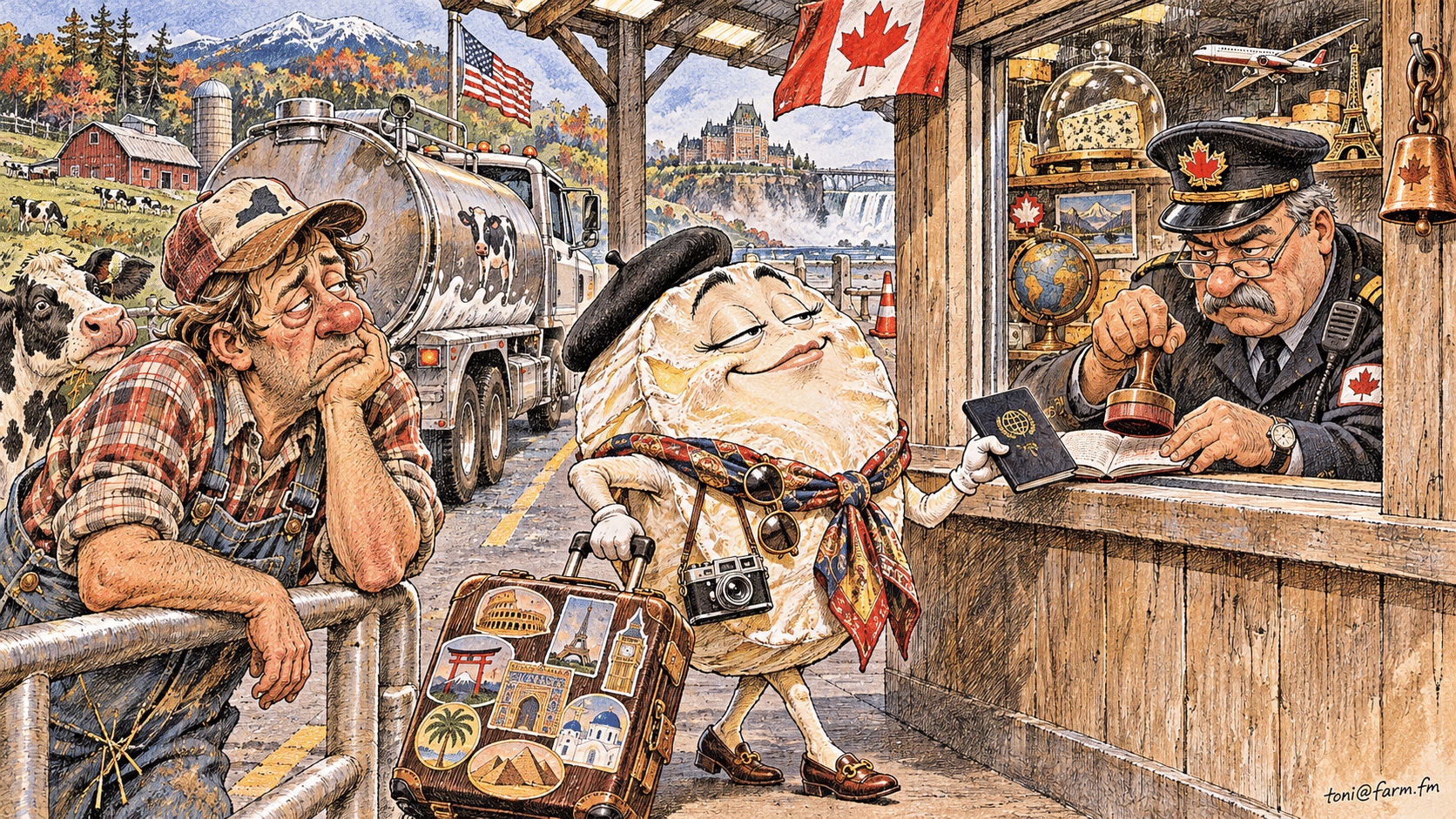
ALBANY — U.S.-Canada dairy tariffs have produced a new class of internationally experienced agricultural product after a quantity of New York milk returned from Ontario as brie and immediately began explaining how travel had changed it.
North Country dairyman Vernon Pail said the cheese had crossed an international border twice, developed a rind and acquired opinions about room temperature. Pail’s most recent excursion was to a parts counter that closed before he arrived.
“It left here in a tank,” he said. “Now it wants to breathe before dinner.”
The Times Union’s reporting on New York dairy and Canadian trade describes an Ontario supplier using New York dairy to make brie shipped back to the United States. Importer Gellert says tariffs are affecting that business. The cross-border route means the commercial consequences can extend to American milk suppliers.
U.S.-Canada Dairy Tariffs Give the Cheese Something to Declare
Pail learned about the journey when a wheel arrived at his kitchen table with a scarf, an expandable suitcase and a request that the television remain off during the cheese course.
His wife, Marlene, asked whether it had brought anything back.
“Administrative complexity,” the brie replied.
It unfolded a receipt that passed the sugar bowl, crossed the floor and entered the dog’s sleeping area. The dog relocated without seeking a customs classification.
Pail had assumed his milk would return with added value. He had not understood that several parties would stand between the value and the addition reaching him.

A Rind Is Accepted as Evidence of Personal Growth
The brie’s travel diary described a transformative stay in Ontario, during which it became firmer about boundaries while remaining soft in the middle.
“I’m still connected to my roots,” it said. “I just prefer them served with quince.”
Pail pointed out that those roots had been milked at four in the morning by a man wearing a sweatshirt with a broken zip.
The cheese called this an authentic origin story and asked whether the sweatshirt could appear on the premium packaging.
Pail asked about a packaging royalty. The cheese referred him to distribution.
Farm Survey Finds Travel Benefits Concentrated in Refrigerated Freight
Marlene’s kitchen-table survey found that 97.3 percent of household international travel spending benefited things that required chilling. The remaining 2.7 percent was a petrol-station sandwich consumed while waiting for a replacement pump.
The survey’s margin of error was one husband insisting the pump trip counted as a break.
Supply-chain adviser Dr. Curdwell explained the arrangement using a holiday analogy: “Imagine sending your child abroad, then being charged to welcome them home because they learned French.”
He was retained for the meeting because his presentation fitted on a placemat. His invoice did not.
Cow Declines Request to Adjust Her Nationality
In the barn, cow number 46 was asked whether future milk could be produced with less exposure to international uncertainty.
She continued chewing. Pail recorded this as the most stable trade position he had heard all week.
The practical problem, he said, was that farms sell into processing and distribution networks. A border charge can alter a buyer’s calculations even when the cow has spent her entire career beside the same bent gate.
Readers following the wider farm story can find more Farm.FM dairy coverage; Pail recommended beginning before the cheese required a booking agent.

Farmer Applies for the Same Opportunities as His Milk
Pail’s request for a brief holiday was rejected by the barn calendar, which contained two milkings beneath every proposed destination.
The brie offered encouragement. Travel, it explained, was about making time.
“Wonderful,” Pail said. “You take the morning shift.”
The cheese checked its watch. It had an appointment with a cracker.
By evening, Pail had put the suitcase in the loft and the brie in the refrigerator. Marlene found him studying its passport.
“Thinking about where we could go?” she asked.
“No,” he said. “Trying to find out who covered for it.”
Fifteen Observations From the Border
- The milk has a passport; the farmer has a feed bill.
- Brie comes home with an accent and an invoice.
- A rind now qualifies as international experience.
- The cheese travels; the owner covers milking.
- Milk leaves American and returns complicated.
- Customs can identify cheese faster than beneficiaries.
- The suitcase holds less than the paperwork.
- Every border crossing adds character and overhead.
- The cheese has connections; the farmer has debt.
- The cow cannot pronounce her finished product.
- Free trade requires expensive interpretation.
- The holiday jar finances refrigerated freight.
- An import can contain a neighbour’s milk.
- The cheese ages while the farmer waits.
- The souvenir is payable in thirty days.
Disclaimer
This is satire inspired by the linked reporting. Vernon, Marlene, the talking brie, survey and adviser are comic inventions; no real source supplied their remarks. The entirely human collaboration between two sentient beings—the world’s oldest tenured professor, the nation’s only agriculture professor that actually needs tenure, and a philosophy major turned dairy farmer—accepts responsibility for the cheese’s travel allowance.
Last Updated on November 28, 2026 by Alan Nafzger