

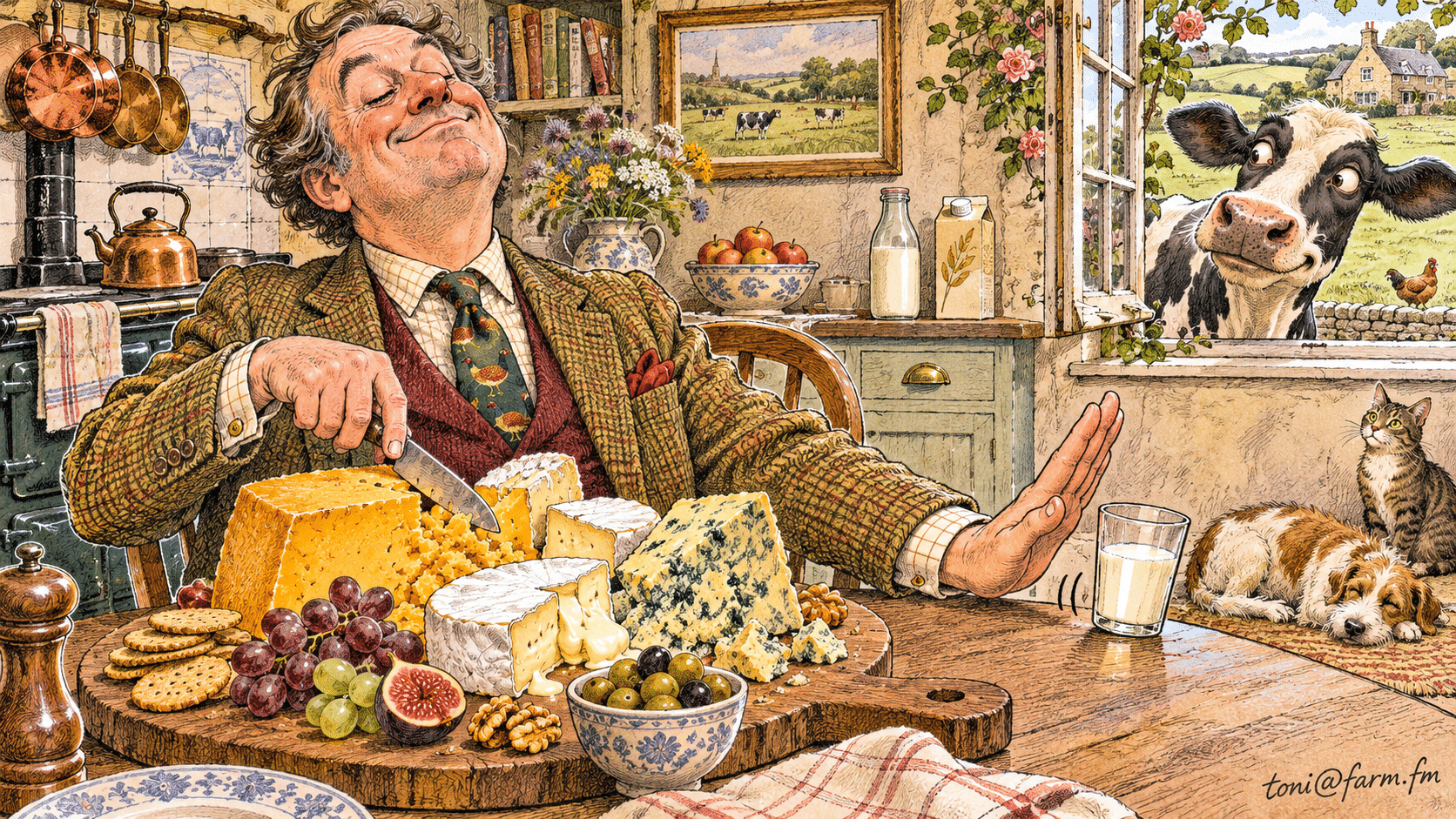
SOMERSET — Britain’s changing relationship with UK milk consumption reached a delicate stage after households announced they were moving on from cow’s milk, then asked whether anybody had remembered the cheese knife.
At a supper hosted by Nigel Crumb, the announcement was followed by a substantial Cheddar, a blue cheese and a bowl of yogurt that nobody considered relevant to the discussion.
“We hardly have milk now,” Crumb said, using a dairy product to glue another dairy product to a cracker.
The long-term change is measurable. AHDB’s analysis of UK milk utilisation, drawing on Defra figures, reports that per-person liquid-milk consumption fell 27 percent between 2015 and 2024, while cheese consumption rose 11 percent. Milk’s career increasingly involves returning to the table in a form requiring cutlery.
UK Milk Consumption Encounters the Cheese Course
Local dairyman Arthur Churn arrived with a milk bottle and received sympathetic looks. Moments later, the host welcomed a cheese board with the enthusiasm normally reserved for a relative who had brought a deposit.
Churn recognised several litres’ worth of earlier work.
“That’s still the cow,” he said.
Crumb explained that the cheese was entirely different. It had been matured, wrapped and introduced by a man who used the word “notes” without referring to unpaid bills.
The bottle, by comparison, had simply stood there containing milk.

Consumer Accepts Dairy After It Develops a Backstory
Dinner guest Felicity Rind said she preferred foods with an interesting journey. Churn described the cow’s morning walk from the cubicles.
This lacked the necessary length.
He tried again, adding hillside pasture, changing seasons and a family connection to a dented gate. Felicity took a second slice.
“You should put that on the label,” she said.
Churn asked whether the label could include the electricity bill. The host suggested keeping the experience positive.
Short-Term Figures Refuse to Attend the Farewell Party
There is a complication for anyone preparing milk’s obituary. AHDB’s November dairy retail report says milk purchase volumes rose 0.2 percent year-on-year in the twelve weeks ending October 31, with whole milk performing particularly well. A recent retail increase can coexist with a much longer decline; the farewell committee had booked the room before checking.
Its chair, Pamela Teaspoon, agreed to amend the programme from “The End of Milk” to “An Evolving Relationship With Milk, Please Keep Your Glass.”
The revised title required a smaller font.
Survey Discovers Dairy Disappears When Served on Slate
A supper-table poll found that 94.6 percent of guests believed they had reduced dairy until asked to list what was on their plates. Confidence fell sharply at the butter dish.
One respondent requested that melted cheese be counted as a topping rather than an admission.
Another said yogurt was a wellness activity.
The pollster classified clotted cream as an unresolved constituency and adjourned for pudding.

Farmer Attempts to Make Bottle Look More Mature
Back at the dairy, Churn experimented with a tiny wooden board beneath the milk bottle. Sales did not improve until he placed a miniature knife beside it.
A marketing adviser recommended describing the contents as an unaged, pourable farmhouse expression.
Churn said he had previously called it whole milk.
The adviser praised that as a useful working title.
For farmers following shifting demand, the distinction matters: buyers, processing capacity and product returns determine where milk can go. More dairy reporting from Farm.FM is available without arranging a tasting flight.
Cow Recognises Herself Despite New Packaging
Churn’s Holstein, Mabel, watched the next tasting through the creamery window. Guests praised the cheese’s texture, complexity and connection to the landscape.
Mabel had supplied all three while standing in the landscape, but nobody had asked for her notes.
Crumb declared the evening a demonstration of how far Britain had moved beyond ordinary milk.
Then he asked Churn to pass the cream.
Churn slid it across the table with a knife, just in case.
Fifteen Observations From the Cheese Board
- Britain quits milk until someone provides crackers.
- Cheddar is milk with better dinner invitations.
- The cow recognises her work in every aisle.
- A cheese knife performs remarkable moral surgery.
- Milk needs a glass; cheese needs adjectives.
- The fridge contains several stages of denial.
- A tasting board is a dairy reunion.
- Consumers reject the bottle and embrace the wheel.
- A rind provides excellent public relations.
- Milk’s comeback requires a different utensil.
- Yogurt brings its own spoon and alibi.
- The oat carton gets credit for the cheese course.
- A cow can survive a change of packaging.
- The farewell toast includes double cream.
- Britain wants less milk that looks like milk.
Disclaimer
This is satire inspired by the linked dairy data. The supper guests, farmer, cow, marketing advice and dinner poll are comic inventions; real sources did not make their remarks. The entirely human collaboration between two sentient beings—the world’s oldest tenured professor, the nation’s only agriculture professor that actually needs tenure, and a philosophy major turned dairy farmer—accepts responsibility for the unnecessary cheese knife.
Last Updated on November 28, 2026 by Alan Nafzger