
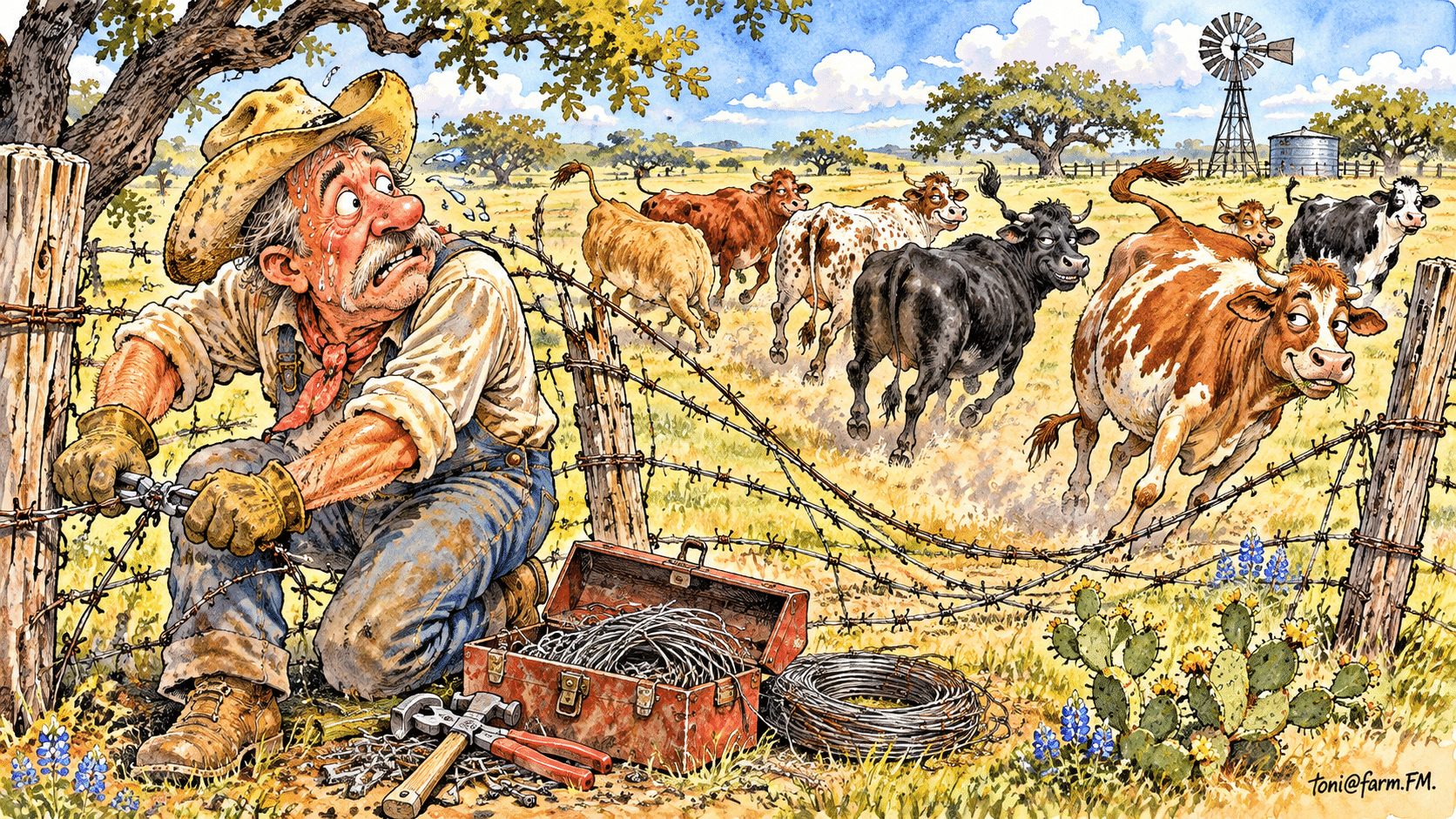
WICHITA COUNTY, TEXAS. Rancher Dale Riggins announced that a quick fence repair begun five years ago has entered its historic-preservation phase, having survived three storms, two calves, one divorce threat and twelve separate promises that he would “finish it Saturday.” The original project consisted of replacing a single broken post. It now occupies four generations of family conversation.
Riggins, 62, described the unfinished section as “a living monument to rural determination.” His wife, Evelyn, described it as “a place where cows leave the property.” Both descriptions are accurate, though only one appears in the proposed tourist brochure.
Five Years of Fence Repair, Three Hundred Feet of Excuses
The first Saturday was delayed by rain. The second required an urgent trip to the feed store. By the third, Dale had discovered that the posthole digger needed repairing, which itself required a part obtainable only from a cousin in Oklahoma who had borrowed it in 1998.
The rancher eventually installed two posts, removed one, discovered the corner brace was crooked, and announced that he was “nearly done” during four consecutive Christmas dinners. A neighbor offered a stopwatch; Dale said deadlines interfere with craftsmanship.
Texas Historical Commission Explains That Five Years Is Not Fifty
The Texas Historical Commission’s Recorded Texas Historic Landmarks criteria generally apply to structures at least 50 years old with historical and architectural significance. Dale believes his fence deserves exceptional treatment because it has already made him feel fifty years older.
When informed that merely failing to complete a project does not make it historically significant, Dale presented the county’s informal preservation committee with a coffee-stained work order, seven photographs of missing pliers and a witness statement from his brother-in-law. The brother-in-law confirmed seeing Dale “fixing that thing” on numerous occasions, none of them recently.

USDA Finds Fences More Useful When They Actually Contain Cattle
The USDA NRCS fencing practice standard addresses barriers used to manage animal movement and access. Dale’s current system encourages animal movement, especially toward the neighbor’s tomatoes. A six-cow field survey found that all six preferred the gap.
The Texas A&M AgriLife Extension fencing resource explains how properly placed fencing helps control livestock movement. Dale calls this a useful principle that he intends to implement once the historical research is completed.
The County’s New Tourist Attraction Has an Escape Route
Local residents have proposed guided tours of the unrepaired gap. Admission includes a photograph, a lecture on procrastination, and a chance to retrieve cattle from the county road. A poll of eight neighbors found seven consider the fence an eyesore. The eighth is a hay supplier whose sales increase every time Dale postpones the job.
Evelyn has offered a practical preservation plan: buy good posts, brace the corner, stretch the wire correctly, check the gates and finish before the cows establish a historical society of their own. Dale says he supports this proposal but would like to study it further.
By sundown, the rancher was photographed leaning on the incomplete fence with a shovel. “Another productive day,” he declared. The shovel had not touched the dirt. The cattle attended the ceremony from the other side of the road.
Disclaimer: Entirely a human collaboration between two sentient beings, the world’s oldest tenured professor and a philosophy major turned dairy farmer. No actual landmark status has been conferred upon the broken fence.
Last Updated on November 13, 2026 by Alan Nafzger