
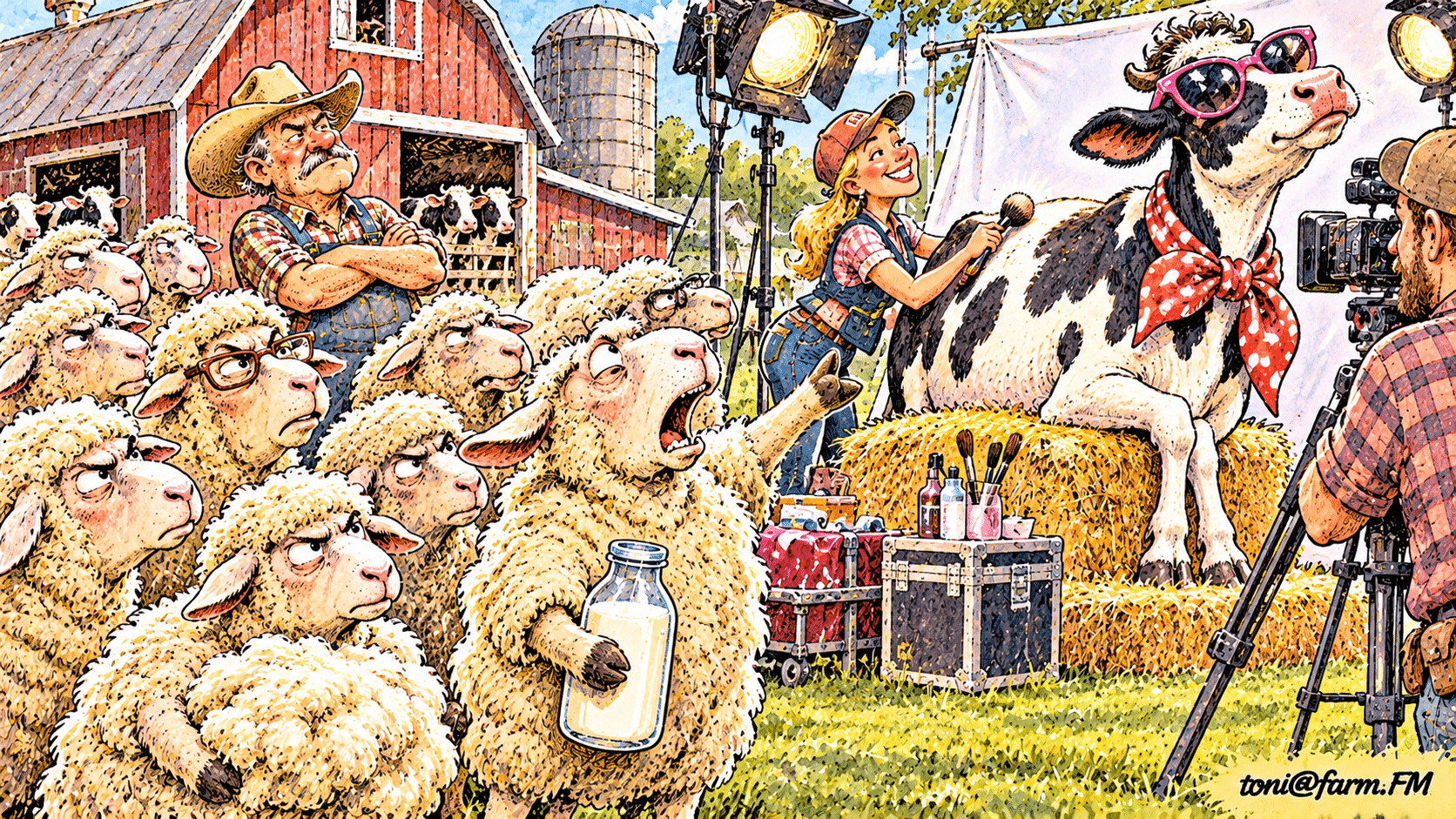
The Cows Get the Ads; the Sheep Get Overlooked
MADISON, Wisconsin (Farm.FM) — A coalition of dairy sheep announced a marketing rebellion Monday, accusing the national food industry of giving cows all the celebrity endorsements while expecting sheep to supply milk, wool and a perfectly reasonable level of pasture diplomacy without so much as a coffee mug.
The rebellion began when a sheep named Mabel saw a television commercial featuring a smiling Holstein and a sunrise. The sheep complained that every dairy advertisement seemed to feature a cow behaving like a retirement-community activities director.
“We can make cheese, too,” declared the group’s spokesman, a farmer who was interpreting several minutes of vigorous bleating.
Dairy Sheep Demand a Seat at the Cheese Board
The new advertising campaign proposed the slogan It’s Not Just a Sweater. A consultant suggested Sheep Milk: The Other White Liquid. The flock rejected both, then expressed unanimous support for a third option that translated roughly as where’s the feed?
The dairy sheep formed a branding committee and demanded a photo shoot. The photographer spent an hour arranging a pastoral scene, only to discover that every sheep wanted to occupy the identical patch of shade.
A ram wandered into the frame wearing a fleece jacket. Asked why he was wearing a jacket made from his own wool, he replied, according to the farmer, that he was merely trying to understand the garment industry’s supply chain.
At the first investors’ presentation, the sheep demanded that cheese labels include an official portrait of the producing animal, an artist’s signature and a footnote explaining why their milk should not be confused with wool.
The marketing firm responded that consumers disliked complicated packaging. Mabel responded by sitting on the product samples.
Sheep Milk Has a Real Place in Dairy Production
USDA’s agricultural statistics resources document the broader livestock sector and demonstrate that not every animal raised on a farm belongs to the same production system. Sheep milk is used in specialty cheeses and requires appropriate milking, animal-health and food-safety practices.
The American Sheep Industry Association provides sheep-production information across a sector that is frequently discussed only in connection with wool and meat. Dairy sheep deserve to be understood as managed livestock, not merely a fluffy logo awaiting a corporate rebrand.
Mabel said she was delighted to hear that the agricultural community acknowledged her nutritional contribution. She asked whether this acknowledgment could be exchanged for alfalfa.
“Not directly,” said the consultant.
“Then stop calling it a contribution,” her handler translated.
Flock Votes to Replace Marketing Agency With Shepherd
After weeks of expensive planning, the agency proposed promoting a sheep as “the cow’s underrated cousin.” That was the final insult. The flock called an emergency meeting and voted to replace the entire communications department with a shepherd who knew how to open the gate.
The shepherd’s first campaign had three priorities: fresh water, good forage and healthy animals. Sales brochures remained optional.
The advertising agency insisted this was insufficiently aspirational. The shepherd asked whether the consultants could tell a dairy ewe from a ram.
Nobody raised a hand.
Mabel returned to the pasture, where the grass was tangible and the branding experts could not reach her.
The agency still sent an invoice marked strategic ewe positioning. The farmer filed it under expensive ways to describe a sheep.
Disclaimer: The sheep’s marketing revolt and quotations are satirical. The linked agricultural organizations supply genuine livestock-industry context. This story is entirely a human collaboration between two sentient beings: the world’s oldest tenured professor and a philosophy major turned dairy farmer.