

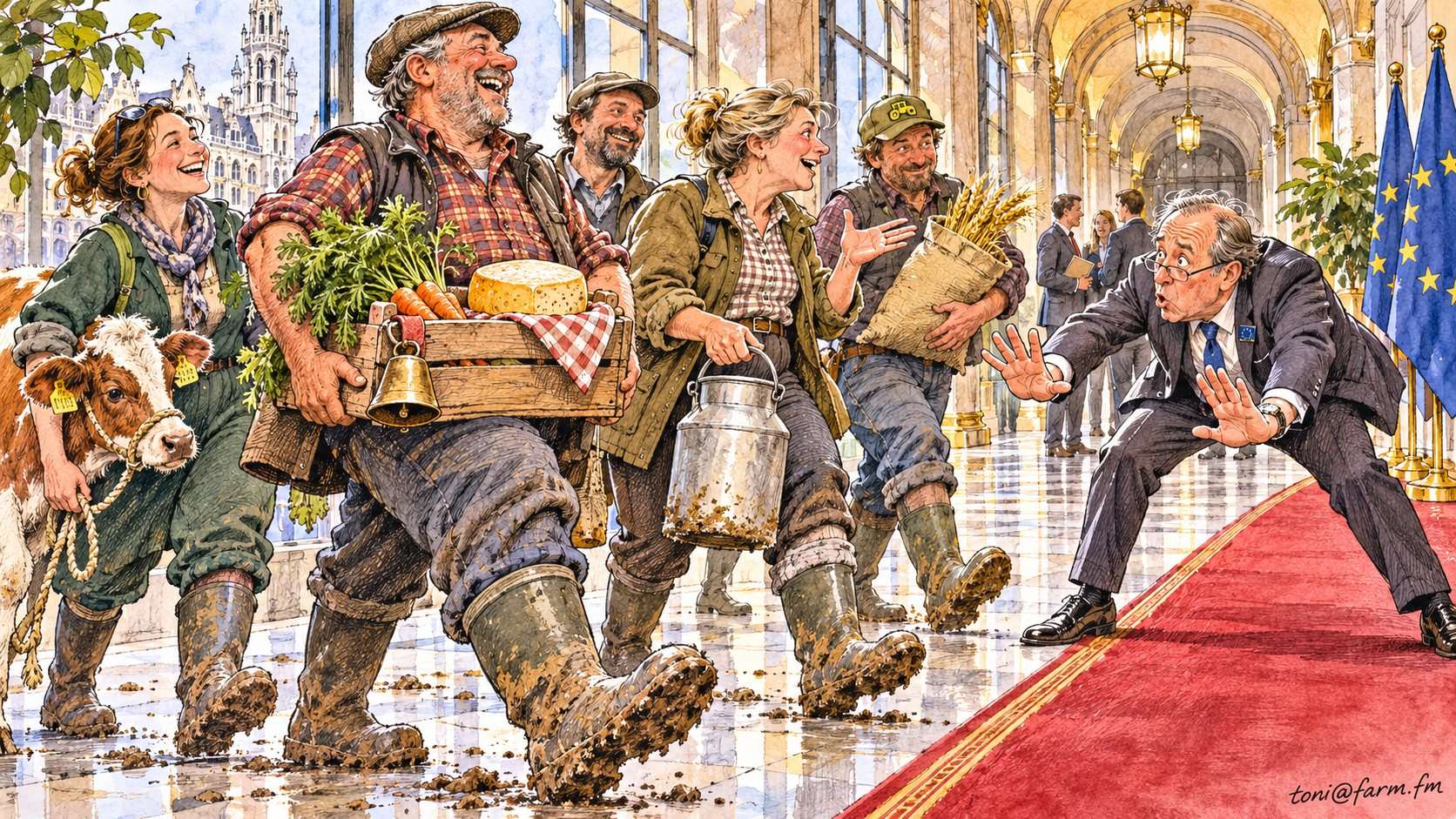
BRUSSELS — The EU farm budget discussion has suffered a serious scheduling surprise: farmers have arrived to discuss it. The committee had prepared for agriculture, but it had not anticipated that agriculture would walk into the conversation wearing boots that had encountered actual soil.
Agence Europe reported November 27 that around 700 farmers marched through Brussels the previous day to defend the Common Agricultural Policy budget for 2028–2034. The organisations called for preserving support amid negotiations. Grower Elise read the report and said it was helpful to distinguish a budget discussion involving farms from a budget discussion in which farms existed principally as a heading.
EU farm budget meets the people in the nouns
Elise placed a small potted crop on the meeting table. An official asked whether it was a visual aid. She said it was also a reminder that the subject continued growing while the table waited for another document.
The official requested that no soil be spilled on the briefing papers. Elise asked whether the papers contained any plan for soil outside the building.
They agreed that both questions could be recorded.
A consultant described the proposals as an opportunity to reconsider priorities. Elise presented her own priority list: operating expenses, useful investment and the capacity to remain a farm. He said the list might benefit from broader framing.
She turned it sideways. The contents remained inconveniently specific.
The percentage cut gets an individual address
The EU farm budget becomes easier to discuss in a room when every number refers to somewhere else. Elise’s neighbour tried a household demonstration by removing one item from a small shopping list and announcing that the average household still looked adequately provisioned.
His wife identified the missing item as the main ingredient for dinner. The experiment ended before anybody could describe the meal as more strategically focused.
Elise brought a receipt to the next conversation. Its prices had not reduced themselves to accommodate an elegant description of reduced support. The official agreed that implementation mattered.
The consultant offered a definition of efficiency that occupied most of a paragraph. Elise asked him to identify the verb meaning do the work. He requested time to revise the wording.
The crop on the table received water. It was the afternoon’s clearest example of a proposal being implemented without first being renamed.

The meeting makes room for a working farm
Elise checked agricultural policy resources beside the information relevant to the discussion. She wanted the debate to account for consequences on an operation, rather than awarding certainty to whoever had the most polished summary.
The official asked which questions required clearer answers. Elise supplied several. This made the conversation less ceremonial, but it also made it possible to tell when an answer had actually been given.
Her neighbour proposed a satisfaction poll of everyone leaving the room. Elise said they should first check what each participant believed had been decided. The consultant called this a demanding methodology.
By the end of the visit, the crop had survived, the table had acquired a little soil and the committee had acquired a better understanding of why a farmer might travel to Brussels rather than remain satisfied by a promise of future consultation.
The official offered to arrange another meeting. Elise asked whether the crop should reserve a chair or whether somebody would finally take its requirements home.
Disclaimer: The march and budget debate are described in the linked report. Elise, the meeting, household experiment, consultant and dialogue are editorial inventions. The oldest tenured professor and philosophy-major dairy farmer have nominated watering the crop for an implementation award.
More from Farm.FM’s agriculture desk.
Last Updated on November 28, 2026 by Alan Nafzger
Brussels finally saw real dirt and asked if it needed a permit.
They needed a permit for the dirt and a translator for the farmer.