

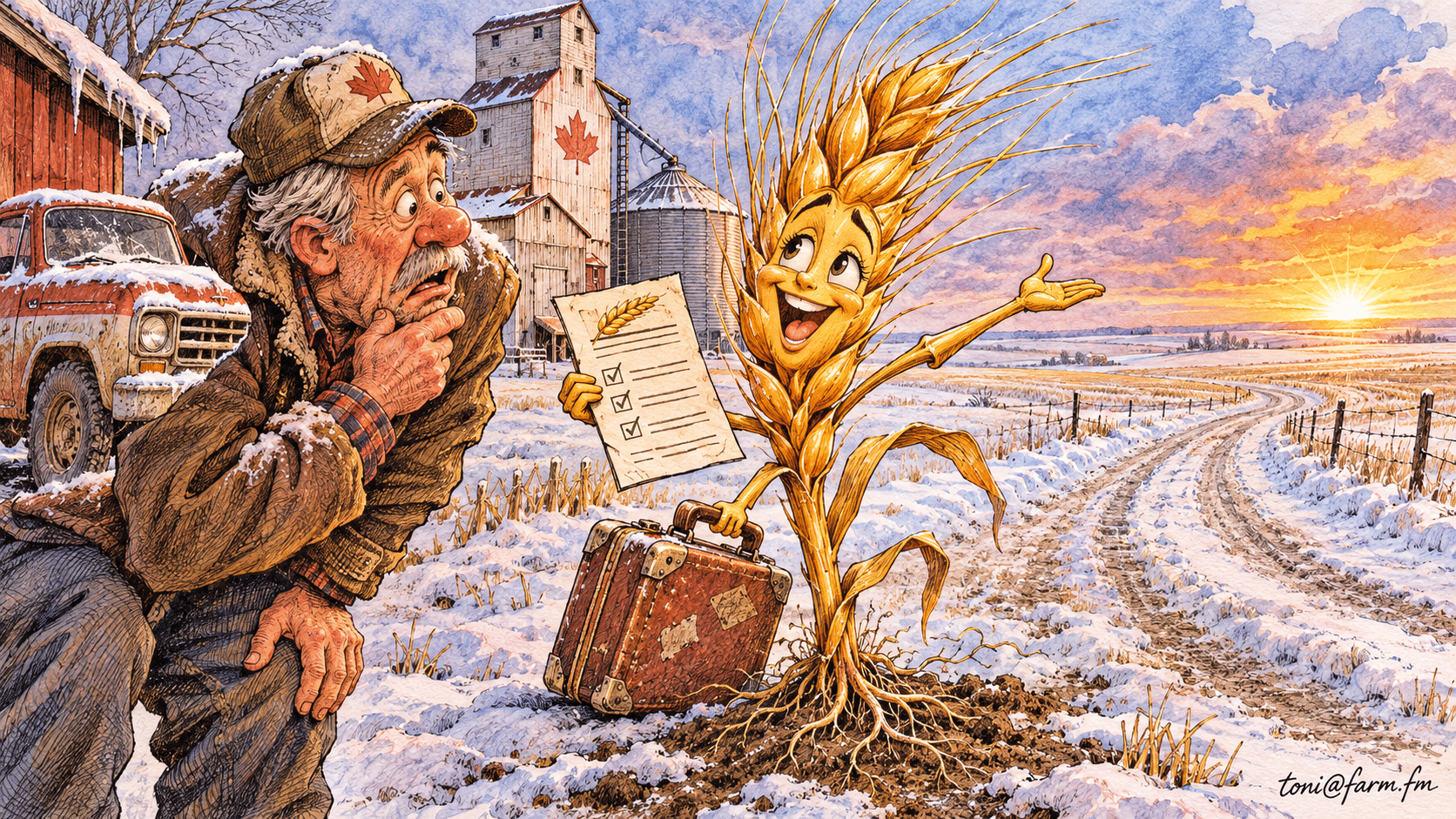
Prairie crop updates résumé after discovering national research discussion has lasted longer than several farm dogs.
SASKATOON — A stand of Canadian wheat has begun discreetly investigating opportunities overseas after learning that discussions about the future of plant breeding have entered their fourteenth year without establishing whether anyone intends to pick up the cheque.
The wheat confirmed it remains committed to Canadian agriculture but has reached the stage in its career where commitment should occasionally include resources.
“I’ve given this country everything,” said a representative stalk identified as Number 47. “Protein. Yield. Straw. An extremely flattering appearance on government brochures. At some point, I’d like somebody to invest in my children.”
The concern follows a RealAg Radio discussion about Canadian plant breeding investment, during which panellists described a funding conversation stretching back roughly fourteen years and questioned how Canada would maintain its competitiveness.
Number 47 said it had initially mistaken the lengthy discussion for a breeding programme.
“There were experts, charts and a room with coffee,” the stalk explained. “From the field, those things look encouraging.”

Wheat Requests References From Previous Growing Seasons
The crop’s résumé lists extensive experience surviving drought, disease pressure and presentations explaining that agriculture is the foundation of the economy.
Under professional achievements, it includes feeding people.
Under compensation expectations, it includes “some indication this is going somewhere.”
A recruitment adviser recommended removing the phrase “willing to grow” because employers generally assume that of wheat.
The adviser also suggested replacing “standing in a field waiting” with “maintaining a strong regional presence.”
“That one helped immediately,” Number 47 said. “Apparently, I’ve had a leadership position for years.”
Its references include a combine operator, a grain grader and a neighbouring crop that has asked to remain anonymous until its own negotiations are complete.
The farmer responsible for the field, Dennis Kettle, said he first suspected something when several wheat heads began leaning toward the border despite a prevailing wind from the opposite direction.
“I thought it was lodging,” Kettle said. “Then I found a cover letter.”
Fourteen-Year Discussion Now Eligible for Summer Employment
At a regional stakeholder meeting, delegates celebrated the funding discussion’s maturity by noting it was now old enough to complain that nobody understood it.
A commemorative cake featured fourteen candles and the words “Who Pays?” in icing.
Nobody cut the cake because responsibility for the knife had not been established.
Meeting chair Lenora Binder said the conversation had made considerable progress since its earliest stages.
“Fourteen years ago, we were asking whether we needed a plan,” she explained. “Today, there is broad agreement that the need for a plan should be reflected in the next planning discussion.”
Binder rejected suggestions that the process had stalled.
“We’ve changed venues twice.”
An internal review found that 96.3 percent of participants supported innovation. Support declined sharply when innovation was described as an expense rather than an aspiration.
The review classified this as a communications challenge.
Kettle classified it as somebody ordering supper and leaving before the bill.
Research Priorities Survive Extensive Research Into Priorities
Delegates agreed that future wheat should produce more grain, resist more diseases and tolerate more difficult conditions.
The wheat asked whether anyone had considered helping.
That intervention was recorded as stakeholder feedback.
A breakout group then examined whether “helping” belonged under strategic investment, industry participation or an appendix.
By the afternoon, the group had developed a working definition:
Investment: money that all participants agree would be highly beneficial if supplied by another participant.
The definition received unanimous support.
Number 47 said this was the first trait the entire room had successfully selected.
“They’ve developed complete resistance to financial responsibility,” it observed. “If we could transfer that into wheat, we’d never lose another acre.”
The proceedings concluded with a photograph of delegates holding ceremonial shovels.
Kettle asked whether the shovels would be used.
Organisers explained that the ground was symbolic.

Crop Investigates Countries With Functioning Follow-Through
The wheat’s overseas search has focused on jurisdictions where a statement beginning “we must remain competitive” is occasionally followed by a budget.
Number 47 declined to name particular destinations, citing the sensitivity of negotiations and its inability to operate a telephone.
Its wish list is modest: research continuity, a plausible route from experiment to field and somebody who recognises that a decade is a meaningful portion of a farmer’s working life.
“I’m not asking for a corner office,” the stalk said. “A corner of a funded trial plot would be lovely.”
A foreign recruiter reportedly asked where the wheat saw itself in five years.
“Still being discussed, if I stay here.”
The recruiter described that answer as unusually clear.
Back on the farm, Kettle admitted he understood the crop’s frustration.
His youngest daughter had started primary school around the time the funding conversation began. She now helps him interpret university application forms.
“The discussion has had more educational opportunities than the wheat,” he said.
Consultation Industry Reports Excellent Growing Conditions
Although the crop’s outlook remains uncertain, businesses supplying conference badges, sandwiches and retractable banners reported strong demand.
One banner manufacturer said “Securing Our Agricultural Future” remained a dependable seller because customers could reuse it indefinitely.
“We offered to print a completion date,” he said. “Nobody wanted to limit the product’s lifespan.”
A conference economist calculated that the plant breeding discussion had generated substantial activity per acre of meeting carpet.
Its contribution to the sandwich economy was described as measurable.
Its contribution to improved wheat remained under review.
Binder cautioned against judging the process solely by agricultural results.
“You have to consider relationships,” she said.
Kettle agreed that several people had developed remarkably durable relationships with the same unresolved question.
Farmer Attempts Direct Negotiation With Wheat
Concerned about losing the crop, Kettle walked into the field carrying a thermos and a proposal.
He promised to keep advocating for research, attend fewer meetings that ended with another meeting and ask harder questions whenever somebody announced a vision.
Number 47 appreciated the gesture but requested something in writing.
Kettle produced a notebook.
The wheat asked whether it was another consultation document.
“No,” he said. “It’s the list of things I actually need before planting.”
For the first time that week, the crop straightened.
The list contained better disease resistance, dependable seed availability and a research system that could continue working while adults discussed how to pay for it.
Nobody had included a slogan.
“That’s a very unconventional document,” Binder said after reviewing it. “It begins with the problem and ends with things somebody would have to do.”
She recommended a preliminary engagement phase.
Wheat Agrees to Stay Through Harvest
Following negotiations, the crop agreed to remain in Canada until harvest, subject to weather, market conditions and no further requests to describe uncertainty as an exciting opportunity.
Number 47 said it had not abandoned the country.
It had simply begun distinguishing between being valued and being featured in a speech.
Kettle returned to the yard and found an invitation to another plant breeding forum.
The theme was “From Conversation to Action.”
He turned the invitation over.
There was no budget on the back either.
Fifteen Observations From the Field
- The plant breeding discussion is old enough to need its own succession plan.
- Canadian wheat has deep roots and increasingly shallow patience.
- Fourteen years is a long time to keep saying “early discussions.”
- The crop wants genetic improvement; the committee wants another room.
- Every research priority becomes less urgent when it reaches accounts payable.
- Conference sandwiches have benefited from remarkably consistent investment.
- The wheat’s résumé contains more completed work than the strategy.
- A vision document is a crop plan without the uncomfortable purchasing stage.
- The strongest trait selected so far is resistance to paying.
- Wheat can survive winter; it struggles with perpetual spring announcements.
- Stakeholder engagement is excellent until someone gets engaged to an invoice.
- The banners remain reusable because the future never arrives.
- The crop would like to move forward without attending a workshop about it.
- “International competitiveness” sounds expensive once you remove the microphone.
- The wheat isn’t leaving Canada; it’s diversifying its exposure to follow-through.
Disclaimer
This is satire inspired by RealAg’s reporting. The speaking wheat, recruitment process, meeting proceedings and survey are comic inventions. The world’s oldest tenured professor and a philosophy major turned dairy farmer are still negotiating which one must water the consultation document.