
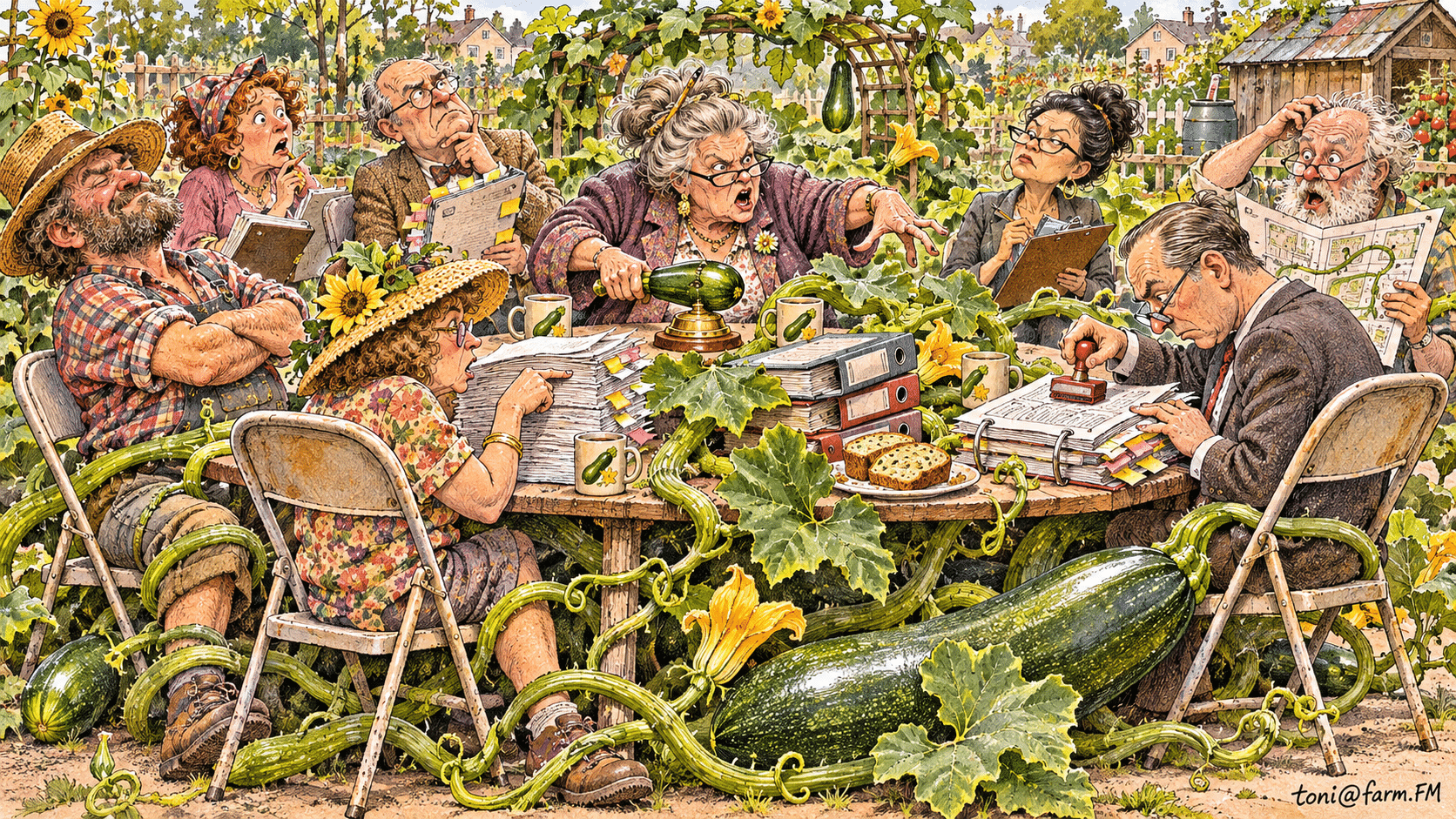
MINNEAPOLIS — The Juniper Street community garden has completed six meetings on whether a zucchini plant occupies excessive space, during which the zucchini occupied the space previously used for meetings.
Committee chair Lenora Finch said the process remained productive. Groundskeeper Walt Beeman said the same about the zucchini, although only one of them had supplied anything for dinner.
“We cannot rush a decision with this many stakeholders,” Finch said, removing a leaf from the attendance sheet. Beeman counted the stakeholders as twelve gardeners and one increasingly confident vegetable.
Community Garden Discovers a Fast-Growing Constituency
The dispute began when plot holder Evan Root planted one zucchini beside a border whose legal standing was defined by a piece of string. The plant treated the string as a suggestion.
Meeting one established a working group. Meeting two debated the phrase “encroachment.” Meeting three ended early when members found three more squash. These were added to the agenda and subsequently to several car seats.
Real University of Minnesota Extension guidance on growing summer squash and zucchini gives gardeners practical information on managing the crop. The committee preferred to begin with a values statement.
Root argued that healthy plants should be encouraged. His neighbour asked whether encouragement could occur on Root’s side of the path. A mediator proposed referring to the path as a shared opportunity.
The Evidence Arrives in Several Wheelbarrows
A Farm.FM inspection found the plant shading a bench, touching a hose reel and participating in the refreshments area. Its estimated political influence had doubled since the previous inspection, a figure based entirely on how many members were now holding zucchini.

Beeman offered direct evidence: a photograph of the garden entrance before the vine and a photograph after it. Finch rejected the comparison because the lighting differed.
Neighbourhood opinion divided into three groups: people requesting limits, people defending biodiversity, and people locking their cars to prevent unsolicited squash donations.
“Someone left two on my porch,” resident June Larkin said. “I put them out with a free sign. Somebody took the sign and left another zucchini.”
The committee defined equitable access as ensuring every gardener had an equal chance to trip over the same vine. A proposal to harvest the squash promptly was tabled pending a decision on whether harvesting prejudged the discussion.
Democracy Eventually Produces Soup
Beeman suggested clear plot rules, sensible spacing and regular attention to the plants. Everyone agreed those were useful ideas and requested that he submit them through the suggestion process.
By meeting six, the zucchini had reached the folding chairs. Members voted to relocate the meeting to a café, where they ordered zucchini bread and praised the importance of local food.
The final resolution permits the plant to remain until the end of its productive period, subject to weekly monitoring and a prohibition on further committee expansion.
Finch called the outcome a triumph of collective governance. Beeman loaded another basket. The zucchini had already begun growing toward the café.
Satirical field note: Committee arithmetic and zucchini political influence are jokes. For the world’s oldest tenured professor and a philosophy major turned dairy farmer: the minutes may be composted after approval.