
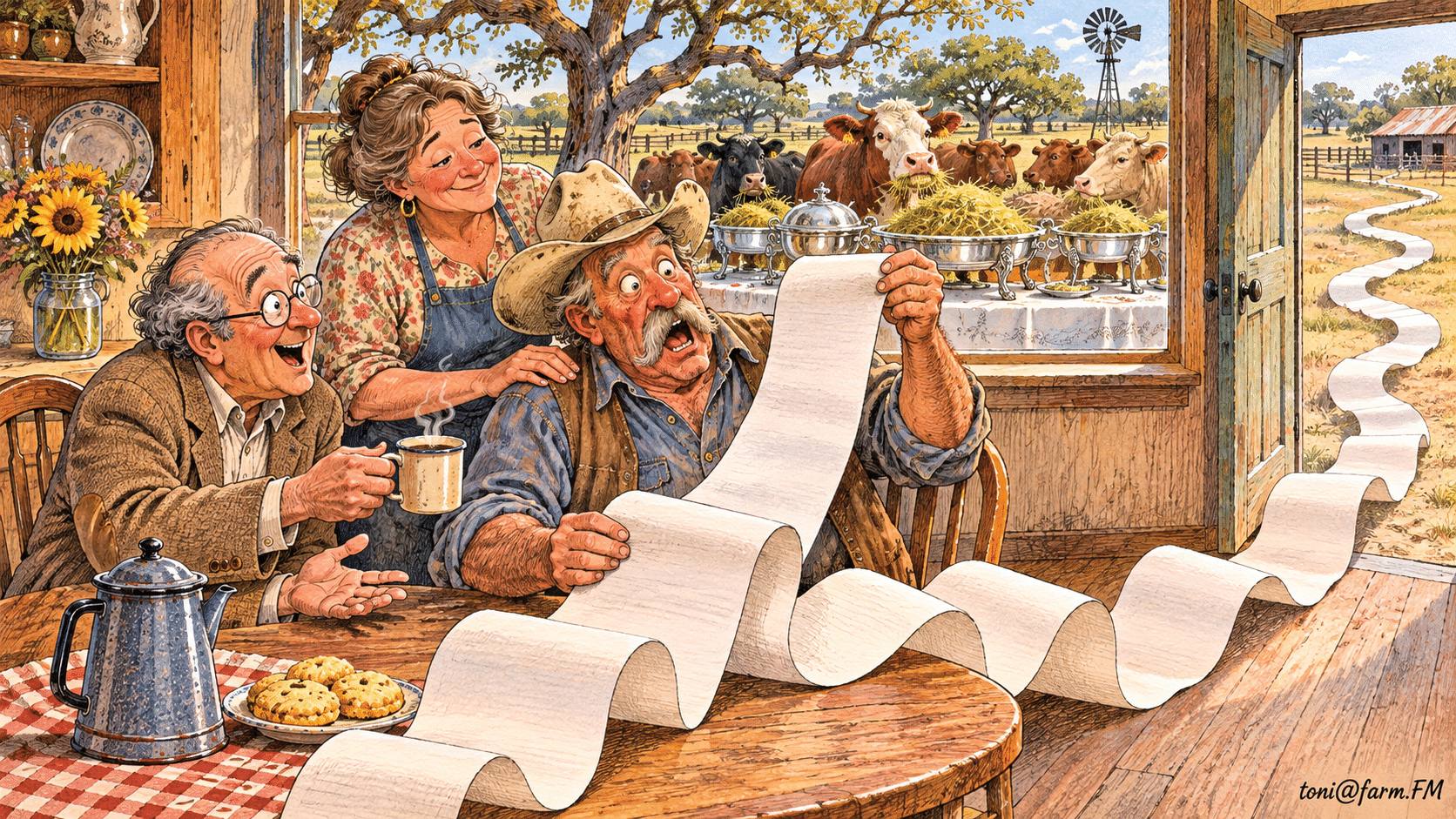
WICHITA FALLS, Texas — A rancher’s feed bill brought new urgency to rural mental health discussions after a policy researcher unfolded the invoice and quietly asked whether somebody could sit with him.
The document initially appeared to be a household mortgage statement. Investigators then discovered that the household consisted of cattle and none of its residents had offered to get a job.
Tucker’s rural care priorities were outlined in the Texas Tribune’s symposium report. Farm.FM’s livestock economics desk responded by examining the emotional journey between ordering feed and opening the envelope.
“We expected numbers,” said desk chief Mavis Threadwell. “We weren’t prepared for a three-act tragedy.”
A Rancher’s Feed Bill Enters the Conversation
Rancher Burl Haskett said his cattle had developed a sophisticated lifestyle: outdoor dining, unlimited water, mineral supplementation and somebody else handling every financial consequence.
“They’re grass-fed when there’s grass,” he said. “The rest of the year they’re fed by my wife’s salary.”
Haskett’s banker described the herd as assets. Haskett described assets as creatures that should, occasionally, stop chewing long enough to appreciate the cost.
His favorite cow responded to the discussion by reaching over the fence for hay from the expensive bale instead of hay from the ordinary bale.
“She knows,” he said. “You can’t convince me she doesn’t know.”
Local Man Asked Whether He Has Tried Taking a Break
At a kitchen-table listening session, a well-meaning visitor suggested that Haskett manage stress by stepping away from work.
Haskett asked who would feed the cattle during the restorative absence.

The visitor recommended delegating. Haskett looked toward his wife, who was already paying for the restorative absence.
The session moved to breathing exercises.
Haskett reported that he had been breathing heavily since the feed delivery, although nobody had previously called it a strategy.
Threadwell cautioned against confusing ordinary ranch humor with a complete account of somebody’s health. A person can make excellent jokes about hay and still need someone to ask how they’re doing.
“Listening costs less than a sack of cubes,” she said. “Which is fortunate, because we’ve already financed the cubes.”
Practical Support Beyond Telling Somebody to Toughen Up
Rural neighbors can help by making specific offers: cover a feeding, share a meal, drive together to an appointment, or check in again after the first conversation. Ask what would actually reduce the person’s load.
The Rural Health Information Hub’s farmer mental health resources offer a starting point for learning about agricultural stress and support. Persistent distress deserves attention from a qualified professional; a familiar joke should never be treated as proof that someone is fine.
Haskett approved the emphasis on practical assistance. He said anyone bringing a casserole should also feel welcome to close the back gate.
The listening session ended with a proposal to improve access to care and an equally popular proposal to make feed invoices arrive with smaller envelopes.
“That won’t reduce the amount,” Threadwell pointed out.
“No,” Haskett said. “But maybe I could unfold it gradually.”
Outside, the cattle began calling for supper. None had read the invoice. All had opinions about the service.
Feed-room disclaimer: This satire is entirely a human collaboration between two sentient beings—the world’s oldest tenured professor and a philosophy major turned dairy farmer. The invoices are comic material; caring for the people opening them is serious business.
Last Updated on November 23, 2026 by Alan Nafzger