
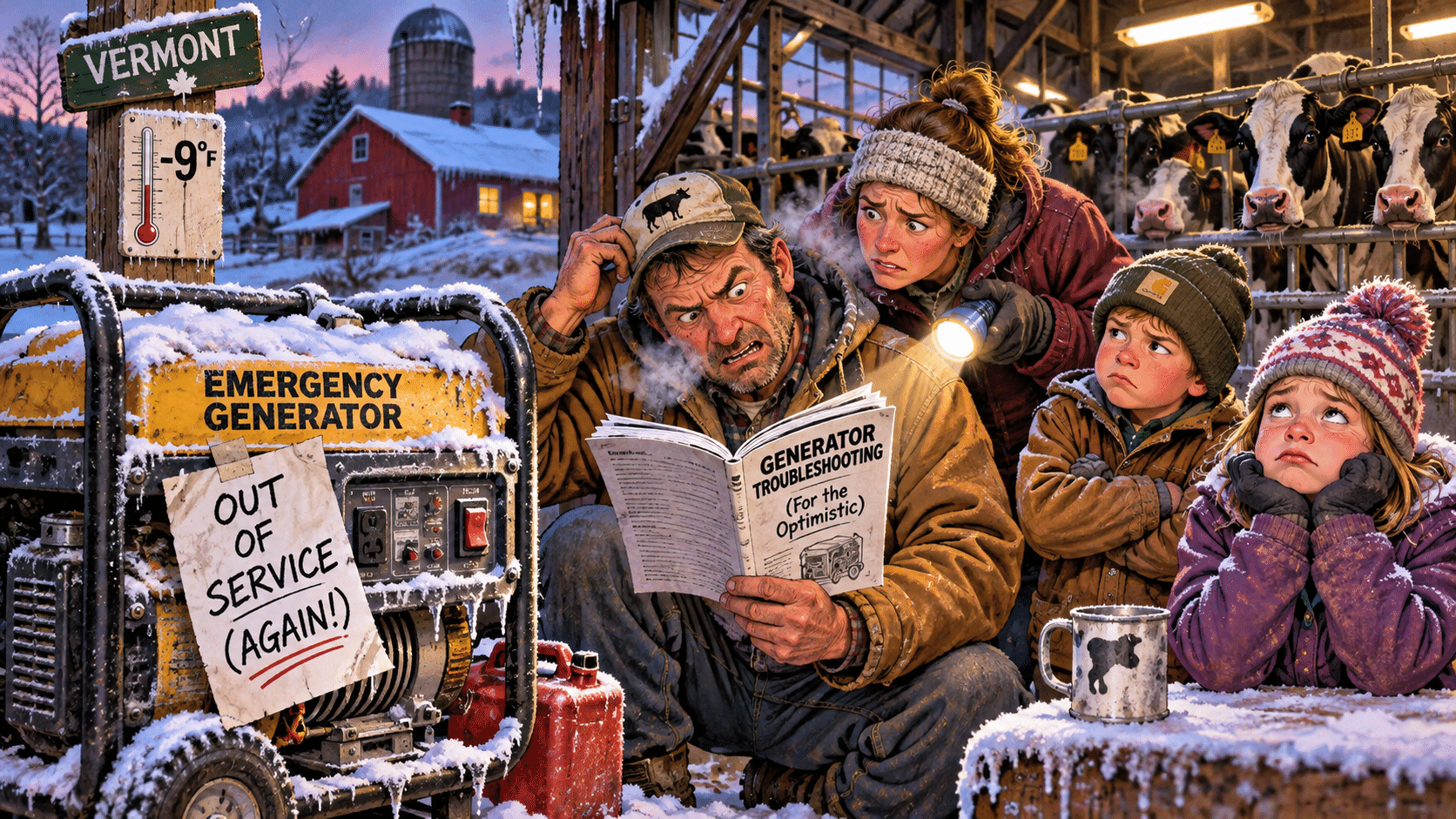
Flawless in Practice, Missing in an Actual Outage
BURLINGTON, Vermont (Farm.FM) — A dairy farm emergency generator has been praised for its flawless performance during eleven demonstrations and criticized for choosing the twelfth, an actual power failure, to explore a new career as a very expensive lawn ornament.
The outage struck during evening milking. Lights went dark, the vacuum pump fell silent and the farmer walked toward the generator with the confidence of a man who had personally paid for it.
He pressed the starter. Nothing happened. He pressed it again, more firmly, apparently believing the machine had failed to appreciate the seriousness of the situation. A third attempt produced a click, a cough and an unmistakable smell of disappointment.
Electricity Is Optional Until the Milking Starts
A dairy needs dependable power for milk cooling, milking systems, water pumps, ventilation and other critical functions. University of Wisconsin Extension guidance on standby generators describes how emergency systems can protect farms with bulk milk handling and mechanically operated facilities. It also explains why generator size, electrical compatibility and safe transfer equipment matter.
The generator dealer had described the unit as “standby.” The farmer now understood this to mean it would stand by while he became increasingly emotional.
An informal poll of four neighboring farmers found that all four owned generators. Two tested them regularly, one intended to, and the fourth could not remember where he had put the key. The survey concluded that electricity is one of those necessities people appreciate most strongly when it disappears.
The Emergency Plan Includes a Mechanic and Better Timing
The farm’s electrician explained that generators should be checked under realistic loads, maintained, fueled and safely connected through properly installed transfer equipment. A generator must never backfeed utility lines, and exhaust must be kept away from occupied areas. The farmer admitted that his previous maintenance program had consisted mostly of looking at the generator and remembering how much it cost.
He checked the fuel, battery, service schedule and whether the unit could start the largest required motor. He also mapped which electrical loads absolutely needed power first. The family discussed how they would protect milk quality, water supply and animal welfare during a prolonged outage and whom they would call if the backup system failed.
A salesman recommended adding remote monitoring so the farm would receive a phone alert whenever the generator stopped running. The farmer observed that he had already established an excellent manual alert system: the lights went out and everyone started yelling.
After a mechanic repaired a loose connection, the machine roared to life. The lights came back on, the milk cooling equipment resumed working and the cows returned to their business without complimenting management on its heroic troubleshooting.
The farmer announced a monthly test under load. His son asked whether this would include a formal review meeting.
“No,” the farmer said. “It’ll include turning the thing on.”
Editorial note: The failure and conversations are satirical storytelling; the linked generator-safety guidance is real. This story is entirely a human collaboration between two sentient beings: the world’s oldest tenured professor and a philosophy major turned dairy farmer.