
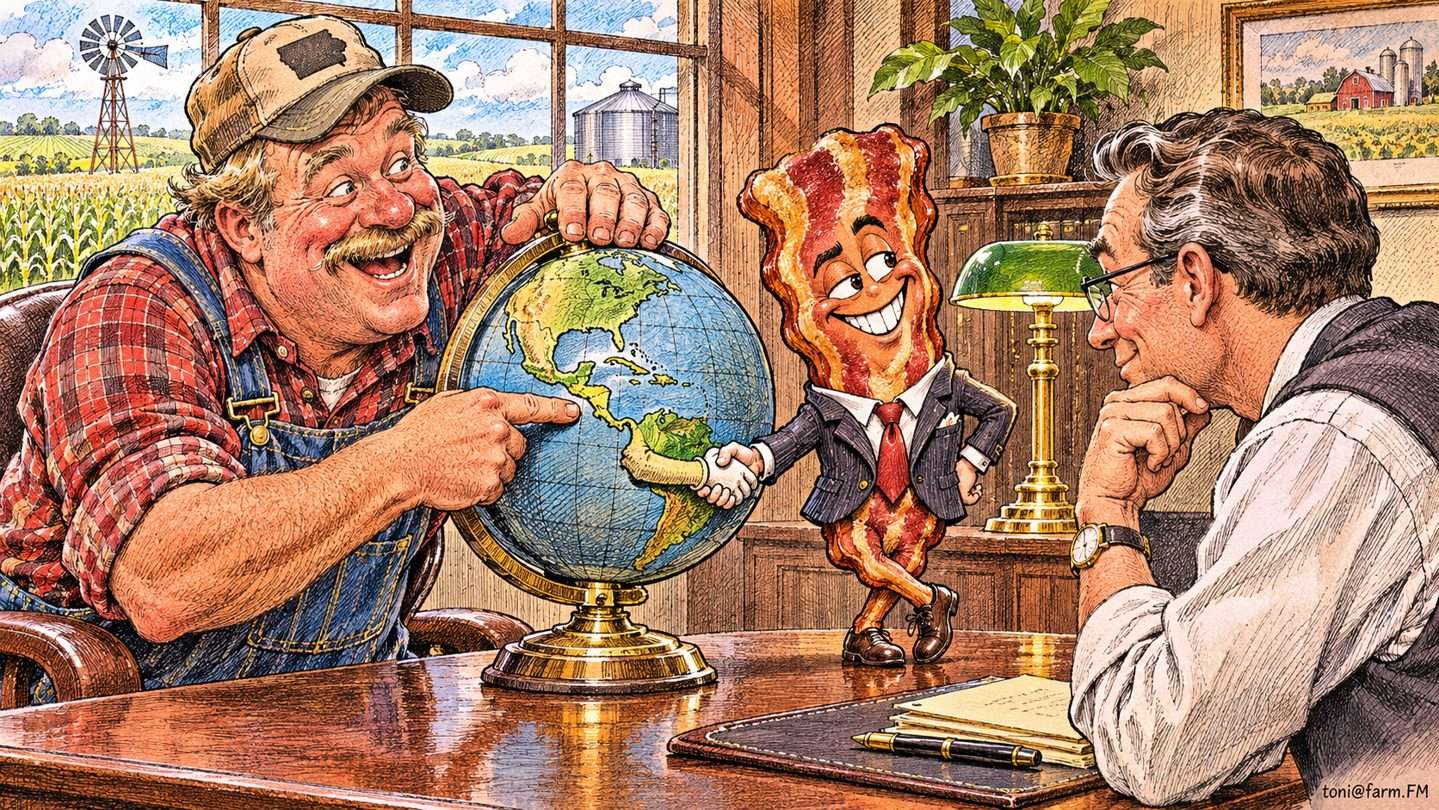
CARROLL, Iowa — Iowa hog producer Paula Senn brought a globe to a loan review after reading that Central America remained on a record pace for U.S. pork imports. The loan officer asked whether she had brought a guarantor. Senn turned the globe slowly, stopped at Guatemala, and said the people she would like to introduce had been a little hard to schedule in person.
“If they’ll let a market move the needle,” Senn said, “I don’t see why I shouldn’t be allowed to bring the market into the room.”
Pork Exports Give the Bank Meeting a Geography Lesson
The U.S. Meat Export Federation’s September trade report described weaker overall U.S. pork exports and strong results in Central America. Its report highlighted a particularly large September shipment volume to Guatemala along with growth in several nearby markets. Senn took heart from the details until the banker reminded her that her agreement was with the buyer named on her settlement.
Senn acknowledges that a market abroad cannot sign her loan packet. She was nevertheless pleased that her banker spent an entire minute looking at a map instead of at the line for building repairs. While he was distracted, she turned the globe again and found several more places where she was suddenly in favor of economic growth.
Neighbor Tom Covey had tried a similar approach with a chart from an industry meeting. The chart looked good. His wife asked which direction he had to turn it to see the bill for feed. He said it was laminated and she could look at it any way she liked.
“I told the banker we had a diversified outlook,” Covey said. “He told me I had one checking account.”

A Good Export Market Still Has to Reach the Farm
Demand abroad can matter for the value of different products, including cuts that have different markets at home and overseas. It is one part of a much larger picture for a producer. Senn keeps the industry reports beside her own records, where actual sale terms, expected delivery dates and cash expenses are easy to locate. She says this has improved the bank meetings considerably, although the banker is still unwilling to initial the globe.
Hog farmer Reina Foster said the best useful question after hearing a hopeful market story is whether it changes any decision on the farm. She asked her husband to answer it after he sent her four articles before breakfast. He concluded it changed one decision. He was going to leave the phone in the pickup until coffee was ready.
“I can appreciate Guatemala from Iowa,” Foster said. “What I can’t do is make Tuesday’s feed delivery wait until all the appreciation has cleared.”
Senn left the bank with a list of figures to bring next time. The banker asked if he could borrow the globe for his son’s school project. Senn said yes, provided it came home with something written under references.
Farm.FM satire disclaimer. The globe was accepted as a visual aid and declined as collateral.