
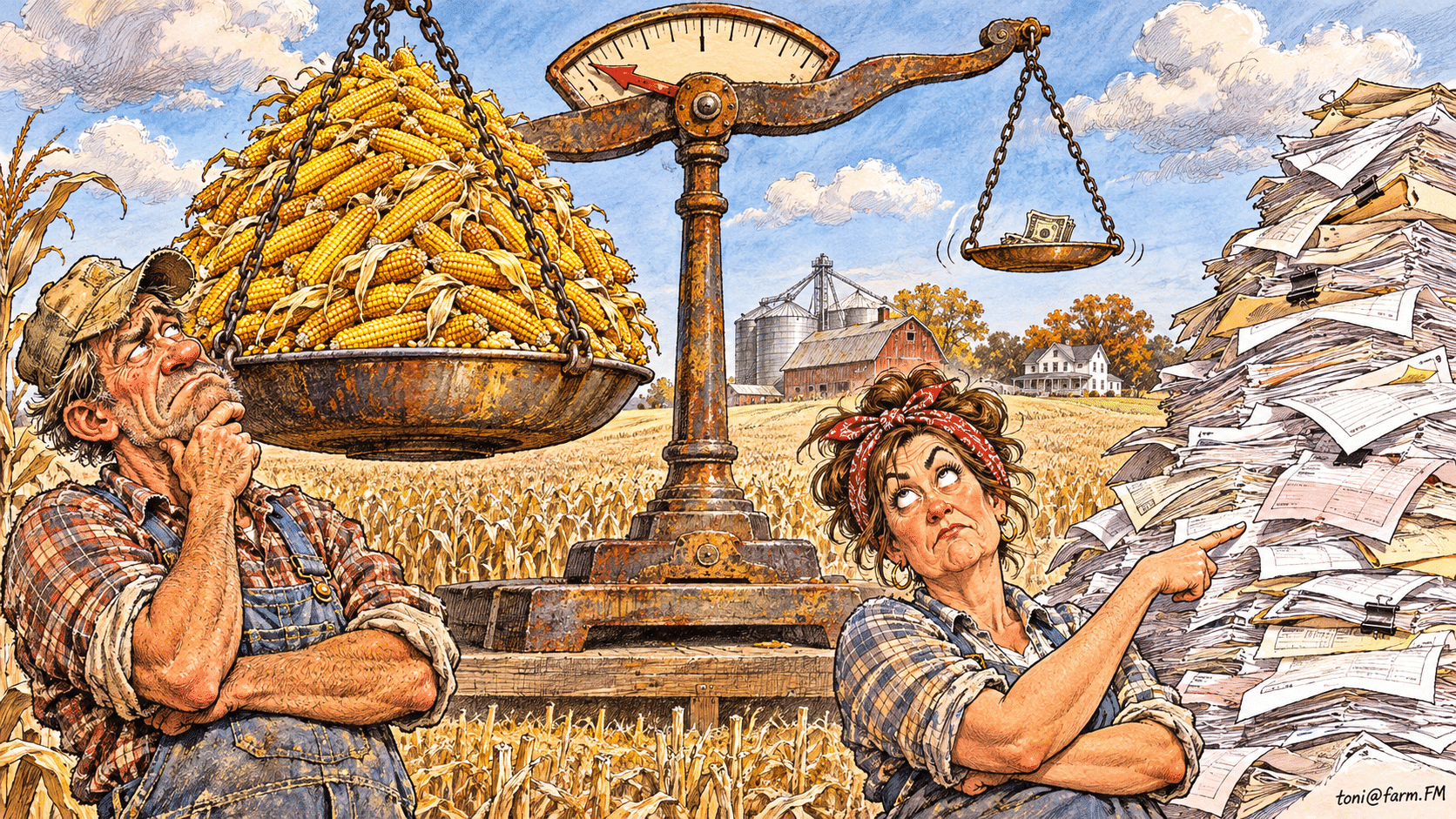
DES MOINES, IOWA — America’s corn growers are celebrating a historic agricultural achievement: the federal government has discovered they are capable of producing less of something other than disposable income. The celebration began after the USDA reduced its November corn harvest forecast by 141 million bushels, proving that even a disappointing harvest can finally bring farmers a number smaller than their annual headaches.
USDA Corn Harvest Forecast Shrinks; Farm Expenses Refuse
According to the USDA November Crop Production report, the 2026 corn crop is forecast at roughly 15.893 billion bushels. Average yield fell to 179.6 bushels per acre. That is still an enormous pile of corn, but in farm accounting, “enormous” describes both the harvest and the pile of bills sitting on the kitchen table.
“I’ve waited my whole life for an agricultural number to go down without it being my checking account,” declared fictional Iowa grower Pete Larkin, briefly interrupting his morning ritual of calculating how many kernels he must sell to afford a replacement tire.
Bankers Demand Proof Farmers Are Enjoying Themselves
Larkin’s wife, June, showed reporters their operating statement. The fertilizer bill occupied three pages, the equipment note four, and the section marked PROFIT had become a convenient place to test whether the printer still had ink.
“Everybody wants to talk about the corn yield,” June said. “I’d like somebody to explain the miracle where the dealer can sell a tractor worth more than our house, then call us irresponsible for needing financing.”
The local banker, who requested anonymity because he is still calculating interest on the interview, reportedly offered the couple a celebratory balloon. It was repossessed before it reached the ceiling.

Unscientific Farm Poll Finds Universal Agreement
Farm.FM conducted its customary research by asking six men outside a feed store whether lower production was good news. Five replied, “Depends what the price does.” The sixth wanted to know whether the question came with coffee. Our margin of error is approximately the width of a combine header.
Market analysts noted that the reduced estimate might support prices, an important distinction: fewer bushels do not automatically mean less revenue, and a higher price does not automatically mean a positive margin. Farmers have been studying this relationship for generations, generally while sitting in equipment they do not yet own.
Next USDA Report Expected to Confirm Farmers Still Need Money
In West Texas, Clyde “Straight Row” Mercer reviewed the numbers and proposed a new agricultural index: dollars left after paying everyone who supplied the crop. “A yield report measures what grew,” Mercer said. “A profit report measures what survived the trip through the banker, the fuel truck and the parts counter.”
For now, growers are enjoying a rare piece of economic optimism. The harvest forecast got smaller. The bills did not. And somewhere in the Corn Belt, an accountant has finally found an agricultural success story that fits in the red column.
Satire note: The farmer interviews and feed-store survey are comic inventions. This story is entirely a human collaboration between two sentient beings: the world’s oldest tenured professor and a philosophy major turned dairy farmer.