
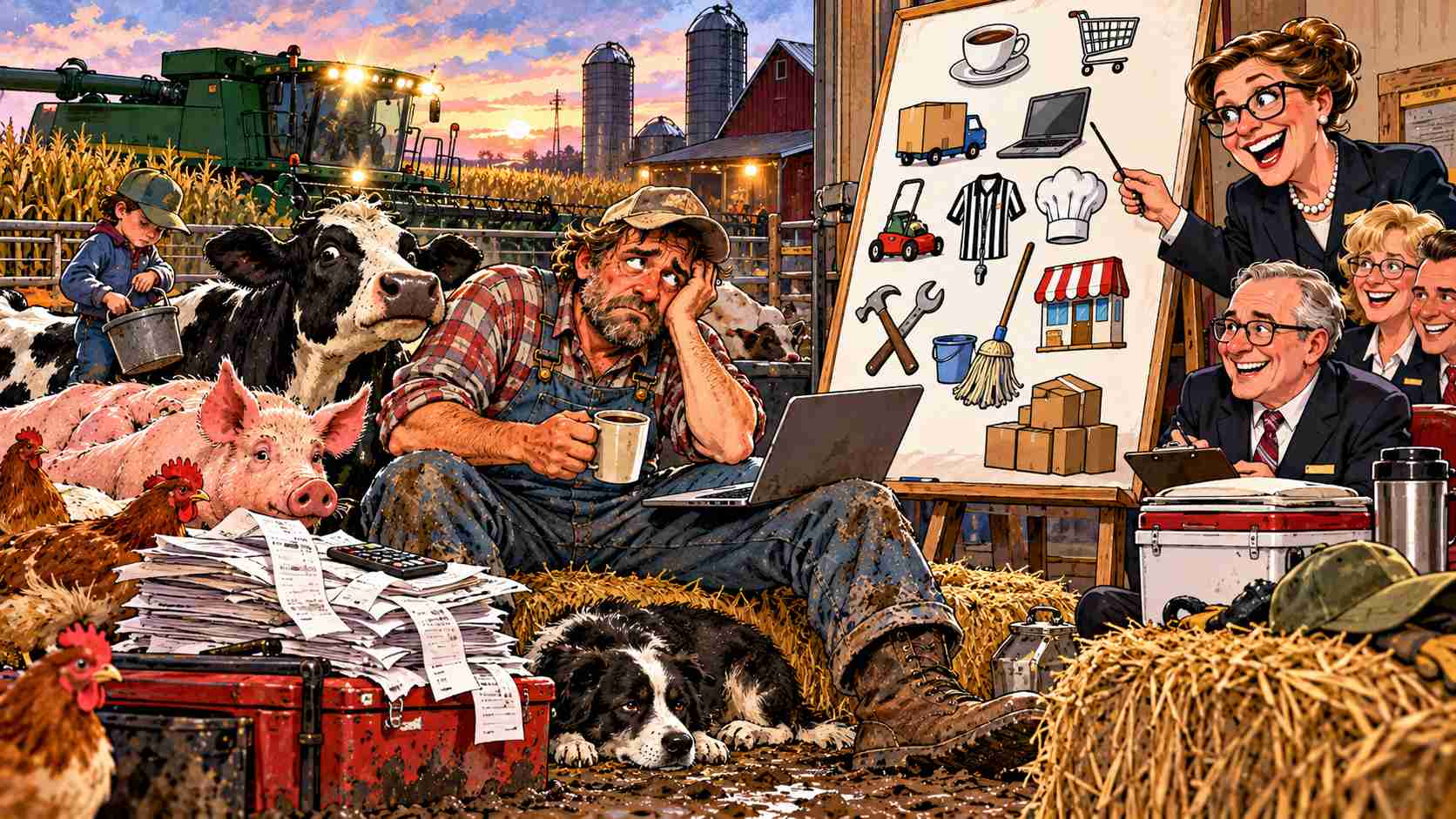
Selling corn below cost is not a business model. It’s charity with tractors.
DES MOINES, Iowa — American farmers have achieved the seemingly impossible: growing enough corn to feed a continent while struggling to afford lunch. Economists call this an agricultural productivity success. Farmers call it Tuesday.
Every autumn, a combine rolls across the Midwest, pours another mountain of grain into a truck, and produces the same financial result as setting a stack of hundred-dollar bills on fire, except the combine uses more diesel.
The difference between a farmer and a magician is simple. A magician pulls a rabbit out of a hat. A farmer puts $900 into an acre, pulls out $850, and is congratulated for producing a record number of rabbits.
USDA Farm Income Forecast: Congratulations, You’ve Grown Yourself Broke
The USDA’s September farm income forecast expects total crop cash receipts to climb in 2026. It also forecasts production expenses across agriculture rising to $492.8 billion, up 4.5 percent. That’s like being told your paycheck went up the same week your landlord bought the printing press that makes the bills.
The national figures include profitable operations and struggling ones. They do not mean every corn grower is losing money. But averages are wonderfully comforting when the person reading them doesn’t have a land payment due Friday.
The University of Illinois farmdoc daily crop budgets make the point in a tidier way: even with expected ARC/PLC support counted, average 2026 returns for corn come out negative in every Illinois region. Nobody in the department has been invited to explain this at a county fair.
Take a farmer in central Iowa. He spends the spring buying seed, fertilizer, chemicals, fuel and equipment repairs. He works through drought warnings, machinery breakdowns and a weather forecast apparently supplied by a drunk roulette wheel. In October, he harvests a beautiful crop.
The banker asks, “Did you make money?”
“I made corn.”
“That wasn’t the question.”
“It was the only thing I was guaranteed to make.”
This distinction has reportedly baffled economists, who assume that if you produce more of something, you must become wealthier. By that logic, a man digging himself into a hole should eventually own a mountain.
Corn Prices vs. Cost of Production: A Nobel Prize for Counting Bushels
In Washington, analysts discuss yields, acreage and carryover stocks with the enthusiasm of people who have never sat inside a broken combine after sunset. USDA even corrected its September 2026 corn estimates after identifying a processing error. Farmers appreciated the correction, although correcting a spreadsheet is cheaper than correcting a harvest.
At an economics conference last month, three proposals were offered for farm prosperity: plant more acres, increase output and become more efficient. The fourth proposal, “pay farmers enough to cover costs,” was dismissed for lacking a PowerPoint transition.
The room then awarded itself a grant to study why its first three proposals weren’t working.
Farmers, meanwhile, have landed on a simpler theory. If every producer responds to low prices by growing more, the result can be more supply chasing the same buyers. The individual farmer needs volume to survive, and collectively the farmers may push prices down. It’s a business meeting where everyone brings extra chairs and nobody brings customers.
Farm Economy Advice From People With Salaries
The farmer’s wife has a second job, the tractor has a third mortgage, and the family dog is considering grain futures. Yet a television commentator explains that agriculture needs to “embrace innovation.”
“I embraced innovation,” the farmer replies. “The dealership sent me a bill for $180,000.”
America can celebrate abundant food and still ask whether the people producing it are earning a sustainable return. A record harvest is a remarkable achievement. A record harvest that doesn’t cover the bills is a remarkable warning.
The final insult arrives when somebody calls farmers lucky because they get to work outdoors.
So do people directing traffic around a sinkhole. Nobody tells them to be grateful the hole is getting bigger.
Evidence From the Co-op Scale House
Notice posted inside the Prairie Valley Co-op scale house
ATTENTION PATRONS. Effective immediately, grain will be accepted at the pit from 6 a.m. to 9 p.m. Patrons waiting in line longer than four hours may request a folding chair. Patrons waiting longer than eight hours may request a folding chair and a counselor. The co-op reminds producers that settlement checks are issued within five business days and that the co-op is not responsible for what the settlement check says.
Text messages, 9:47 p.m., farmer to loan officer
Farmer: Harvest is done. 214 an acre. Best crop I ever raised.
Loan officer: Congratulations!!
Farmer: Do I still owe the operating note on the 15th
Loan officer: Yes
Farmer: Good. Wanted to make sure the best crop I ever raised hadn’t changed anything.
Loan officer: It has not.
Five Observations on Growing Too Much
- Farming is the only job where “record year” is a threat. Nobody walks into a bakery and hears, “Bad news, we sold too many cakes. Hide the good knives.”
- The government says produce more, you’ll be richer. Great advice. I’m going to dig a bigger hole and wait for the mountain.
- A farmer plants in April, prays in July, harvests in October, and in November a guy in a nice sweater tells him he had a “strong supply year.” Strong for who? My checking account is lifting nothing.
- “Embrace innovation.” I did. It had a financing plan and a cup holder, and it still doesn’t plant itself.
- They tell you you’re lucky to work outdoors. So is the guy who stands in the rain waving cars past a sinkhole. Nobody’s throwing him a parade.