
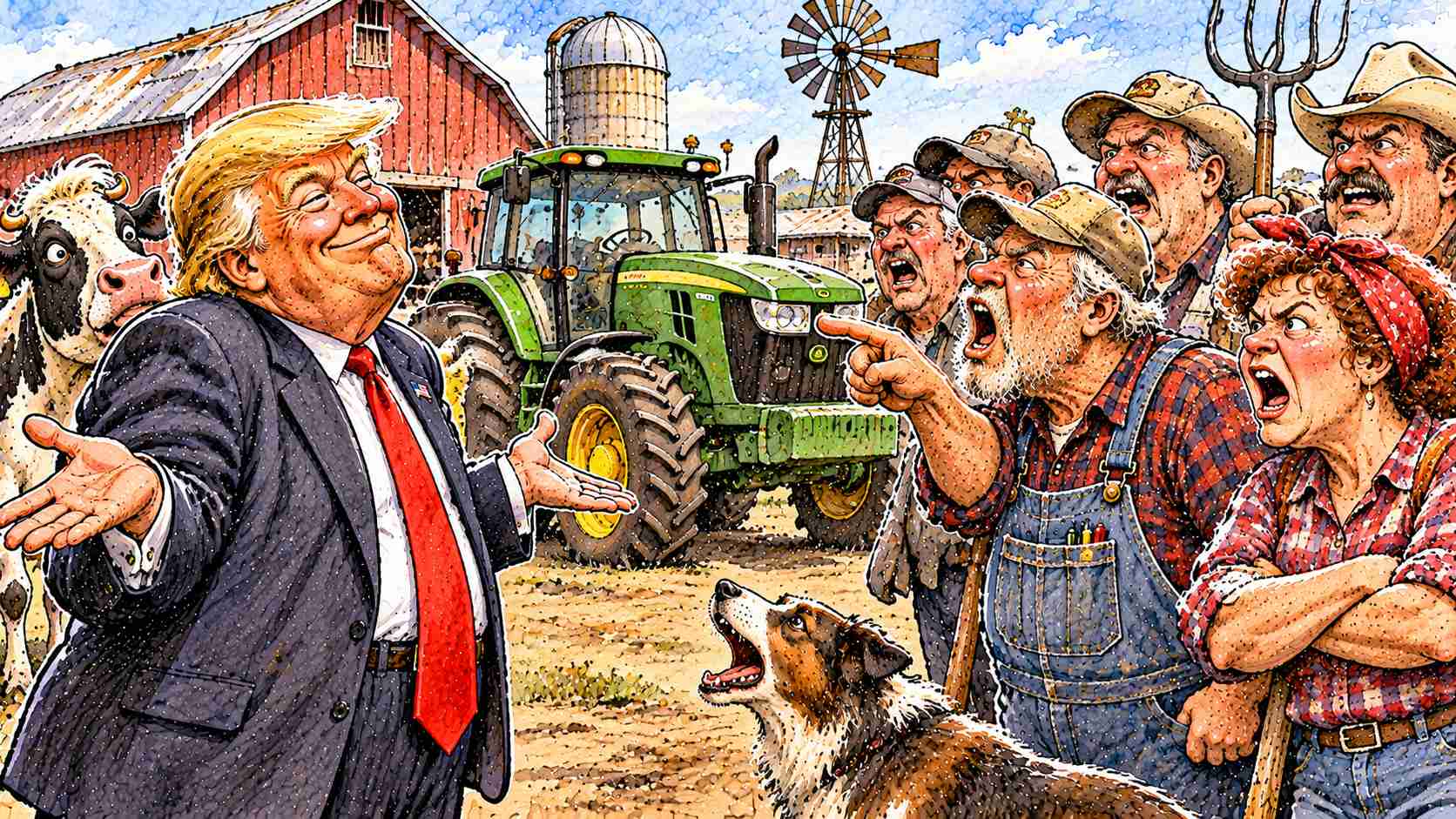
Farmers Remember the Good Times, Prefer Affordable Diesel
SIOUX CITY, Iowa — Donald Trump’s long political romance with rural America has entered a difficult new phase after farmers began demanding economic results instead of emotional reassurance. The relationship once appeared indestructible. Trump attended agricultural rallies. Farmers cheered. Politicians climbed onto tractors for photographs. The tractors, understandably, never expressed an opinion.
Now Republican campaign consultants are confronting a troubling possibility: Farmers may have developed expectations beyond being repeatedly told how wonderful they are.
One Iowa farmer compared the relationship to dating a man who constantly promises to take you somewhere expensive but never pays for dinner.
“Eventually, you start checking whether he’s got his wallet.”
The trouble began when the farmer reviewed his agricultural expenses.
He discovered that diesel, fertilizer, insurance and equipment repairs had collectively developed the spending habits of a divorced Hollywood celebrity. Meanwhile, the price of his crops remained stubbornly unromantic.
The Tractor Becomes a Custody Issue
Republican consultants responded by organizing a series of listening sessions designed to reconnect with rural voters. At the first session, a consultant asked what farmers wanted most.
“Profit,” replied one.
The consultant wrote down “patriotism.”
“No,” said the farmer. “Profit. Money left over after expenses.”
The consultant nodded thoughtfully and wrote down “stronger border security.” Communication had become difficult.
Another farmer asked why agricultural campaign appearances always featured politicians standing beside immaculate machinery.
“Nobody ever photographs them standing beside the repair bill,” he observed.
The comment inspired a new proposal requiring campaign consultants to spend one entire afternoon inside an agricultural equipment dealership’s service department. Several resigned immediately.
Democrats attempted to enter the political dating market with promises of economic fairness. Their opening line was that wealthy corporations should pay more taxes.
A cattle rancher asked whether that included the large agricultural companies that buy his livestock. The organizer said the issue required additional consultation.
The rancher asked whether additional consultation would increase cattle prices. The organizer requested everyone’s email address.
Meanwhile, Trump loyalists argued that the president remained the strongest political advocate for rural communities.
Many rural voters certainly continued to support him, but the relationship had developed an important new condition: admiration must now survive an audit.
Iowa Rural Turnout Could Decide Toss-Up House Races
Iowa is the state where the stakes are easiest to see. Trump carried it by 13 points in the last presidential race, yet the Brookings analysis notes that analysts now rate two of the state’s four Republican-held House seats as toss-ups, along with the governor’s race. An Echelon Insights poll put Trump’s rural approval at 50%, one point above water, but the same coverage cautioned that voters can approve of the president without supporting his party’s local nominee.
A Review of the Listening Session
Attendees were invited to rate a recent Republican listening session at a Woodbury County fire hall. The event drew two stars. “Free coffee, no answers,” one reviewer wrote. Another wrote: “Brought my own chair. Left with it.” A third review consisted of a single photograph of an empty folding table.
From the Sheriff’s Log
The Woodbury County sheriff’s log records a call about a campaign van parked across a gravel driveway for forty minutes. The responding deputy noted that the van’s driver was “explaining the economy to a goat.” The goat did not appear to be persuaded. No citation was issued.
A Witness at the Dealership
“I was at the implement dealer when he got the estimate,” said a farmer who asked that his name be withheld since the dealer is also his brother-in-law. “He read it, folded it into quarters, and put it in his shirt pocket like a funeral program. Didn’t say a word. Then he asked if they had any of that free coffee.”
One elderly farmer recalled displaying Trump signs along his fence during previous elections.
“I had six signs,” he said. “Now I’m wondering whether the plastic has any scrap value.”
A Republican strategist suggested that farmers were simply experiencing a temporary romantic disagreement. The farmer disagreed.
“A temporary disagreement is when my wife complains I left my boots in the kitchen. This is when the bank calls and asks whether the tractor has been seeing somebody else.”
The Republican Party promised renewed attention to agricultural economics. The farmer agreed to consider reconciliation. But he insisted on one condition. No more engagement rings shaped like MAGA hats. He wanted something considerably more romantic. A positive cash-flow statement.
Five Humorous Observations About Tractors, Trump and Taking Back the Keys
- Nobody ever asks the tractor how it feels. That tractor has been in more photos than my cousin and it’s still on payments.
- Dating a politician is like dating a guy who “forgot his wallet.” Once, okay. Ten years, that’s a lifestyle.
- A listening session is where they listen, so you can finish talking, so they can hand you a hat.
- Six yard signs on the fence. That’s more signs than a regional airport.
- The man wants a positive cash-flow statement. Ladies, that’s the most romantic thing a farmer can say, and the dinner’s already paid for.