
SALINA, Kansas — Sustainable agriculture passed its soil test, infiltration test and fuel-use comparison Friday, then failed the coffee-shop test when no one could explain it in fewer than seven words.
Farmer Dean Larkin had planted rye after wheat, reduced one tillage pass and begun measuring soil cover, water infiltration and input costs. At breakfast, his neighbor Wesley asked whether this made Dean sustainable, regenerative, climate-smart, conservation-minded or merely “one of those fellows with a clipboard.”
Dean said he was trying practices that protected soil and improved the farm’s long-term economics.
“Clipboard,” Wesley ruled.
Dean later opened the Sustainable Ag Library farm-stewardship directory and organized his questions by soil, water, resilience, pest management and measurable tradeoffs. He found that sustainability was less a ceremonial label than a series of decisions, which disappointed the committee preparing to sell him a ceremonial label.
Sustainable Agriculture Gets Three Chairs
SARE describes sustainable agriculture as a whole-farm approach built around three common goals: long-term profit, stewardship of land, air and water, and quality of life for farmers, workers and communities.
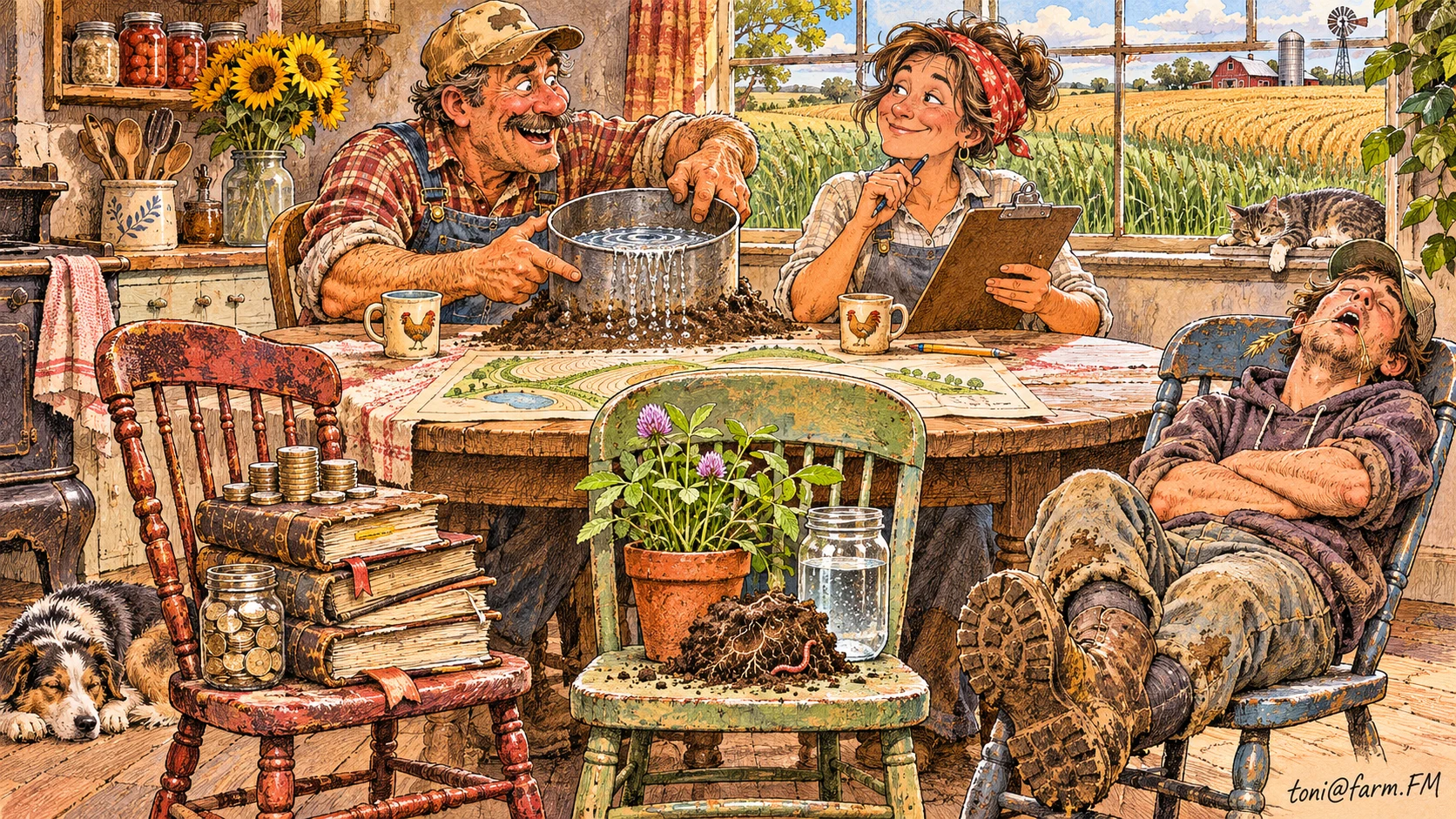
Dean placed three chairs at the kitchen table—one for profit, one for stewardship and one for quality of life.
Profit arrived early and asked who was paying for the seed. Stewardship brought an infiltration ring. Quality of life slept through the meeting because it had been repairing a planter until 1:20 a.m.
Dean’s wife, Carla, suggested that any practice advertised as sustainable should survive three questions:
1. What farm problem are we trying to solve? 2. How will we measure whether it helped? 3. Can we afford to keep doing it after the conference tote bag wears out?
This eliminated six fashionable ideas, two expensive attachments and a consultant whose primary measurement unit was applause.
The Cover Crop Files for Employee Status
The rye emerged in neat green rows and immediately behaved like a new employee. It protected soil, captured nutrients and improved field cover. It also required management, equipment timing and a termination decision during the busiest part of spring.
Dean praised its environmental services. The rye requested health insurance.
“You’re seasonal,” Dean said.
The rye pointed out that so was corn.

Carla tracked seed cost, establishment, spring moisture, termination expense and changes in field conditions. Wesley tracked whether the field looked strange from the county road. Both data sets were discussed at the café, but only Wesley’s included the phrase “I don’t know what he’s up to.”
Infiltration Becomes a Competitive Sport
Dean compared water infiltration in the cover-cropped field and a compacted headland. Water entered the covered soil steadily. On the headland it gathered around the ring and remained there long enough to qualify for a fishing license.
Wesley accused the test of favoritism because the healthy soil had roots.
“That’s the point,” Dean said.
“Then the healthy soil knew the questions in advance.”
Dean repeated the test in several locations and wrote down conditions. This made the result more useful and the story much less exciting, which is the traditional cost of evidence.
Every Practice Receives a Job Description
The Larkins assigned each proposed practice a job. A cover crop had to improve soil cover or nutrient management. Reduced tillage had to save passes without creating a weed emergency. Crop rotation had to spread risk and interrupt pest cycles. Irrigation changes had to improve water-use efficiency, not just add a screen to the pump.
They also established a termination clause: if a practice repeatedly failed the farm’s agronomic or financial tests, it would be changed or dropped. Sustainability, Carla said, did not require preserving an unworkable idea in amber because somebody used it in a keynote speech.
The banker approved this reasoning but asked for projected cash flow. The earthworms offered no written guarantee, having invested entirely in tunnels.
Dean calculated that eliminating one tillage pass saved fuel and hours. The cover crop still had costs, and its benefits varied by field and season. He recorded both. At last, he possessed something rare in agricultural debate: a conclusion containing the word “depends” and numbers on both sides.
The Coffee-Shop Certification
By summer, Dean had better soil cover, fewer erosion concerns on one slope and enough records to decide what deserved another year. He did not claim the farm had achieved permanent sustainability. Farms, he observed, are living businesses, not merit badges laminated at the county office.
Wesley studied the green field and asked for the short version.
Dean tried again. “Protect the farm, measure the results, keep it profitable.”
That was eight words.
Wesley denied certification.
Carla removed “the,” bringing the statement within coffee-shop limits. Sustainable agriculture had finally passed every test, although Quality of Life requested that the next meeting begin after breakfast.
Disclaimer
No cover crop was promised lifetime employment, and no earthworm was asked to personally guarantee a farm loan. Results vary by soil, weather, system and management; test practices against clear goals and local evidence. This article is entirely a human collaboration between two sentient beings—the world’s oldest tenured professor and a philosophy major turned dairy farmer.
Last Updated on November 17, 2026 by Alan Nafzger
Failing the coffee-shop test just means the farm wouldn’t fit on the chalkboard; hands-on agricultural career listings are still a better map than a latte and a menu of ideals.