
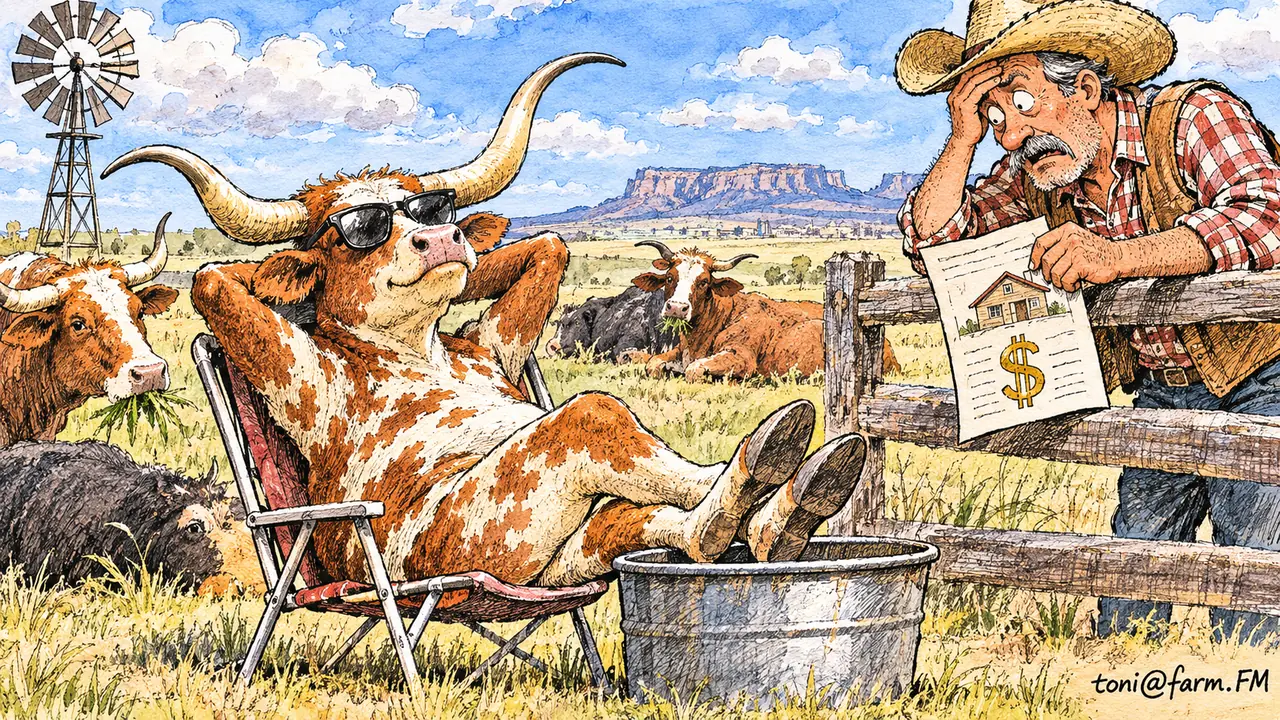
Pasture Now Earns the Respect of a Manhattan Penthouse
AMARILLO, Texas (Farm.FM) — Ranch land prices have reached the point where cattlemen are looking at their pasture with the same respect normally reserved for Manhattan penthouses, only with considerably more manure and fewer functioning elevators.
A Panhandle rancher said he learned his property was becoming valuable when a stranger drove through the gate wearing white sneakers and asked where the infinity pool would go.
“Right there,” he answered, pointing at a stock tank. “It’s infinite if it keeps raining. We haven’t tested that theory lately.”
A Millionaire Who Can’t Buy Lunch
The USDA’s 2026 land-value data put average U.S. pastureland at $2,000 per acre and average farm real estate, including buildings, at $4,500. Texas pastureland averaged $2,420 per acre, according to a Texas A&M AgriLife review of the federal report.
At that Texas average, a hypothetical 2,000-acre pasture carries an indicated land value of $4.84 million before debts, improvements or the inconvenient question of whether anyone would actually pay it. That figure does not mean the owner’s checking account contains $4.84 million. In many cases, the checking account is looking for a co-signer.
“On paper I’m rich enough to buy a small airline,” said cattleman Roy Timmons. “In practice I’m trying to decide if the pickup needs four new tires or whether three and prayer will get me through November.”
An urban investment adviser suggested Timmons unlock his wealth by selling the land. Timmons asked what he was supposed to do after selling it. The adviser said he should pursue his passion for ranching.
This was the first recorded instance of a man recommending retirement from cattle production in order to afford cattle production.
Grass Does Not Read Real-Estate Listings
The trouble with ranch land prices is that real-estate value and agricultural earnings answer different questions. A developer asks what a parcel might become. A rancher asks whether it will grow enough grass to carry the cows through August. Neither question can be answered by staging a sunset photograph with a distressed-wood bench.
At a neighborhood meeting, prospective buyers complained that the ranch did not have a homeowners association. Timmons offered to establish one, provided the members agreed to fix fences, haul hay and follow a bull into a creek.
One buyer requested a property tax estimate and fainted. Another asked whether the cows could graze somewhere less visible so she could enjoy the view of the ranch.
Timmons said the cattle would be happy to move if she could explain the arrangement to them personally.
The cows have since issued their own position on soaring land values. They will continue to eat at the old rate, refuse to contribute toward the mortgage and occasionally destroy a gate worth more than their mothers.
Timmons has therefore postponed becoming a real-estate tycoon until after he pays the veterinarian.
Editorial note: The ranchers and dialogue belong to a comic account; the linked land-value statistics are USDA-based.