
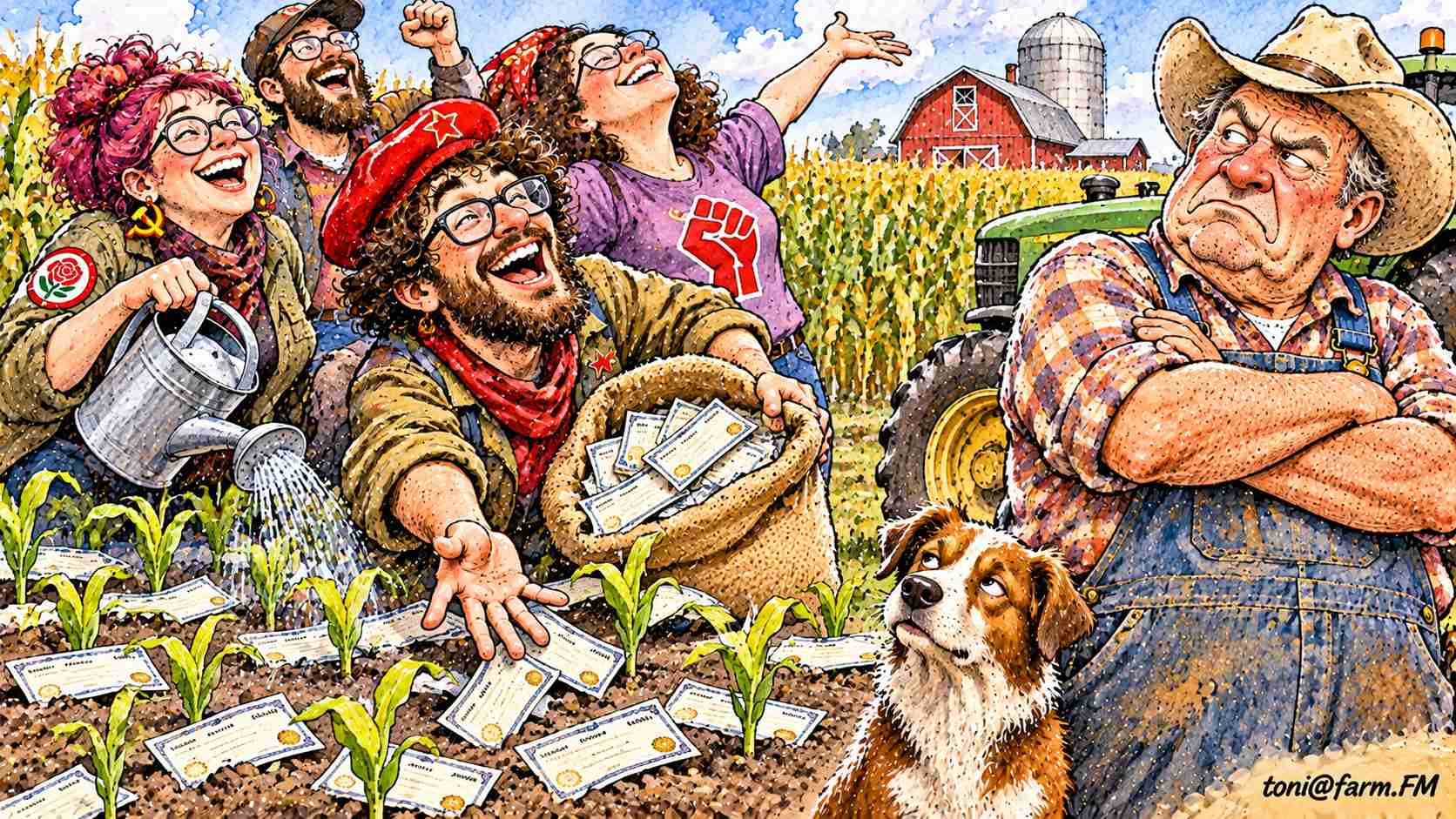
Resentment Does Not Qualify as Fertilizer
DES MOINES, Iowa — America’s agricultural community has apparently discovered a new crop following the midterm elections: political resentment, which requires no fertilizer, survives drought and produces an abundant harvest of government officials who have never operated a tractor.
Farmers frustrated with Donald Trump, agricultural costs and Washington’s endless political circus helped create an opportunity for progressive candidates promising a revolutionary approach to agriculture.
Unfortunately, the revolution appears to involve replacing sunlight, rainfall and competent management with federal grants.
The Progressive Farm Policy Philosophy: Grants Instead of Rain
The philosophy is simple.
If corn prices are too low, Congress should raise them.
If fertilizer is too expensive, Washington should make it free.
If farmers lose money, somebody should investigate whether the wealthy are responsible.
And if a crop fails because of drought, the Department of Agriculture should issue a strongly worded statement condemning insufficient precipitation.
The proposal has obvious appeal among politicians who believe agriculture begins when somebody opens a supermarket.
Farmers, however, possess an inconvenient familiarity with biology.
Corn requires soil, water, sunlight, nutrients and an appropriate growing season.
It does not respond to congressional resolutions.
Soybeans are similarly indifferent to social justice.
A Holstein cow cannot be persuaded to increase production simply because a federal administrator has announced ambitious milk-output targets.
Federal Paperwork and the Farm Subsidy Application Process
Nevertheless, progressive agriculture policy offers extraordinary opportunities for bureaucratic expansion.
Under one proposal circulating among committee staff, farmers would receive grants for demonstrating that their fields had achieved an acceptable level of environmental enthusiasm.
Corn plants showing insufficient commitment to sustainability would be required to attend counseling.
Farmers would complete forty-three pages of paperwork documenting their crops’ emotional well-being.
The forms would be due before planting.
Page thirty-one of the draft application, in the fine print beneath a section headed “Crop Attitude,” asks the farmer to certify that “no seed was planted under duress, coercion or poor soil conditions without prior written acknowledgment.” A footnote adds that “poor soil conditions” will be defined in a later document.
“I read all forty-three pages,” said Dale Hutchins, who farms four hundred acres of corn and soybeans outside Boone. “On page thirty-eight there’s a box that says ‘Describe your relationship with your field.’ I said, it’s a field. I put in the seed, it grows or it doesn’t. They sent it back. Said I had to use complete sentences.”
Naturally, none of this would produce a single additional bushel.
What Farm Economics Actually Depends On
Actual farm economics remains considerably less romantic.
The USDA Economic Research Service tracks an industry where profitability depends on production costs, commodity prices, debt, land values and numerous variables that cannot be corrected by an inspirational press conference.
A farmer can experience rising machinery costs, declining grain prices and expensive financing simultaneously. The Farm Service Agency administers the loans, and the Iowa State University Extension publishes the cost-of-production numbers that farmers read at the kitchen table in January with the shades pulled.
Politicians generally call this an opportunity to announce another program.
Farmers call it Tuesday.
The political irony is that many rural Americans genuinely have reasons to be angry.
They endured tariff uncertainty, expensive inputs and repeated promises that prosperity was arriving shortly.
Some voters became so dissatisfied with Republicans that supporting a Democrat seemed less like ideological conversion than throwing a wrench at the television.
That does not mean farmers suddenly want collective agriculture.
Most simply want to produce something, sell it profitably and be left alone long enough to finish harvest.
Unfortunately, Washington operates on a different calendar.
Farmers measure seasons by planting and harvesting.
Politicians measure them by elections and fundraising deadlines.
And bureaucrats measure them by the number of applications still awaiting approval.
The ultimate agricultural lesson remains simple.
Hatred can help elect a socialist.
Government grants can occasionally help a farmer.
But neither can make corn grow without rain.
Congress is reportedly considering an investigation into why Mother Nature refuses to follow federal guidelines.
Five Observations From the Back Forty
- Forty-three pages of paperwork about the emotional well-being of corn. I’ve been married nineteen years and nobody’s ever asked about my emotional well-being on a form. The corn gets a counselor. I get a seed catalog.
- A box that says “Describe your relationship with your field.” It’s dirt. We don’t have a relationship. It’s a business arrangement. I give it seed, it gives me a bill.
- The Department of Agriculture is going to issue a strongly worded statement about the drought. A strongly worded statement. You know what a drought does when it gets a strongly worded statement? Nothing. It’s a drought. It’s got nowhere to be.
- Farmers call it Tuesday. Politicians call it a program. Same thing happens, one of them gets a press conference.
- Throwing a wrench at the television. That’s the most honest voter analysis I’ve ever heard, and it came from a guy in a seed cap. Every political scientist in America just got out-reported by a man who owns a combine.