
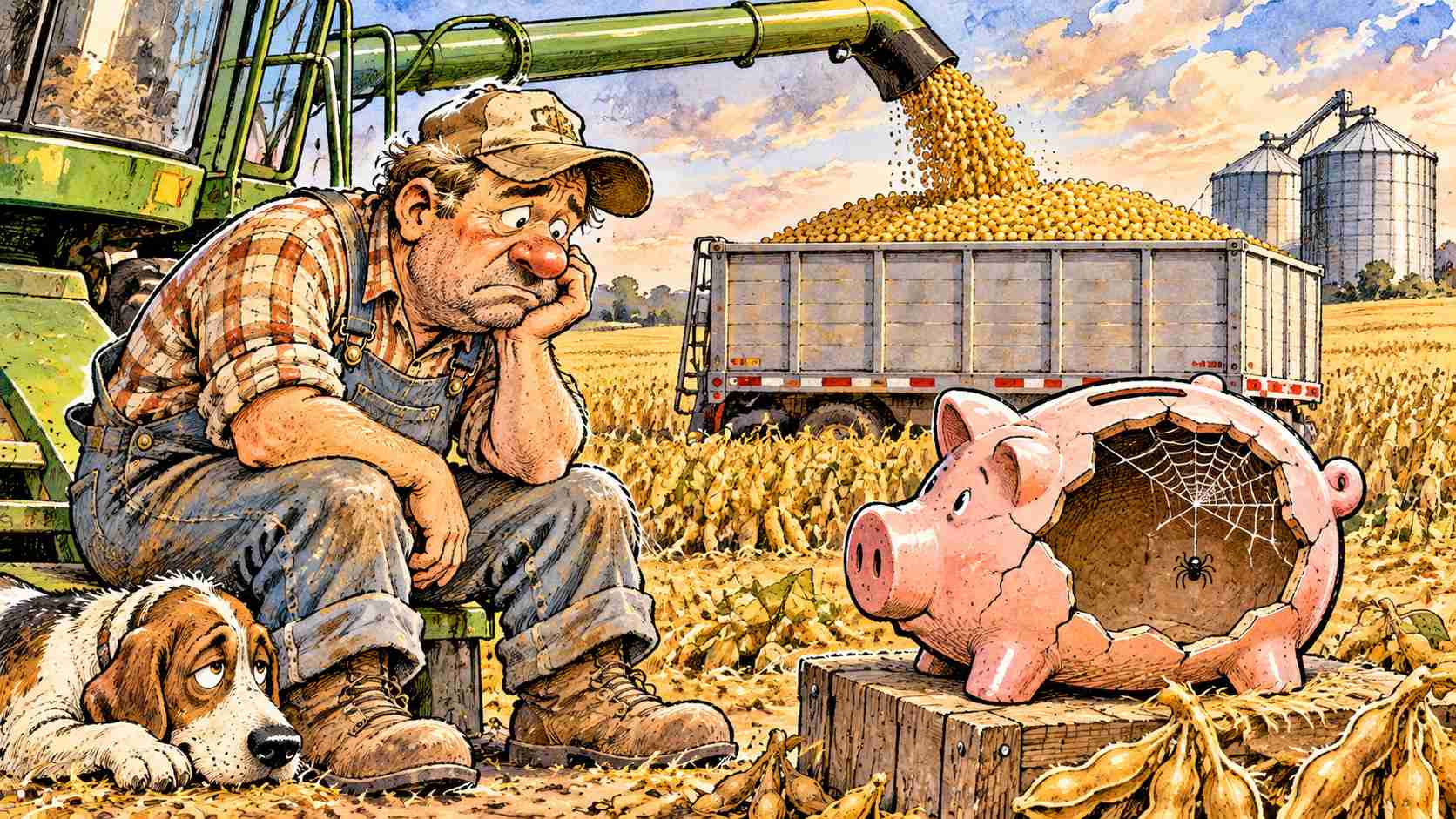
Bankers Prepare to Collect Everything That Is Not Nailed Down
OMAHA, Nebraska — American farmers have nearly finished harvesting their soybean crop, achieving the remarkable feat of producing billions of dollars in agricultural commodities while remaining uncertain whether any of the money will belong to them.
According to USDA’s latest crop progress report, the nation’s soybean harvest reached 88% completion, four percentage points ahead of the five-year average. Corn harvest stood at 74%, slightly behind its historical pace. Agricultural officials celebrated the impressive progress.
Farmers celebrated by examining their financial statements and discovering that the crops had apparently been grown for somebody else.
Soybean Harvest Progress Versus Farm Profit
One Iowa producer explained that his soybean harvest had exceeded expectations.
“We had excellent weather, the combine ran beautifully, and the yields were terrific,” he said. “If I could figure out how to grow soybeans without buying land, equipment, seed, fertilizer, chemicals, diesel, or insurance, I’d probably be a millionaire.”
His banker reportedly suggested eliminating the farmer.
This revolutionary business concept, known as agriculture without agriculture, is gaining popularity among people who have never operated a combine.
The agricultural economy functions through a sophisticated arrangement in which farmers assume the risk of production while numerous other businesses receive guaranteed invoices. The seed company gets paid before planting. The fertilizer dealer gets paid before application. The fuel supplier gets paid when the tank is filled. The insurance company gets paid regardless of whether the weather behaves.
The machinery manufacturer gets paid every month. The farmer gets whatever remains. Occasionally, this includes a complimentary hat.
Economists describe the arrangement as a complex system of financial interdependence. Farmers describe it as working for everybody in town.
What USDA Crop Progress Reports Leave Out
Harvest reports, meanwhile, continue to inspire national optimism.
Government analysts celebrate completed acreage, improved efficiency, and crop volumes.
Nobody asks the obvious question: Did the people producing the food actually make any money?
One Nebraska farmer proposed a simple modification to USDA’s weekly reporting system.
“Instead of reporting how much corn we’ve harvested, how about reporting how many farmers can afford Christmas?”
The suggestion was rejected because USDA does not publish a statistical category for agricultural despair.
Big Crops, Thin Margins: The Farm Income Picture
A fast harvest tells you how much grain is coming in, not how much money is staying. The USDA farm income forecast has net farm income edging down this year with production expenses holding near their current high levels, and the Purdue University/CME Group Ag Economy Barometer shows more producers expecting to be worse off than better off a year from now. A bumper crop is still a bumper crop. It is just not always a bumper check.
A Tally From the Coffee Shop
A coffee shop near Omaha kept a running count of harvest-related remarks over one week. “Good yields” came up 41 times. “Good weather” came up 37 times. “Good prices” came up zero times. A clerk added a column for “profit” and left it blank, she said, “out of respect.”
An Eyewitness at the Elevator
“There were eighty trucks in line,” said a driver waiting to unload. “Everybody was in a good mood for about ten minutes. Then the price came up on the board and it got real quiet. The guy in front of me took his hat off.”
County Report
A county Farm Service Agency summary notes that “harvest progress is ahead of schedule.” Under the heading “Producer Financial Condition,” it reads: “See attached.” The attachment is a blank page.
A banker in Illinois offered a different interpretation.
“Farmers need to understand that agriculture is a long-term investment,” he explained while calculating compound interest on a short-term operating loan.
Asked how long a farmer should expect to wait before earning a reasonable return, the banker replied, “Ideally, until his children inherit the problem.”
The expanding use of precision agriculture, advanced genetics, larger equipment, and sophisticated management has made American farming extraordinarily productive. Yet productivity alone cannot guarantee profitability.
When grain prices are weak relative to operating costs, a bumper harvest can still leave a producer struggling to service debt. That’s economics.
And economics has never been particularly impressed by the emotional satisfaction of filling a grain bin. Fortunately, farmers remain resourceful.
They repair equipment, negotiate costs, improve marketing plans, and continue working through uncertainty because food production is more than a financial spreadsheet.
It is also a profession, a family tradition, and occasionally a hereditary addiction. The USDA expects the remaining soybean acres to be harvested soon.
Farmers hope that someday the government will also measure the percentage of agricultural profits successfully harvested. Preliminary estimates suggest the banker has already finished his.
Five Humorous Observations About the Harvest
- Soybean harvest eighty-eight percent complete. Profit harvest, zero percent. It’s like getting a report card in a language you don’t speak.
- The seed company gets paid before planting. The fuel guy gets paid at the pump. The insurance guy gets paid even if it doesn’t rain. The farmer gets a hat.
- “Agriculture without agriculture.” My banker’s been trying to sell me that for years. It’s called a golf course.
- USDA doesn’t have a category for agricultural despair. Strange. I’d call it the main crop.
- You fill the grain bin and it feels great. Then the banker comes by. It’s like hosting a barbecue and the IRS shows up with a paper plate.