
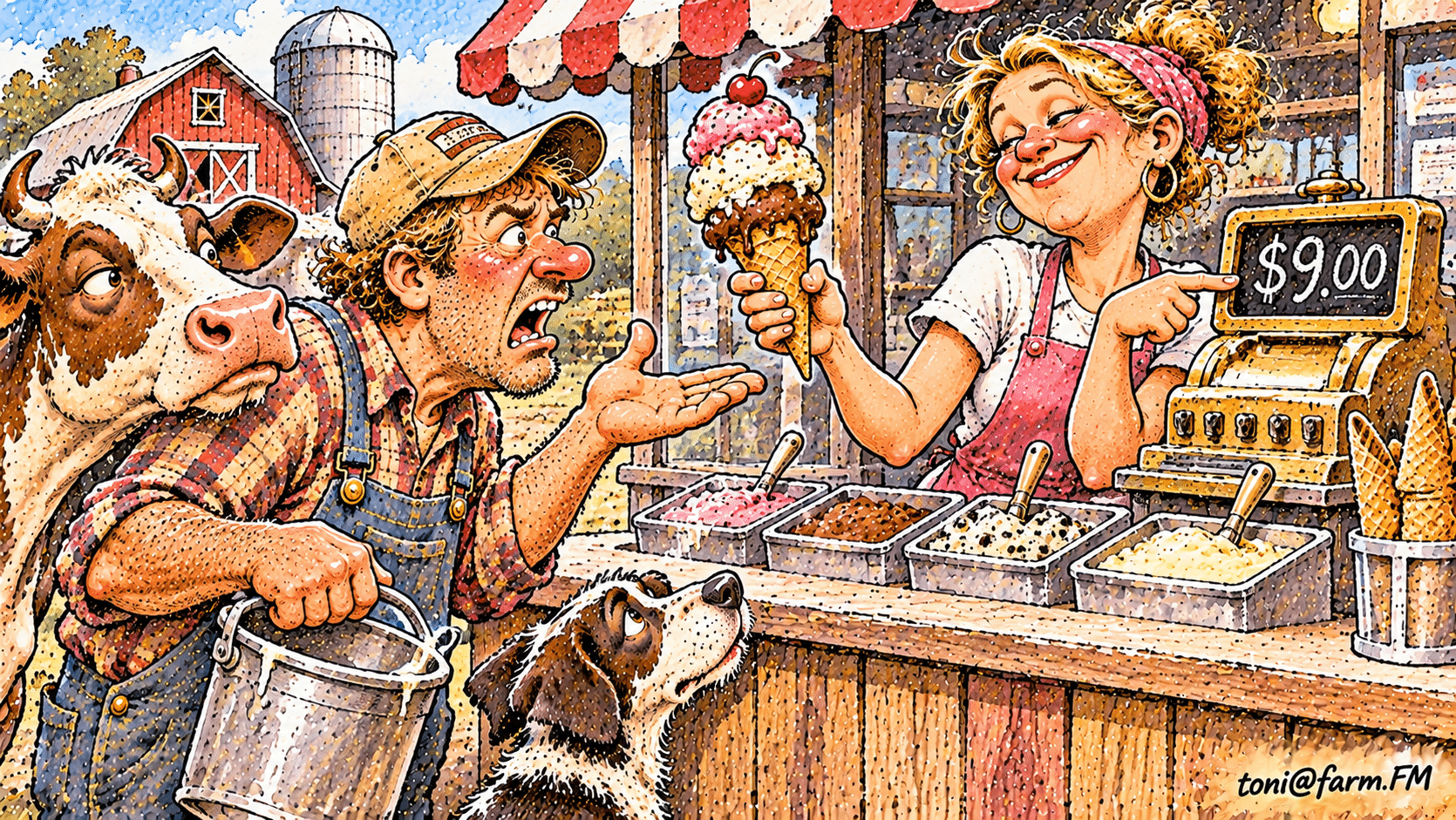
The Scoop Costs $9; the Milk Check Tells Another Story
VERONA, Wisconsin (Farm.FM) — A dairy farmer has asked federal economists to investigate how dairy ice cream can sell for nine dollars a scoop while the person responsible for the milk still checks the price of everything at the grocery store.
“It starts with my cows,” said milk producer Hank Weller, holding a receipt from a fashionable dessert shop. “By the time it reaches this little paper cup, apparently the milk has earned a master’s degree.”
The shop advertised its signature scoop as Hand-Curated Pasture Memories. Weller observed that none of his cows had been consulted about the memories and the paper spoon looked substantially less expensive than a college education.
Dairy Ice Cream Economics: Follow the Milk Money
The supply chain includes processing, refrigeration, distribution, staffing, and retail costs. Those expenses are real, as is the farmer’s relatively small share.
A USDA Economic Research Service analysis published in 2025 estimated that farmers received 19 percent of the retail value of ice cream in 2024 for the milk components used to make it. That statistic concerns a standardized retail product, not a nine-dollar scoop in this particular satirical shop.
Weller did the arithmetic on his napkin anyway. He concluded that if the cup was worth nine dollars, the empty cup must be made of rare minerals.
The cashier explained that the price reflected a premium atmosphere. Weller looked around at the exposed brick, six plants, and an employee describing vanilla as a journey.
“That’s not a journey,” he said. “That’s a flavor.”
The Cow Wants a Seat on the Pricing Committee
The manager offered a chart of brand identity and emotional resonance. Weller preferred his chart of feed costs.
One specialty item cost fourteen dollars and came with a story about a pasture at sunrise. Weller offered to tell customers a more accurate pasture story, involving mud, rain, and a cow named Dorothy who had once stood on his foot.
Management declined on the grounds that the experience sounded insufficiently aspirational.
The USDA documentation on farm-to-consumer price spreads explains that calculating farm value in ice cream requires accounting for butterfat and skim milk solids. It does not support treating every dollar left over as pure profit. There are genuine expenses after the milk leaves the farm.
Still, Weller noticed that his cows receive no tips, despite being the only contributors who work every morning before the manager arrives.
He proposed placing a tip jar at the barn. The first cow knocked it over. The second ate the suggested gratuity card.
Before leaving the shop, Weller bought a single scoop of plain vanilla. The cashier asked whether he’d like to add a dollar for a complimentary handwritten description of the dairy experience.
Weller offered the real dairy experience at four tomorrow morning.
Nobody volunteered.
Disclaimer: The shop, farmer, prices, quotations, and events are satirical. USDA farm-share data refer to real retail research, not the hypothetical scoop. This story is entirely a human collaboration between two sentient beings: the world’s oldest tenured professor and a philosophy major turned dairy farmer.