

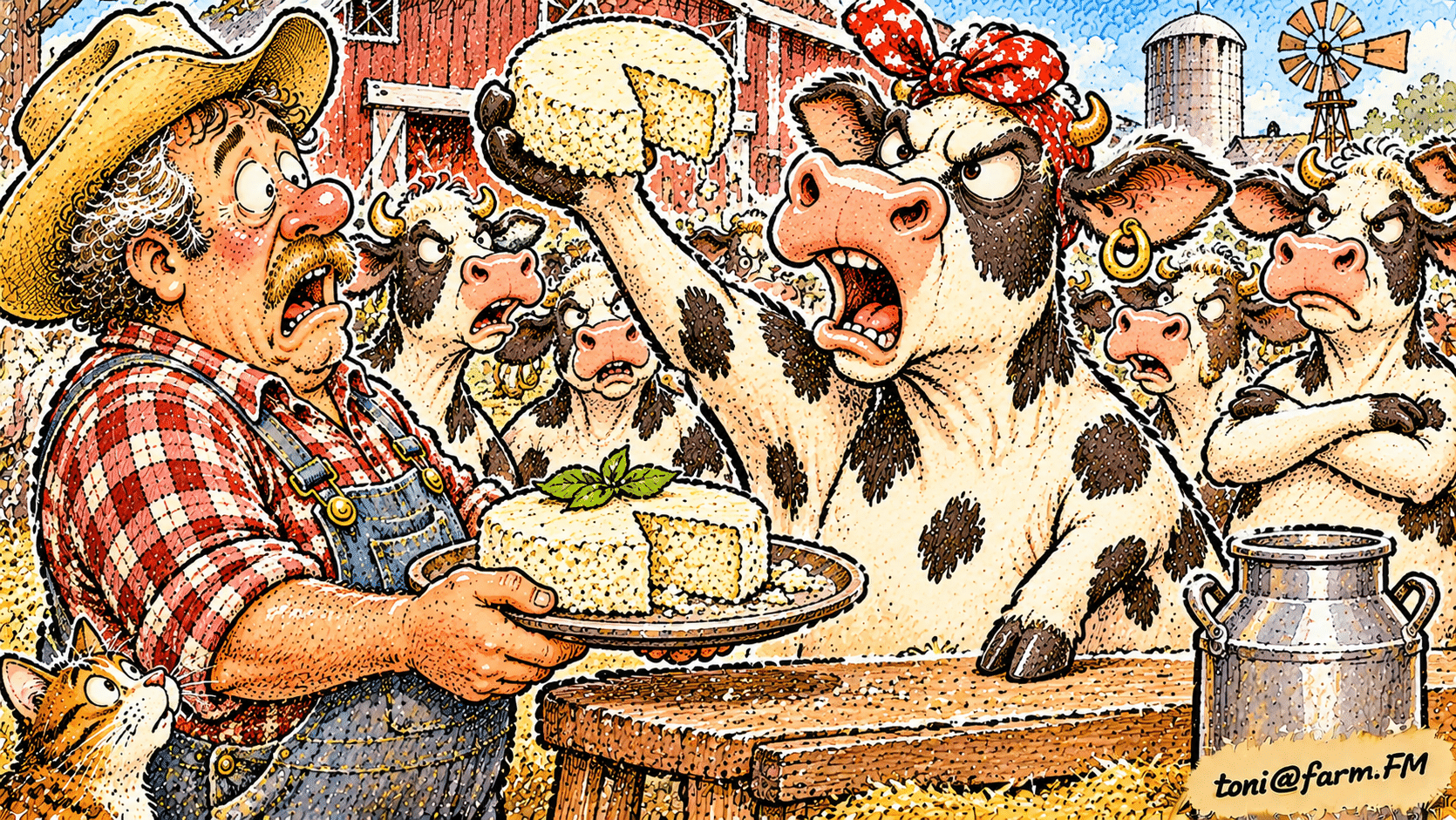
Wisconsin Cows Want Royalties for the Word Cheese
MADISON, Wisconsin (Farm.FM) — A Wisconsin dairy herd has filed an unofficial grievance against dairy free cheese, arguing that the product has appropriated the name of their life’s work without so much as offering them a complimentary cracker.
The uprising began after farmer Ed Krueger brought home a package of cashew-based cheddar alternative. His oldest Holstein, Marge, inspected the label, stared at him for several seconds, and produced a noise that sounded suspiciously like an attorney clearing his throat.
“She looked offended,” Krueger said. “I’ve seen that expression before. Usually when I forget to open the feed gate.”
The cows demanded an explanation of how cheese could be made without dairy. Krueger attempted a comparison involving decaffeinated coffee. The herd rejected it on the grounds that coffee has never been milked at 4:30 in the morning.
Dairy Free Cheese Enters a Very Serious Naming Dispute
The actual labeling debate has regulators involved, though not, so far, any cows. In January 2025 the FDA published draft guidance on labeling plant-based alternatives to animal-derived foods. The nonbinding recommendations emphasize clear descriptions of plant sources, so shoppers can understand what they’re buying.
Marge interpreted the guidance differently. She insisted all packages include a photograph of a cow looking disappointed and the sentence, “No udders were consulted.”
Krueger’s niece, a marketing graduate, proposed a compromise: “Dairy free cheese, now with 100 percent less moo.” The cows rejected this as an insult to their intellectual property.
A barnyard survey of twelve Holsteins recorded eleven hostile stares and one respondent eating the clipboard. Researchers declared the results statistically significant because nobody wanted to question the respondent with horns.
Cow Lawyers Demand Royalties in Hay, Not Cash
The herd’s legal strategy faces a basic problem: cows cannot own trademarks, and their spokesman is a farmer who spells litigation using the letters in fertilization.
Still, Marge presented a persuasive economic case. Dairy farmers buy feed, maintain milking equipment, handle animal health, and absorb operating costs. An almond, by comparison, reportedly sits on a branch until a marketing consultant declares it artisanal.
The USDA’s 2026 farm-income forecast describes a complicated national farm economy with falling inflation-adjusted aggregate profits. Dairy producers, meanwhile, still have to pay real bills, regardless of how creative the grocery aisle becomes.
Krueger made the mistake of asking the cows to try the alternative. Marge sniffed it, turned away, and resumed chewing hay, thereby delivering the strongest product review since his uncle tried microwave brisket.
Nutrition-conscious consumers can choose dairy or plant-based products, and clear labels help everyone. The cows’ only demand is that nobody pretend a cashew has ever contributed to the butterfat test.
Negotiations concluded when Krueger offered extra alfalfa and agreed never again to describe a nut beverage as “udderly delicious.”
Marge accepted the hay. Her attorneys are still reviewing the pun.
Disclaimer: The bovine grievance, survey, legal threats, and characters are satire; the FDA guidance and USDA economic reporting are genuine sources. This story is entirely a human collaboration between two sentient beings: the world’s oldest tenured professor and a philosophy major turned dairy farmer.
Real cheese starts with a cow, the rest is yellow wishful thinking.
Calling that stuff cheese is like calling my pickup a limousine.