

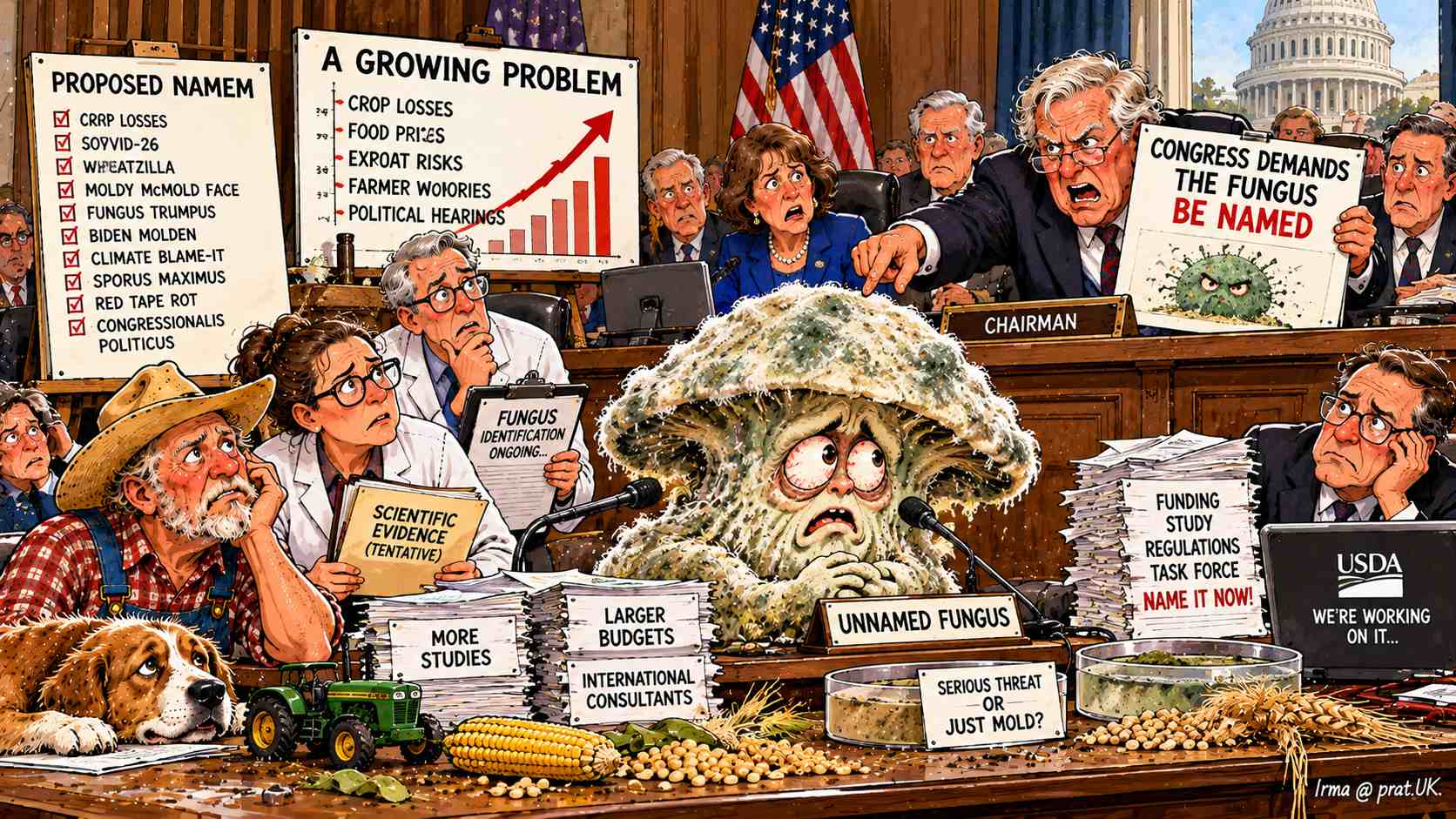
Michigan State asks for evidence and Washington asks for a committee
LANSING, MICHIGAN – Researchers investigating mysterious white spots on Michigan corn have committed an increasingly controversial act in modern American public life: they have admitted they do not yet know the answer.
Michigan State University scientists are examining a newly observed corn leaf spot problem resembling maize white spot or Phaeosphaeria leaf spot. The symptoms have appeared across numerous Michigan counties, with similar reports elsewhere in the Great Lakes region and Northeast. Scientists are trying to identify the responsible organism through laboratory analysis, DNA sequencing and controlled experiments. Washington reportedly expressed concern that experts were demanding evidence before announcing a conclusion.
Science Makes the Mistake of Being Careful
Researchers Martin Chilvers and Jan Byrne have warned that finding fungi in affected corn tissue does not automatically prove those fungi caused the damage. Their investigation combines fungal isolation, microscopy, genetic analysis and pathogenicity testing. These are standard scientific approaches for telling possible causes from demonstrated ones.
A congressional committee considered the methodology unnecessarily complicated.
“Why can’t you just name the fungus?”
“Because we haven’t conclusively identified it.”
“Can’t you vote?”
“Science doesn’t work that way.”
“Could you appoint a bipartisan fungus?”
The researchers requested that lawmakers leave the laboratory. Congress accused them of insufficient stakeholder engagement.
Washington Announces the National Fungus Naming Commission
Under a federal proposal, a new commission would select an official name for the suspected crop pathogen before scientific identification is complete. Democrats proposed the Agricultural Inequality Fungus. Republicans preferred the Foreign Agricultural Interference Fungus. Independent voters suggested calling it Bob. A lobbyist proposed the Premium Crop Protection Market Opportunity.
Farmers overwhelmingly preferred identifying the actual organism. The committee explained that its funding did not cover practical solutions.
The Economic Stakes of Corn Leaf Disease Are Not a Joke
The Michigan State University investigation concerns symptoms that could affect grain corn, sweet corn, seed production and silage. Researchers are still gathering evidence about possible quality and yield impacts. Agricultural diseases matter because damaged leaf tissue can interfere with crop performance, although an observed symptom does not establish a particular level of yield loss.
Farmers must therefore make decisions with incomplete information. One grower asked a crop consultant whether to buy another fungicide application.
“What would it cost?”
“Several thousand dollars.”
“Will it work?”
“We don’t know yet.”
“Will the supplier still charge me?”
“Absolutely.”
The farmer observed that at least one part of agricultural economics remained scientifically certain.
The Great Congressional Fungal Opinion Poll
A survey asked 500 Americans whether Congress should identify agricultural pathogens through a national vote. Twenty-eight percent supported the idea. Forty-one percent opposed it. Thirty-one percent believed fungus was something growing in the congressional budget.
A parallel poll of plant pathologists found that every respondent preferred laboratory testing to legislative speculation. One researcher suggested that lawmakers first demonstrate the ability to tell an ear of corn from a stalk of wheat. The proposal was described as politically divisive.
Farmers Understand the Value of Evidence
The history of agricultural science includes countless examples of diseases whose management improved after researchers identified their causes. Accurate identification helps establish diagnostic methods, understand transmission and investigate useful control measures. That takes evidence, replication and time. It also requires scientists to acknowledge uncertainty honestly.
Farmers deserve reliable recommendations, not expensive guesses dressed up as emergency advice. Michigan State is asking growers to report affected fields and submit representative samples. That is more useful than announcing a national fungus awareness month.
The Fungus Declines to Testify
At the commission’s concluding hearing, lawmakers announced that the suspected fungus would be required to explain its intentions. The fungus did not appear. A senator demanded a subpoena. A scientist explained that fungi cannot testify.
“Can they be sanctioned?”
“No.”
“Can they be taxed?”
“Probably not.”
Congress adjourned in frustration. Michigan farmers continued inspecting crops. University researchers continued gathering evidence. And the mystery fungus, whatever its eventual scientific identity, had already accomplished something remarkable. It had persuaded Congress to discuss a subject it knew almost nothing about.
Agricultural scientists called that an unfortunate coincidence. Farmers called it a normal Tuesday.
The Evidence File
Expert Disagreement, Politely Done
Real scientists disagree in a way that politicians have never managed: with a method. The researchers say a fungus is repeatedly found, a leading suspect is named, and a final answer needs proof. That’s the exact opposite of a congressional hearing, where the answer comes first and the hearing is scheduled afterward.
Real-World Precedent: Tar Spot
When tar spot arrived in Michigan in 2016, MSU’s team spent years on fungicide screening and hybrid trials, with funding from groups like the Corn Marketing Program of Michigan, as MSU’s own writeup describes. Nobody held a vote on the name. The disease was the disease.
Role Reversal
If Congress were held to the same standard as the lab, a bill could not pass until its sponsor had isolated, cultured and reproduced the problem in a controlled environment. Congress would be adjourned until spring of 2041.
Sources and Further Reading
Updates are posted by MSU Extension, with national guidance from the Crop Protection Network and trade coverage in Farm Progress.
Evidence: Michigan State University’s continuing crop disease investigation, September 23, and October 21 agricultural reporting.
Humorous Observations
- A “bipartisan fungus.” The only organism in America that actually could be, because it grows on everything and nobody likes it.
- Thirty-one percent think fungus is something growing in the congressional budget. They’re not wrong. It’s dark, it’s damp, and it’s been there since 1987.
- The scientist says “We don’t know yet.” And the whole room goes crazy. We’ve reached the point where “I don’t know” is a controversial opinion.
- Subpoena a fungus. It’s the first witness in D.C. history with nothing to hide, and honestly, the first one with a clear root system.
- Congress adjourned in frustration. Over a mushroom. You know the founding fathers pictured this exact moment, right before they picked the wine.
Last Updated on September 9, 2023 by Alan Nafzger