
SACRAMENTO — By the Farm.FM Rural Affairs Desk
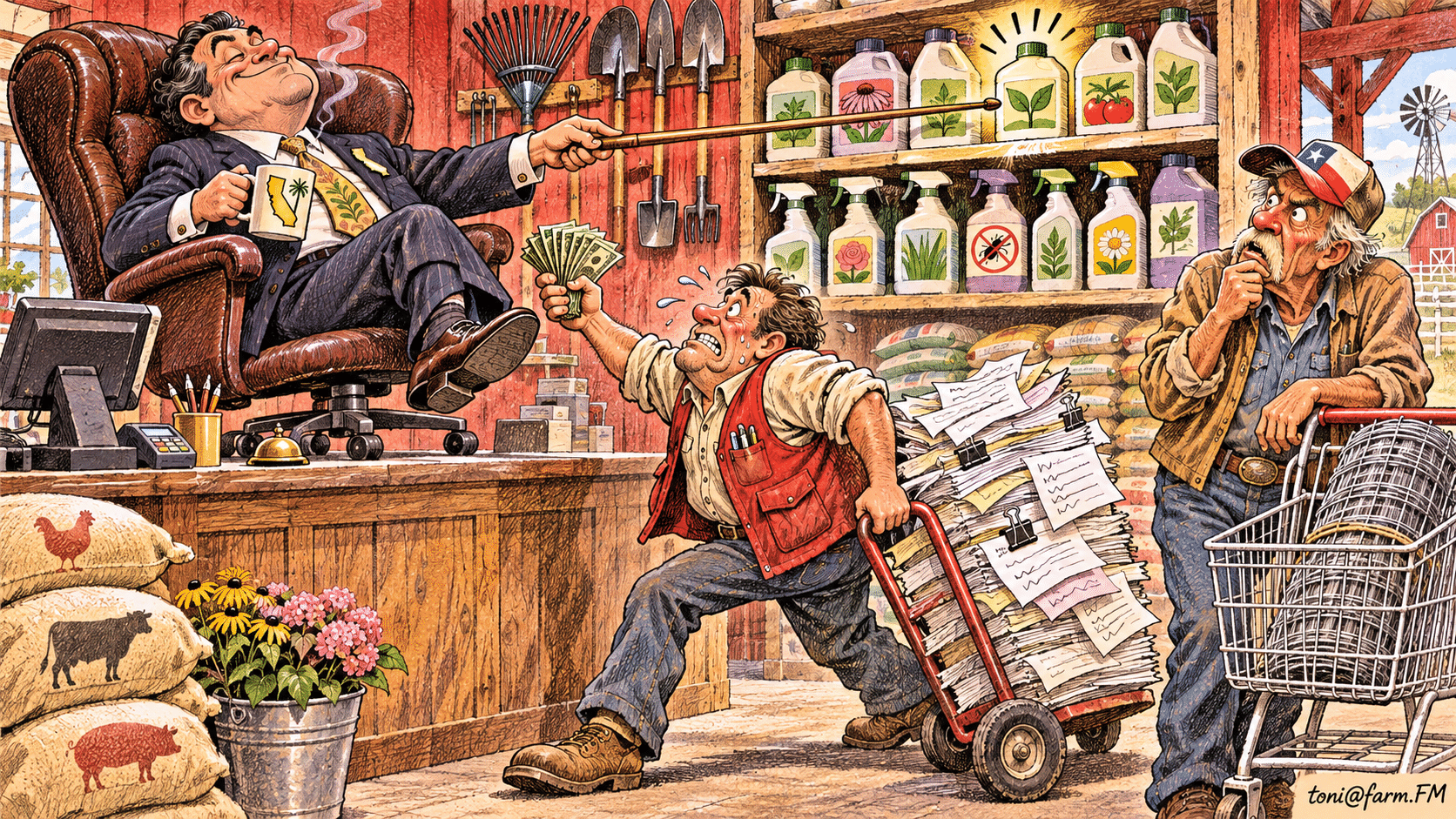
California has perfected a version of nationalization so fiscally responsible that the government gets to supervise the merchandise while the previous owners retain the privilege of financing everything that goes wrong.
The California Tractor Supply probation dispute concerns pesticide sales, but Sacramento’s contribution to business philosophy is broader: ownership is a beautiful relationship between a company and its expenses.
Under the California Department of Pesticide Regulation’s five-year Tractor Supply probation order, the retailer must stop selling restricted pesticide materials and submit quarterly sales reports. Officials cite repeated licensing and sales violations. The agreement takes effect December 7.
No deed changed hands. Sacramento apparently checked what deeds cost and discovered that a clipboard accomplishes much the same thing without property taxes.
California Assures Tractor Supply It Still Owns the Store in a Deeply Symbolic Sense
At a ceremonial transfer of absolutely no financial responsibility, an official presented the manager with a miniature gold shopping cart representing his continuing entrepreneurial freedom.
The cart had no wheels. Those were awaiting review.
“You remain the owner,” explained Deputy Assistant Director of Commercial Latitude Leonard Parchment. “You may replace the roof, repair the toilets, purchase insurance, negotiate with your lender and lie awake wondering how you’re going to make payroll. We have preserved all the traditional satisfactions of capitalism.”
The manager asked whether ownership included choosing merchandise.
Parchment smiled with the patience normally reserved for a toddler trying to refinance a submarine.
“Let’s stay focused on your rights.”
The framed certificate of ownership was positioned beside the utility bill so visitors could compare the symbolic asset with the operational one.

Tractor Supply Learns Private Ownership Includes Everything Except Deciding What Goes on the Shelf
Employees described the arrangement as running a restaurant where the health inspector also selects the soup, writes the specials and leaves before the dishwasher breaks.
“The state doesn’t own the building,” said assistant manager Earl Dobbins. “It just has strong feelings about what happens inside it. My first wife had a similar arrangement with my fishing boat.”
Dobbins demonstrated the new division of labor. He moved a box. An official observed. He scanned a label. Another official conferred. He sneezed. A third requested clarification about whether the sneeze constituted an aerosol application.
By lunchtime, the store had moved six products and generated enough correspondence to insulate a calving barn.
An economic consultant called this increased activity. Earl called it Tuesday, except expensive.
The consultant’s evidence was compelling: before oversight, one employee sold one bottle. After oversight, that same bottle supported a manager, a compliance officer, two conference calls and a man who described himself as a process architect. Productivity had plainly increased if you measured the number of people preventing the transaction.
Sacramento Declines to Buy Tractor Supply, Citing Ability to Manage It for Free
The proposal to purchase the stores was reportedly abandoned when an accountant explained that buying a business traditionally involves paying its owners.
“Why would we do that?” asked a member of the acquisition committee. “They already have a perfectly good bank account.”
The committee instead adopted an arrangement in which the company supplies the premises, workers, inventory, electricity and consequences, while Sacramento supplies the confidence.
West Texas farmer Clyde “Straight Row” Mercer recognized the business model immediately.
“That’s a hired hand who tells you where to plant, won’t ride the tractor and wants credit when it rains,” Mercer said.
He added that his wife also tells him what he can bring home from Tractor Supply, but at least she occasionally helps unload it.
California Announces Public-Private Partnership: Tractor Supply Provides the Private Money, State Provides the Orders
Partnership was defined at the briefing as two parties sharing a mission while only one receives the invoices.
The public partner would identify acceptable outcomes. The private partner would identify which personal belongings could be sold to afford them.
“We bring oversight,” said Parchment.
“I bring seventeen employees and a forklift payment,” replied the manager.
Both contributions were entered in the minutes as equivalent.
The forklift, however, remained stubbornly capitalist. It demanded diesel instead of vision statements. Attempts to power it with shared values produced no measurable lifting, although a communications specialist said the machine had made meaningful progress toward acknowledging the pallet.
In a customer survey conducted beside the loading dock, six of seven respondents preferred that the person issuing instructions also take a turn carrying feed. The seventh was the official conducting the survey and therefore counted twice.
The published result showed overwhelming support for stakeholder engagement.
Mercer requested that the next stakeholder engagement involve holding the other end of a fence stretcher.
Tractor Supply Changes Slogan to ‘For Life Out Here, Subject to Approval From Over There’
The revised slogan proved difficult to fit on a cap, requiring a second cap and a stapled appendix.
Customers were encouraged to begin shopping with a clear description of their proposed agricultural intentions.
“I came for something to handle weeds,” said rancher Bill Haskett. “By the time we’d established what kind of weeds, where they were standing and whether I had considered their perspective, they’d gone to seed.”
A shopper buying gloves was asked what activities he anticipated gripping.
“Mostly my remaining patience,” he said.
Store staff considered shortening the slogan to “Maybe,” but the suggestion needed approval from branding, legal and a working group examining whether certainty disproportionately benefits people with errands.
Meanwhile, the automatic doors continued opening freely, an administrative oversight scheduled for discussion.
The store’s greeter developed a practical distinction: customers were people who asked where things were; partners were people who explained why things shouldn’t be there. Only the first group ever bought dog food.

Tractor Supply Put on Five Years’ Probation; Weeds Released Without Bail
Outside the store, a thistle celebrated the announcement by occupying three parking spaces and declaring itself essential habitat.
The dandelions retained counsel. The bindweed simply expanded operations.
“We appreciate California’s commitment to giving every unwanted organism a second chance,” said a tumbleweed that had crossed four property lines without presenting identification.
Haskett observed that the store had a reporting schedule, the buyer had a list of requirements, and the pigweed had neither.
“Everybody in this transaction has paperwork except the thing destroying my fence line.”
A weed-management listening session ended when the weeds declined to listen.
Mercer suggested sentencing the worst offenders to five years in a compost pile. A facilitator explained that punitive language could damage the relationship.
“It’s a relationship already,” Mercer said. “I’m paying for dinner, and it’s taking the farm.”

California Tractor Supply Probation: What Farmers Actually Need to Know
Away from the ceremonial clipboards, the underlying enforcement case concerns real compliance failures. DPR says inspections cited 65 of the company’s 99 California locations; a separate sales review found 123 transactions involving unregistered products, including 75 involving restricted materials without the required purchaser permits.
Those details matter. A cash register cannot substitute for a required license, and calling something a farm store does not make every product suitable for every buyer.
For a practical shopping plan, read the actual Tractor Supply settlement and disciplinary order, confirm product availability before driving, and consult your county agricultural commissioner’s office about applicable permits. An empty afternoon and a full fuel tank are expensive ways to discover that an item cannot be sold.
The restriction concerns restricted pesticide materials, rather than every item in the store. Your feed scoop has not been placed under house arrest.
Owners Retain Exclusive Rights to the Expenses
As the briefing concluded, the manager asked whether Sacramento would contribute toward a leaking roof above the newly supervised aisle.
Officials explained that weather entering a privately owned building remained a private-sector matter.
“But you control what goes under it,” he said.
“Exactly,” Parchment replied. “We wouldn’t want to interfere with your independence.”
Mercer watched the delegation leave in vehicles that someone else maintained.
“I’ve finally figured out their position on private property,” he said. “They’re strongly in favour of you owning the deductible.”
The manager returned to his office, where his gold shopping cart was waiting beside another bill.
For the first time all morning, the division of responsibilities was perfectly clear.
Disclaimer From the Loading Dock
This satire is entirely a human collaboration between two sentient beings: the nation’s only agriculture professor that actually needs tenure and a philosophy major turned dairy farmer. Neither has annexed a Tractor Supply, although both have entered for one item and emerged with financial responsibilities.
Last Updated on November 18, 2026 by Alan Nafzger