
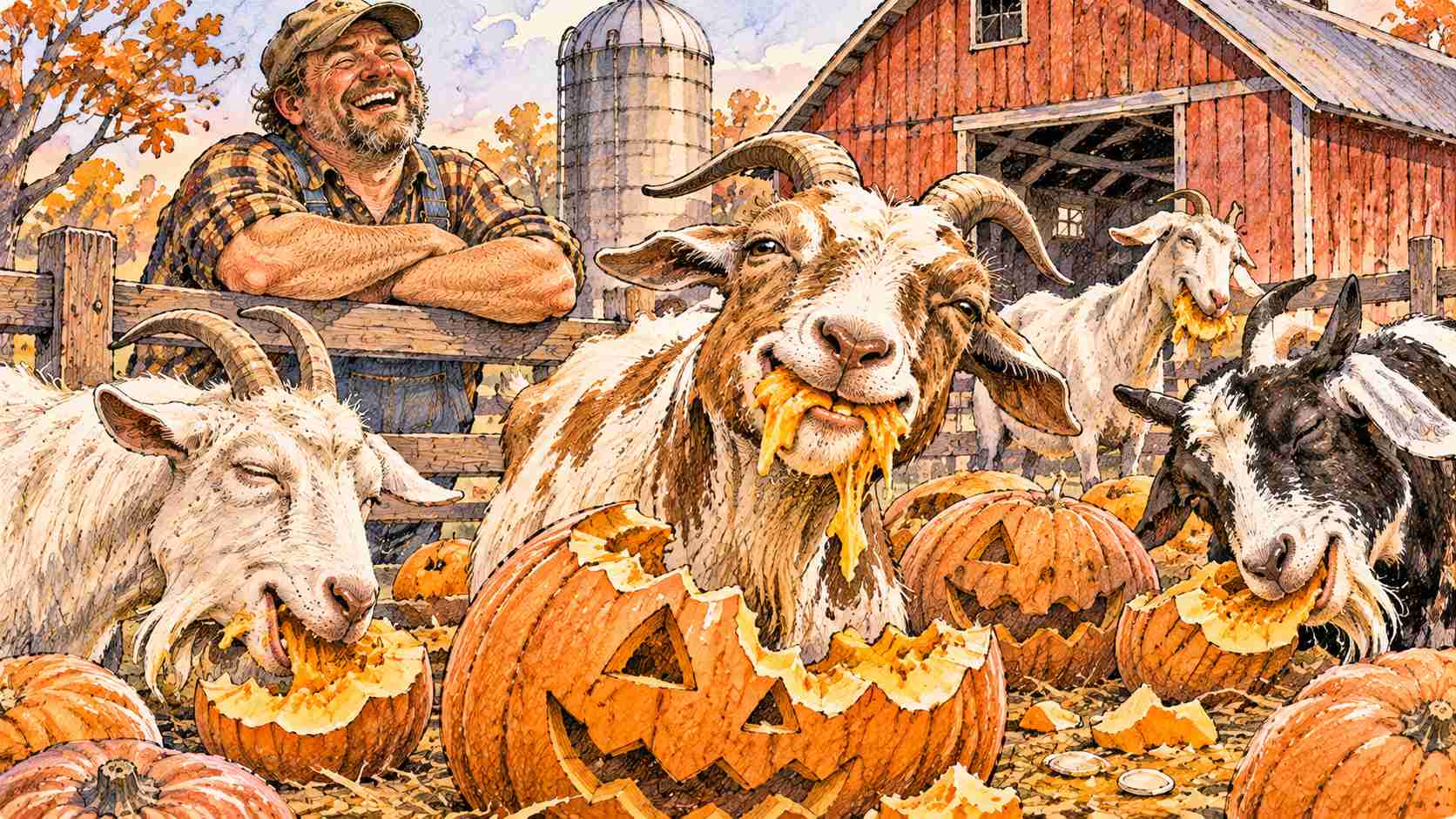
Goats offer a cheaper disposal plan
PHOENIX, Arizona (Farm.FM) — American consumers have wrapped up another Halloween season by buying enormous quantities of pumpkins, carving frightening expressions into them and discovering that the agricultural industry already knows a much cheaper method of disposal.
Goats.
According to USDA Economic Research Service data, American farmers produced about 1.47 billion pounds of pumpkins last season, with a total crop value of $259 million, down from $286 million a few years earlier. A nonprofit called Let’s Go Compost is urging Americans to compost unwanted pumpkins or donate suitable ones to farms and animal rescues rather than send them to landfills, as RFD-TV reported.
This confused suburban homeowners, who’ve always believed that food becomes garbage the minute somebody puts a candle inside it.
Goats Have Been Recycling Since Before Recycling Was Fashionable
For generations, farm animals have been eating plant material that city consumers think of as a decorative investment. Now environmental advocates are explaining the same principle using educational programs and carefully prepared promotional materials.
“Some people pay $18 for a pumpkin and then spend three hours cutting a face into it,” said Arizona goat farmer Russell Tate. “My goats would’ve finished the whole project before the knife came out.”
The nonprofit works with hundreds of schools, libraries and community organizations to promote composting and waste reduction. Its founder, Lauren Click, has warned that a large share of purchased pumpkins may eventually reach landfills.
Farmers say the solution is sensible, as long as people remember that not every discarded pumpkin is suitable for livestock. Pumpkins offered as feed should be appropriate for the animals, free of paint, plastic and other decorations, and not spoiled. A goat can digest plenty of surprising things. That doesn’t mean its owner wants a stomach full of glitter.
Composting Halloween Pumpkins: Suburban America Meets Agricultural Biology
The idea of composting pumpkins has also introduced many Americans to decomposition, a process farmers have understood since the first person left a vegetable behind the barn. Composting returns organic material to the soil under suitable conditions, as the Environmental Protection Agency explains. It’s cheap, useful and doesn’t require a subscription.
That has alarmed several Silicon Valley entrepreneurs, who are reportedly developing a $499 smart compost bin that sends your phone an alert whenever something rots. Farmers are skeptical. “I’ve had manure breaking down behind the barn for 30 years,” Tate said. “It never once asked me to update its software.”
The Great American Pumpkin Economy
According to USDA statistics, Illinois led the nation in pumpkin production last season with about 533 million pounds. Other leading states included California, Indiana, Michigan and Pennsylvania, and the National Agricultural Statistics Service keeps the running totals.
A big portion of American pumpkin production supports the ornamental market, which is an unusual economic arrangement. Farmers spend months growing food. Consumers buy it. Then consumers cut holes in it, set it outside and celebrate when it starts to rot. A vegetable farmer trying the same business strategy with lettuce would be arrested by the health department.
The Sheriff’s Report, the Patch Sign and the Eyewitness
The Deputy’s Incident Report
A sheriff’s incident report from a rural county describes a call about six missing pumpkins. Deputies located the suspects in a nearby pen. The report states the suspects “appeared calm, were chewing, and declined to answer questions.” No arrests were made. The goats were released to the custody of their owner, who thanked the deputies and asked if they wanted any pumpkin.
The Pumpkin Patch Sign
The sign posted at a pumpkin patch outside Phoenix reads: “All sales final. Faces are your responsibility. Management is not liable for what the pumpkin looks like after you’re finished with it.” Tate says he copied the sign down and hung it over his goat pen, “because it works for goats too.”
The Eyewitness Account
“I watched one of them eat a whole pumpkin in under four minutes,” said a neighbor who stopped by Tate’s farm. “The seeds, the stem, the little ghost sticker. It didn’t even look up. I’ve never felt so judged in my life.”
The Goats Win Halloween
Farmers say the post-Halloween recovery campaign is a practical way to cut waste, enrich soil and support animal care. People interested in donating pumpkins should contact a local farm or rescue first to find out whether the material is wanted and suitable. Composting is another good option. Either approach beats sending every leftover jack-o’-lantern to the landfill.
Tate says his goats are enthusiastic participants. They have no interest in Halloween traditions. They don’t care whether the pumpkin looks like a ghost, a politician or the neighbor’s unpleasant mother-in-law. They just recognize food.
“Last night somebody dropped off six pumpkins,” Tate said. “My goats finished them before I could get a photograph.”
Which proves the agricultural industry’s most enduring environmental principle. One man’s holiday decoration is another goat’s breakfast.
Five Humorous Observations
- Eighteen dollars for a pumpkin, three hours of carving, and the goat finishes the job before the knife is out. That’s the most efficient employee in America, and it’s not even on payroll. Doesn’t want benefits. Doesn’t want a title. Just wants the pumpkin.
- “Faces are your responsibility.” Great sign. Honestly I want that on my tombstone. Faces are your responsibility. I did my best. It looked like my uncle.
- A $499 smart compost bin that texts you when something rots. I’ve got a refrigerator that does that for free. It’s called opening the door and screaming.
- The goat ate the seeds, the stem and the little ghost sticker, and then didn’t look up. That’s confidence. That’s a creature who has never once checked a menu for the price.
- The deputies found the suspects in a pen, chewing, and the report says they “declined to answer questions.” That’s every guy at my family reunion. Chewing, calm, and not answering questions about where the potato salad went.