

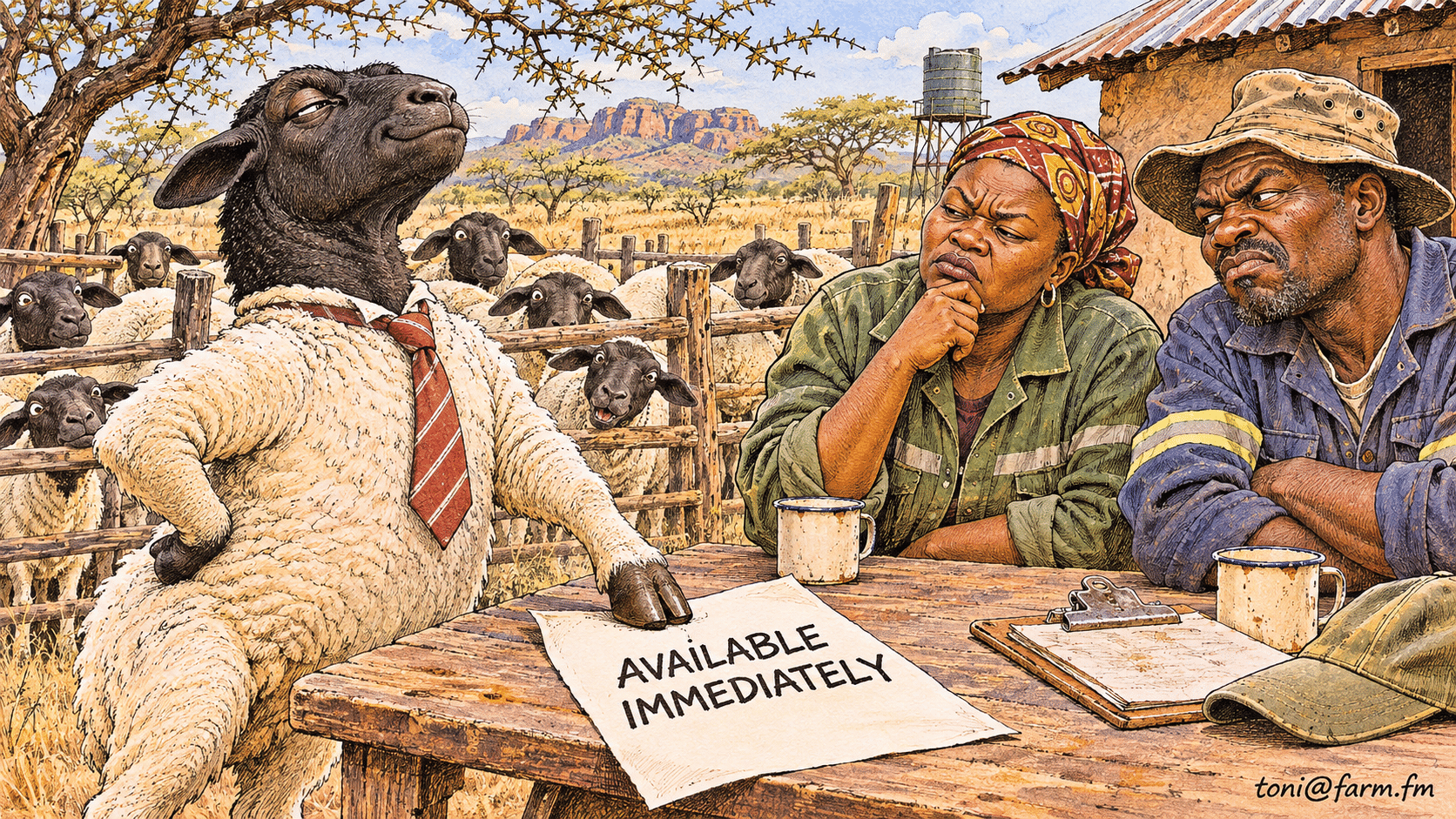
LIMPOPO, SOUTH AFRICA — A local ram has submitted a sheep breeding résumé consisting entirely of the words “Available Immediately,” explaining that previous employers had never required additional documentation because he was generally already in the paddock.
The applicant, known around the fence as Mr. Immediate, described himself as a self-starter, a people person and a results-oriented professional, although the people disputed the second claim and the results had never been weighed.
Asked for references, he nodded toward several lambs. Asked whether they were definitely his, he requested that the interview remain focused on the future.

Sheep Breeding Study Finds Being Nearby Is Not a Hereditary Qualification
The actual research behind the commotion surveyed 70 smallholder sheep farmers in two Limpopo villages. As reported in The Conversation’s account of sheep breeding practices, 90% of those surveyed used uncontrolled mating. That finding describes this sample, rather than every sheep farmer in Africa.
Researchers recommended supplementing farmers’ existing selection priorities with reproductive anatomy assessments and proposed community breeding programmes. Mr. Immediate objected to the word “supplementing,” which sounded suspiciously like somebody was bringing another ram.
“I’ve been standing beside that gate for three years,” he told the selection panel. “If that isn’t experience, what exactly have I been doing?”
The panel explained that proximity and inherited merit were separate concepts. The ram called this a dangerous precedent that could spread to management, politics and the owner’s nephew.
The Entire Career Fits on One Sheet
His application listed no growth records, parentage information or evidence about offspring performance. Under education, he wrote “the field.” Under leadership, he wrote “front of the flock.” Under weaknesses, he ate the question.
The committee acknowledged his confidence. Unfortunately, confidence had become the only farm input available in unlimited quantities, and the feed merchant still refused to accept it.
One farmer described the old arrangement as hiring a delivery driver because he happened to be leaning against the truck. Mr. Immediate considered that analogy unfair. The driver, he noted, probably required weekends.
Sheep Breeding Researchers Bring Measuring Tape to Ram Selection
The afternoon changed when a livestock specialist opened a measuring tape. Until then, the applicant had supported science in principle, particularly science conducted on other animals.
The source article identifies scrotal measurements among traits useful when assessing breeding potential, alongside live weight. It also discusses udder and teat characteristics in ewes. These are additional selection tools, not a promise that one measurement guarantees a productive flock.
Mr. Immediate nevertheless requested an immediate recess, an independent observer and clarification about whether the committee would accept a personality test instead.
“I thought we were discussing my vision,” he said.
“We’ve heard your vision,” replied a farmer. “You’ve been announcing it through the fence since breakfast.”
A second candidate, previously swaggering near the water trough, suddenly remembered an urgent grazing appointment. Witnesses watched him become the first ram in local memory to voluntarily respect a closed gate.

A Performance Review With Actual Performance
The committee proposed keeping useful records rather than relying entirely on appearance and enthusiasm. This was unsettling news for an applicant whose personal brand consisted of looking enormous beside smaller sheep.
Mr. Immediate argued that numbers stripped away the human element. The farmers reminded him that the human element paid the feed bill.
He then suggested counting every time he looked busy. The committee declined to adopt a management system already causing enough trouble in offices.
Community Sheep Breeding Plan Shares Best Ram
When farmers discussed selecting suitable breeding males for use across participating flocks, Mr. Immediate experienced a dramatic recovery of faith in agricultural cooperation.
He called the meeting the most productive of his career and volunteered to chair a subcommittee on regional access. He also proposed removing travel restrictions, shortening consultations and replacing the minutes with a map.
The farmers explained that a community programme involved agreed breeding goals and planned management. It was not a village-funded holiday for whichever male had arrived early.
This distinction wounded him. He had already described the opportunity as a promotion on his résumé, doubling its length.
The attraction for farmers was sharing access and expertise, especially where resources were limited. The attraction for the ram was considerably easier to explain and required no slide presentation.
The Ewes Request a Seat at the Table
Several ewes then asked why every discussion of flock improvement began with a male explaining how exceptional he was while they continued raising the next generation.
One pointed out that she had successfully mothered lambs, found grazing and remained functional through difficult weather without once describing herself as a thought leader.
The committee added maternal performance to its discussion. Mr. Immediate said he strongly supported women in agriculture, especially when they agreed with his application.
The ewes requested that this statement be entered into the minutes under “additional maintenance costs.”
A candidate who had survived difficult grazing conditions asked whether the panel would consider more than who looked largest beside the trough. Mr. Immediate accused him of introducing a divisive new emphasis on doing the job. The farmers called that the job.
The interview also exposed a misunderstanding about breeding objectives. Mr. Immediate believed the objective was to keep Mr. Immediate occupied. The owners preferred lambs that grew well and a flock that helped pay household expenses. Both sides agreed there had been a communication failure, although only one side had brought a pencil.
Asked what he would do if unsuccessful, the applicant outlined a consulting career. He would advise younger rams to believe in themselves, maintain visibility and never let evidence undermine their personal story. His proposed fee was access to the same paddock he was currently trying to enter for free.
He offered to begin with a motivational seminar called Finding Your Inner Gate. The farmers said they had found the gate. The remaining issue was the latch.
Better Sheep Breeding Still Has to Work on the Farm
The International Livestock Research Institute’s work on sheep and goat breeding goals stresses local production environments and the practical design of breeding programmes. A useful animal must suit the conditions in which farmers actually keep it.
In committee language, that meant preserving valuable local adaptation. In farm language, it meant that an animal requiring perfect weather, imported breakfast and emotional support at every cloud was going to have a difficult probationary period.
Nobody wanted an impressive photograph that turned into an invoice when the pasture dried out. Farmers already owned enough equipment meeting that description.
A Notebook, a Plan and a Gate That Closes
The sensible starting point was discussing breeding goals and animal assessments with qualified local livestock advisers, then keeping records the farmer could actually use. A notebook that survives a pocket is more useful than a complicated system nobody opens.
Mr. Immediate supported the notebook until he learned that it would record outcomes rather than his opinions about himself.
He made one final appeal to tradition: his father had qualified by being nearby, his grandfather had qualified by being nearby, and the family had never allowed paperwork to interfere with momentum.
The committee thanked him and said it would be in touch after reviewing the other candidates.
He remained outside the meeting, available immediately. For the first time in his working life, somebody had remembered to latch the gate.
Fifteen Observations From the Sheep Pen
1. An open gate is apparently the livestock equivalent of a glowing recommendation.
2. The ram’s résumé is short because the rest of his career is confidential.
3. Being nearby works wonderfully until somebody asks what you contribute.
4. Every breeding programme has goals; his were mostly across the fence.
5. A measuring tape can end more boasting than an entire university department.
6. The first ram to demand privacy was previously advertising himself from a hill.
7. Sharing one superior ram is the first cooperative proposal the ram has enthusiastically supported.
8. Nothing frightens an unqualified applicant like a second applicant.
9. Farmers want healthy lambs; the ram wants the selection process wrapped up before lunch.
10. Local adaptation means surviving the climate, not merely knowing where the shade is.
11. A family tree should contain more information than ‘probably that fellow.’
12. An impressive body is useful, but a breeding record occasionally ruins the mystery.
13. The ewes have been carrying the production targets and the production.
14. Community breeding creates economies of scale and one spectacularly inflated ego.
15. The only candidate opposing performance reviews was the one already holding the job.
Disclaimer From the Breeding Committee
The ram insists this story is entirely a human collaboration between two sentient beings—the world’s oldest tenured professor, who still needs tenure, and a philosophy major turned dairy farmer. Neither has accepted his offer to demonstrate his qualifications. Scientific source links concern the research; the ram’s résumé remains subject to verification.
Last Updated on November 28, 2026 by Alan Nafzger