
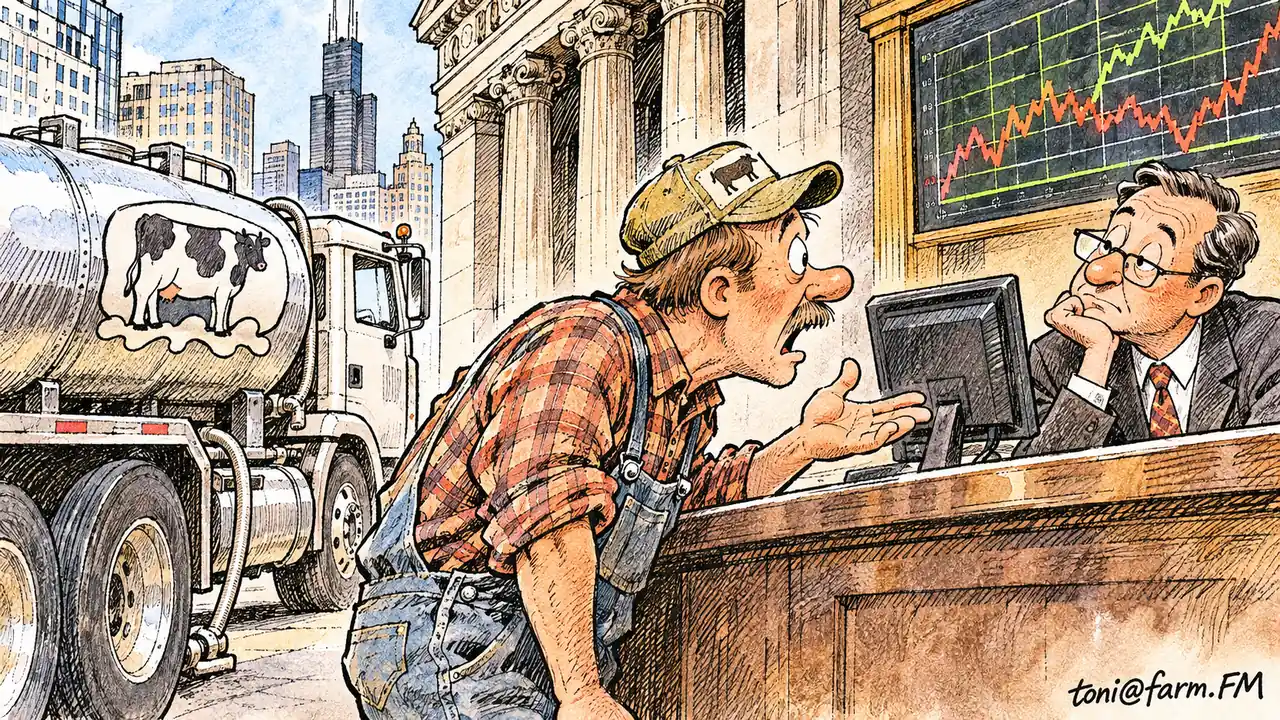
Can Futures Guarantee the Banker Stops Calling?
MADISON, Wisconsin (Farm.FM) — A dairy farm milk price hedging seminar ended Thursday with a farmer asking whether the futures market could guarantee a future in which his banker stopped calling during morning milking.
The instructor said the course was about managing price risk, not curing human suffering. The farmer replied that this was an unnecessarily narrow interpretation of agriculture.
Attendees arrived expecting advice on milk checks. Instead, they were handed charts full of contracts, options, strike prices, basis and margin requirements. One man asked where the cows went in the equation. The instructor pointed to the cash market. The man said his cows preferred the feed bunk.
A Hedge Is Not a Shrub Behind the Barn
The basics are real. CME Group lists Class III and Class IV milk futures and options for managing price exposure. A standard Class III milk futures contract represents 200,000 pounds of milk, or 2,000 hundredweight. It is financially settled, which disappointed one attendee who had brought a trailer and expected the exchange to load 200,000 pounds of something into it.
Hedging can help manage uncertainty, but it cannot promise a profit, eliminate production risk or ensure the farm’s actual mailbox price matches the futures benchmark. CME’s explanation of dairy basis makes clear why the price a farm receives can differ from the traded reference price.
The farmer wanted to know whether a negative basis was morally negative or only financially negative. The instructor said it was a price difference. The farmer wrote down, “Another way to be disappointed, now with mathematics.”
An informal survey at the coffee table found four farmers supported risk management, two supported stronger coffee, and one insisted that his grandfather had already hedged successfully by never selling anything until the tax bill arrived.
The Futures Market Meets Yesterday’s Hay Bill
The instructor demonstrated a hypothetical hedge. Prices moved, accounts changed value and somebody needed enough liquidity to handle margin calls. The farmers understood the last part immediately. They had experienced calls from people wanting more money since the moment they bought their first calves.
The practical plan was less glamorous than the chart: determine how much milk production is actually exposed, estimate the farm’s basis, understand contract size and transaction costs, and review the strategy with a qualified adviser before placing trades. Price protection should be measured against the operation’s cash flow rather than against the thrill of correctly predicting Tuesday.
At graduation, participants received certificates stating that they understood dairy derivatives. The instructor asked the class what a put option did. A farmer said it gave you the option of putting your head down on the kitchen table.
That was not technically correct, although every person in the room recognized the practical application.
Editorial note: The seminar and survey are satirical storytelling; the linked exchange contract details are real. This story is entirely a human collaboration between two sentient beings: the world’s oldest tenured professor and a philosophy major turned dairy farmer.