

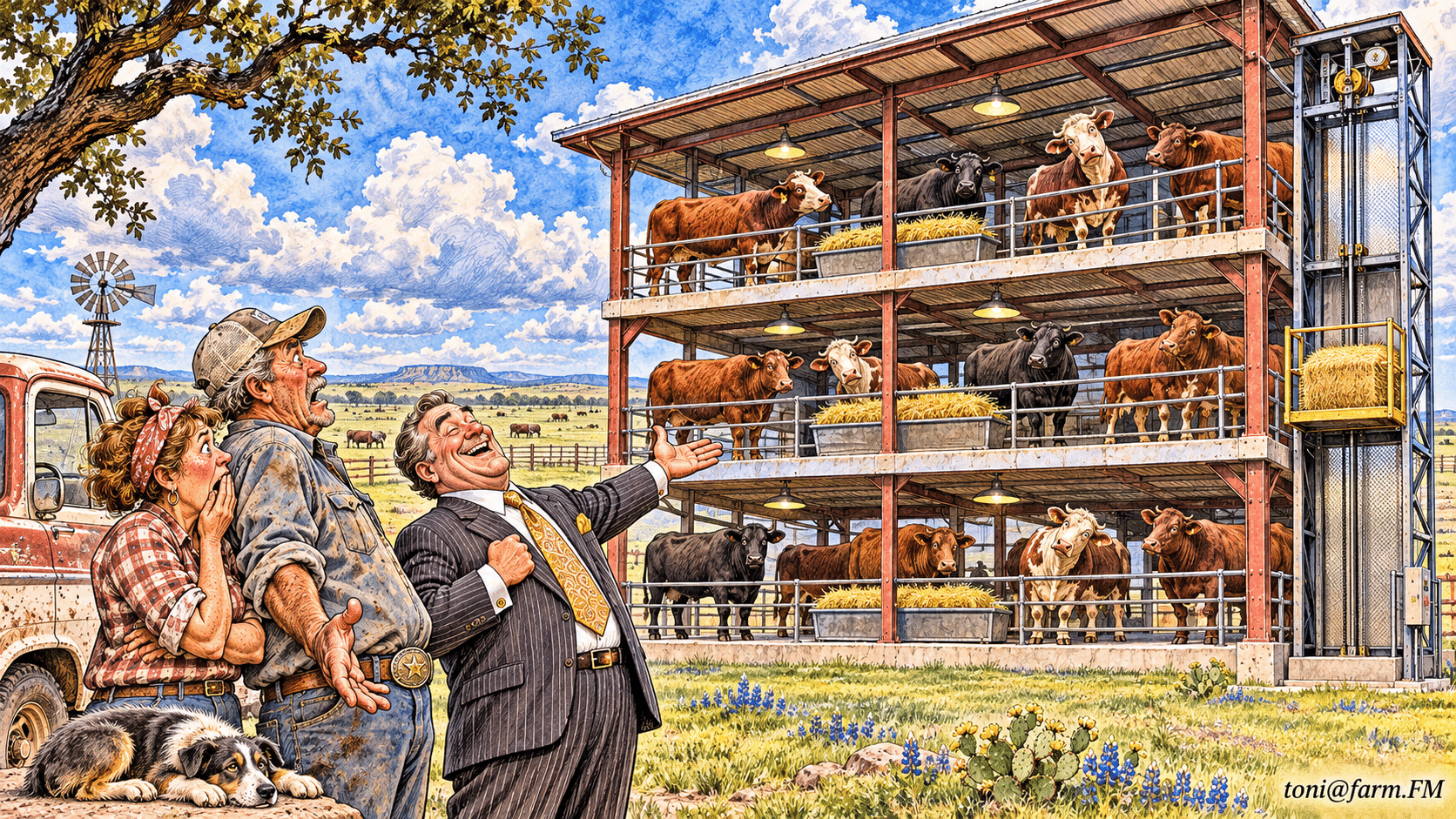
WICHITA COUNTY, TEXAS — A rancher seeking herd expansion financing received an innovative solution from his bank: keep the same acreage and arrange the cattle in additional stories.
Loan officer Brent Ledger proposed the strategy after studying a spreadsheet that contained purchase prices, projected calf revenue and no column for gravity.
“Your problem is horizontal thinking,” Ledger told rancher Wade Blevins. “Every time you buy another cow, you insist on putting her next to the existing cows. Have you considered above?”
Herd Expansion Meets the Bank’s Elevator Pitch
Blevins had arrived with pasture maps and feed estimates. Ledger arrived with six toy cattle, a stapler and the confidence of a man whose office plants are maintained by somebody else.
He arranged the cattle in three tiers, using loan brochures as structural supports. The demonstration collapsed when Blevins opened the folder containing his operating expenses.
“Normal market volatility,” Ledger said, retrieving a plastic Hereford from his coffee.
The real arithmetic is challenging enough. USDA’s 2026 land-values report puts average U.S. pasture value at $2,000 an acre. That is a national average, not an appraisal of Blevins’s place, though his banker appeared willing to appraise the air above it immediately.
More Cows Per Acre, Same Planetary Laws
Ledger’s plan would increase cattle density by adding what he called premium livestock mezzanines. Blevins asked where the grass would grow.
“We’re solving the real-estate problem first.”
“The cows eat every day.”
“Then we’ll need a recurring-revenue solution.”
Blevins explained that stacking animals would not manufacture additional forage. Ledger nodded sympathetically and suggested vertically integrating the hay.
For illustration, Blevins described a 100-acre pasture priced at the national average: $200,000 before fencing, water, cattle or financing. Ledger agreed the number was substantial, then divided it by three floors and announced that affordability had improved.

“That’s the same two hundred thousand dollars,” Blevins said.
“Yes, but now it has an elevator pitch.”
Herd Expansion Requires Feed on Every Floor
The Dallas Fed’s second-quarter agricultural survey reported high cattle prices alongside persistent profitability concerns. Ledger interpreted this as proof that ranchers needed an exciting new expense.
His preliminary design included a freight lift, rooftop mineral stations and a manure-management feature described only as downward mobility.
Blevins’s wife, Rita, asked whether the bank would finance the structure. Ledger said approval depended on a satisfactory cash-flow projection. She asked whether the structure improved cash flow. Ledger said that depended on approval.
Rita recorded the exchange as the first self-licking salt block.
Independent Review Finds the Ground Still Useful
Visiting row-crop farmer Clyde “Straight Row” Mercer reviewed the proposal from the tailgate of his pickup.
“A banker telling you to stack cows is a man who’s figured out how to put one bad loan on top of another,” Mercer said.
A quick show of hands among six ranchers produced unanimous support for leaving livestock on the ground. Ledger dismissed the sample as unrepresentative because every respondent had worked with livestock.
Rita suggested the family compare lease costs, forage capacity and debt payments before expanding. Blevins agreed. The banker requested that they call this a feasibility phase so his original recommendation could remain in the file.
The meeting ended with Ledger approving an additional line of credit for planning.
Blevins declined. “I came in needing more pasture,” he said. “Somehow I’m leaving grateful my cows don’t have upstairs neighbors.”
Elevated disclaimer: This satire’s banker and cattle tower are comic inventions, not livestock advice. The world’s oldest tenured professor and a philosophy major turned dairy farmer serve as honorary human collaborators; neither is licensed to install a second floor on a bull.
Last Updated on November 23, 2026 by Alan Nafzger
That banker wants three stories of cows, and I got one story for him: whoever bunks on the ground floor ain’t gonna like the plumbing. I’ll stack a heifer upstairs the day that bank puts a cattle ramp on the drive-thru.
Stack my cows three high and the bottom one will file a complaint.
Banker never had to shovel the bottom floor of a cow tower.
Fine by me, as long as the banker takes the top floor milking shift.
I’ll stack cows when the banker stacks his interest rate lower.