

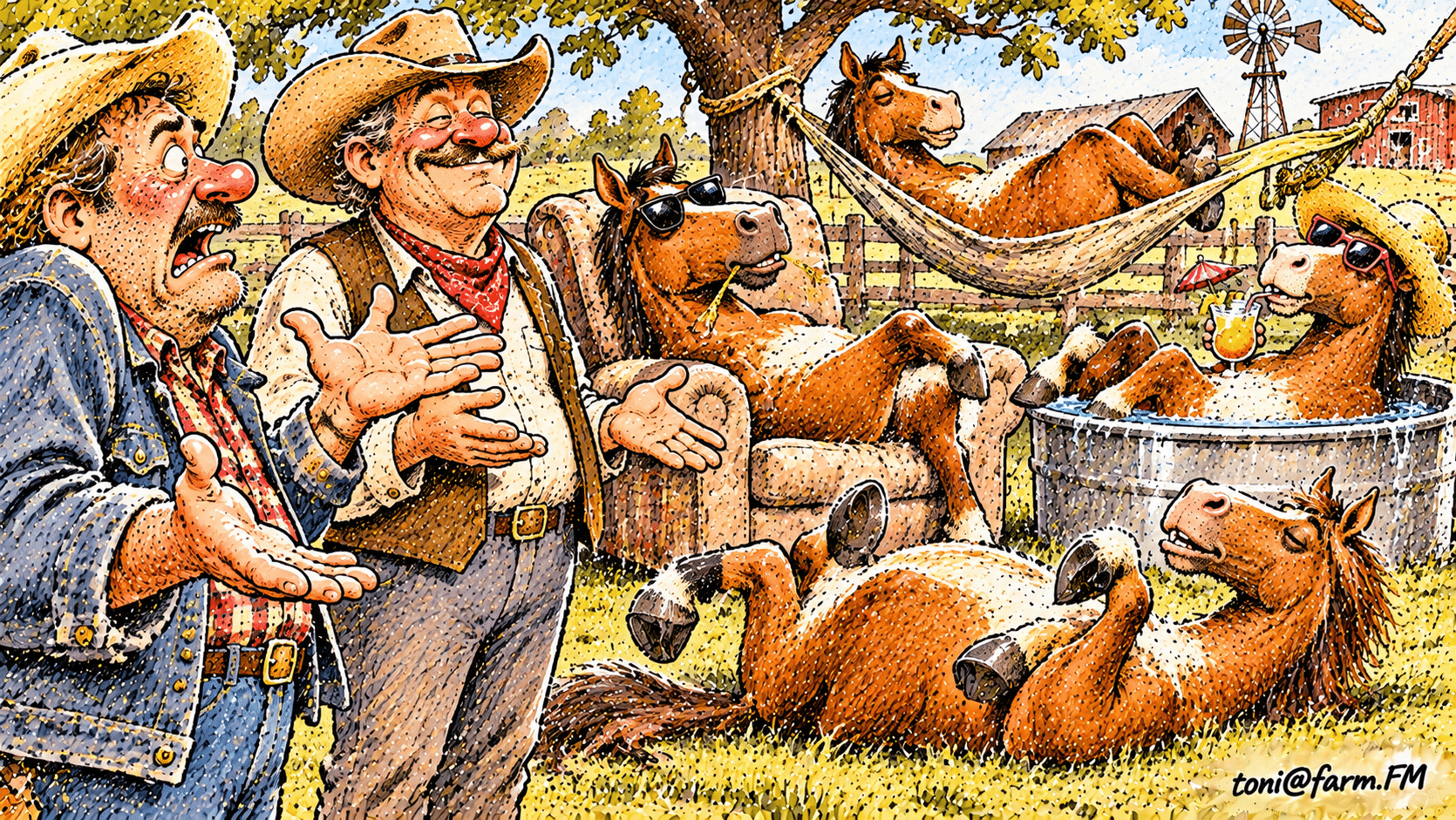
Independent Thinker Turns Out to Mean Won’t Be Caught
CHEYENNE, Wyoming (Farm.FM) — An advertisement for ranch horses for sale has described an eleven-year-old gelding as an “independent thinker with a strong sense of personal boundaries.” Buyers discovered he interprets those boundaries as a firm prohibition against saddles, trailers, gates, and most human suggestions.
“He’s got leadership qualities,” seller Wade Barlow explained after the horse refused to cross a shallow puddle. “He leads you directly back to the barn.”
The horse, named Senator, was listed as suitable for an experienced rider. Barlow said the phrase could also mean the rider should have extensive experience apologizing to horses.
Ranch Horses for Sale Now Sound Like Dating Profiles
A second listing offered a mare who “enjoys an active lifestyle,” a description that proved accurate when she ran away from everybody. Another was “highly motivated by food,” the equine equivalent of advertising a pickup as fond of gasoline.
A third horse was praised for its “excellent recall.” Barlow clarified that this meant it remembered exactly which fence had collapsed last spring and still declined to approach that location.
Prospective buyer Abby Flores arrived with a sensible checklist: temperament, training, age, health, and the specific ranch work expected. The seller produced a laminated photograph of Senator against a dramatic sunset. The horse looked employable. The seller looked relieved.
“Does he gather cattle?” Flores asked.
“He gathers attention,” Barlow replied.
“Does he stand for the farrier?”
“Eventually. The farrier generally stands first.”
Flores did what equine professionals recommend. She arranged a pre-purchase examination and asked to see the horse perform ordinary tasks rather than relying on poetic advertising. The University of Connecticut’s horse-selection guidance advises prospective buyers to consider behavior and conformation and involve a veterinarian. Romance is not a substitute for soundness.
The Trial Ride Reveals a Negotiation Specialist
Senator accepted the saddle after a lengthy discussion and one apple. He walked seventeen feet, stopped, and stared toward the barn. Barlow described the pause as an opportunity for rider reflection. Flores described it as the least successful seventeen-foot commute in Wyoming.
When encouraged to turn left, Senator turned right. When encouraged to trot, he sighed. When asked to back up, he backed into a gate with the precision of a lawyer finding a loophole.
Ranch Horses for Sale Need More Than Creative Ad Copy
Real buyers need a horse suited to their skill level and intended work. Missouri Extension’s guide to buying a horse recommends a veterinary examination and consideration of health, soundness, and training. None of those qualities can be established by putting “cowboy ready” on a photograph.
Flores eventually purchased a quieter mare from another ranch. The seller had described her simply: “Saddles, loads, works cattle, not pretty.” Flores called it the finest résumé she’d seen all month.
Barlow revised Senator’s listing to “executive-level strategic thinker seeking low-pressure opportunities.” A consulting company in Denver offered him a position immediately.
Senator declined to relocate.
Disclaimer: All sellers, horses, buyers, advertisements, and quotations in this account are satirical. The equine purchasing guidance cited is real. This story is entirely a human collaboration between two sentient beings: the world’s oldest tenured professor and a philosophy major turned dairy farmer.