
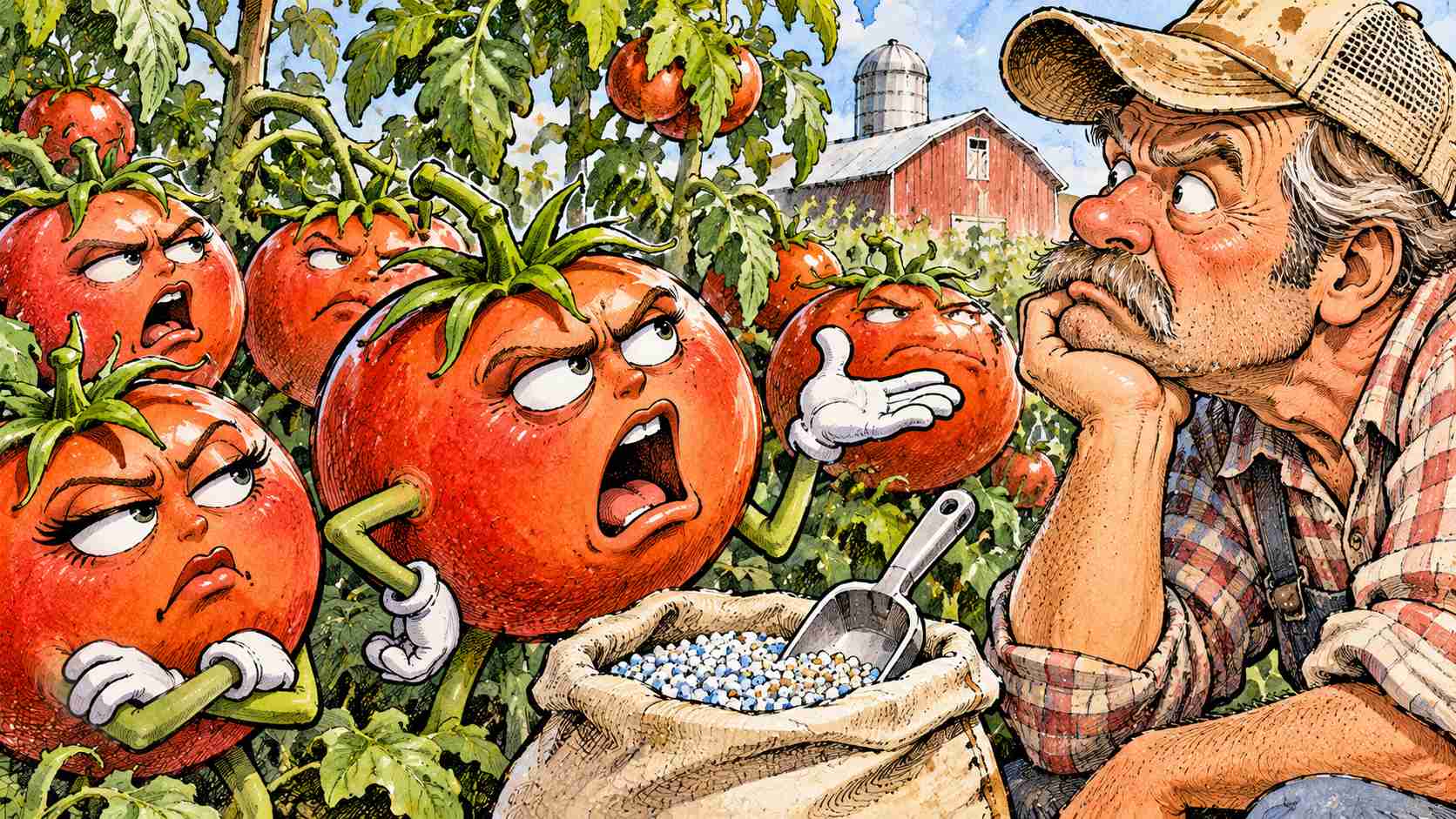
Farmers say their wives and bankers already do that
AMES, Iowa (Farm.FM) — American agriculture has entered a dangerous new era: Scientists have taught tomatoes to complain, and farmers who already answer to spouses, bankers, machinery dealers and livestock now fear the vegetables are organizing.
Cornell University’s RedAlert tomatoes turn red-purple when nitrogen is low. Their leaves and flowers use a pigment associated with beets to make nutrient stress visible. The plants are experimental field sensors, not a new variety for the produce aisle. That did little to comfort Iowa grower Clyde Merritt.
“I’ve got a wife who wants the porch fixed, a banker who wants his payment, and calves who want breakfast,” Clyde said. “Now I’ve got a tomato changing outfits because lunch is late.”
His wife, Janice, objected. “I asked him to fix the porch in 2019. The tomatoes have already developed a better communication strategy.”
Nitrogen Sensor Plants: The Farm Gets Its First Botanical Teenager
For ten thousand years, plants had the courtesy to stay quiet. When they were hungry, they yellowed. When they were thirsty, they drooped. Now a tomato can express unhappiness before dinner has even been served.
“That’s not precision agriculture,” Clyde said. “That’s raising another teenager. Green when it’s happy. Purple when it’s hungry. What happens when it gets a driver’s license?”
A visiting consultant suggested that different shades might eventually map to different nitrogen conditions. Clyde immediately pictured a glossy chart with 46 gradations of purple, a subscription fee and a mandatory webinar called Listening to Your Tomato’s Needs.
Dale Voss, a farm-management consultant who works with growers across central Iowa, said a color scale would be “useful, eventually, and expensive immediately.” The service agreement his firm drafted for a pilot program runs eleven pages. Section 14(c), in type small enough to require a second pair of glasses, states that the tomato’s needs “may change without notice.” Clyde read it twice.
“Same clause my wife has,” he said. Janice did not dispute this.
She liked the idea of a second sensor that checked whether the farmer was listening. “It would glow bright red every time Clyde says, ‘I’m getting to it.'”
Color-Changing Tomato Research: Still Being Tested
Scientists can reasonably hope the color shift will improve fertilizer decisions, but the real-world test is still running. Cornell reported that hot early days and powdery mildew complicated its 2026 field season. Mature plants sometimes grew greener leaves after nitrogen was added, an encouraging sign that still needs careful interpretation. The invention was also a finalist in the national Collegiate Inventors Competition, run by the National Inventors Hall of Fame.
Clyde called that ordinary farm life. “A crop gets sick, the weather goes nuts, and the farmer spends money. You don’t need a laboratory to reproduce that.”
Warning Lights, but No Repair Manual
The tomatoes reminded Clyde of his pickup, whose dashboard currently looks like a Christmas tree with a gambling problem.
Low tire pressure. Check engine. Service soon. Now apparently his fields will come with their own warning lights.
“A pickup tells me what’s wrong, but it never offers to pay for repairs,” he said. “Same with the tomato. It turns purple and sends me straight to the fertilizer dealer.”
Text messages Janice shared with Farm.FM suggest the communication gap predates the tomato:
Janice, March 4: Porch?
Clyde, March 4: Getting to it.
Janice, June 11: Porch?
Clyde, June 11: Getting to it.
Janice, Oct. 29: The tomato’s messages have more detail than yours.
The farm’s hired hand, Dustin, supported the invention as long as it could also locate missing equipment. The sensor plant can sense nitrogen around its roots, Dustin noted, while he had spent most of Tuesday looking for a tractor parked behind a grain bin.
“Maybe the tomato should supervise,” Janice said.
Dustin replied that he would consider working for a vegetable, but only if it offered dental.
Farmer Seeks Emotional Support From the Crop
Cornell researchers picture sentinel plants growing alongside commercial crops to flag nutrient shortages. Clyde supports agricultural innovation, especially anything that cuts wasted fertilizer, and he has read the Iowa State University Extension and Outreach guidance on nitrogen enough times to know none of it comes in purple. A nutrient runoff problem he never asked for is one more reason he’d like the sensors to work.
But he asked the scientists not to give the plants any more vocabulary.
“First it’s fertilizer. Next they’ll demand paid vacation, workplace dignity and a four-day growing week. Then the cucumbers will want collective bargaining.”
Janice reminded him the tomatoes are not meant for eating.
“Perfect,” Clyde said. “Another dependent I have to feed who’ll never put supper on the table.”
By evening he had decided the tomato wasn’t the problem.
“The problem,” he said, “is that the vegetable is now the only member of this family whose complaints count as scientific data.”
Five Observations on Vegetables With Opinions
- They taught a tomato to complain. We spent ten thousand years of agriculture getting plants to shut up and grow, and one grad student undid it with a pigment.
- Green when it’s happy, purple when it’s hungry. That’s not a sensor, that’s a toddler with a root system.
- A tomato you can’t eat, that asks for fertilizer and never helps with dinner. So it’s a teenager with better PR.
- My pickup tells me everything is wrong. The tomato tells me exactly what to buy. Finally, a salesman who can’t take a lunch break.
- “I’m getting to it” is the longest-running sentence in American agriculture. It has outlasted four farm bills and one porch.