
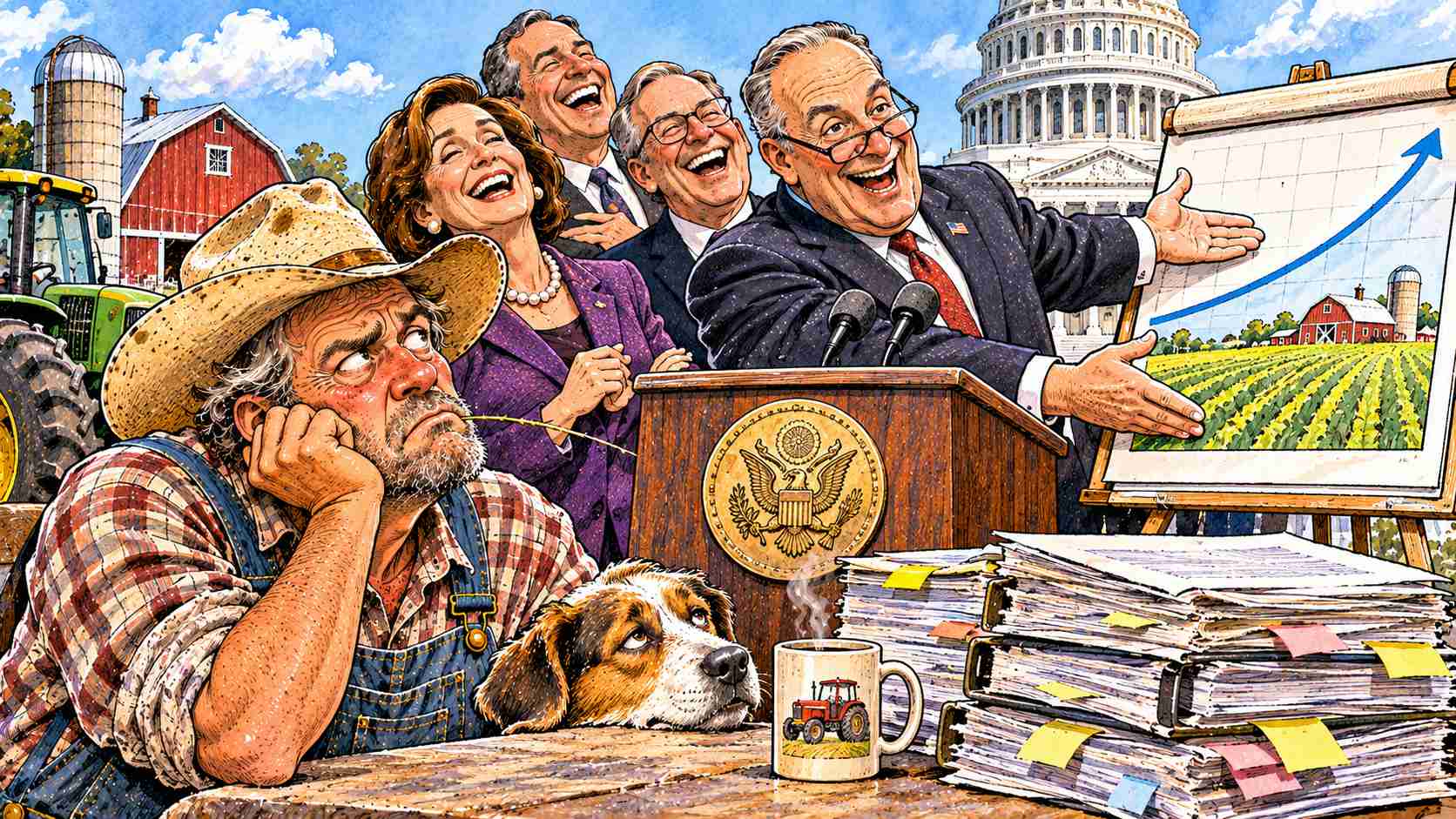
Officials Say Foreclosures Will Be Faster, Paperwork Lighter
DES MOINES, Iowa (Farm.FM) — Washington has reassured American farmers that another 1980s-style agricultural financial crisis will be handled more efficiently, with improved foreclosure technology, electronic bankruptcy applications and federal employees on hand to explain why losing the family farm is an exciting economic transition.
The announcement follows growing concern about agricultural debt, rising production expenses and the remarkable ability of politicians to discuss farming without ever getting manure on their shoes.
1980s Farm Crisis Lessons Washington Never Learned
During the original farm crisis, thousands of producers lost their livelihoods as land values collapsed, debt piled up and interest rates punished anyone foolish enough to believe that growing food should be financially sustainable.
According to the USDA’s historical agricultural land statistics, average farmland values declined approximately 25 percent between 1984 and 1987.
Washington studied the disaster extensively and eventually concluded that farmers should have avoided borrowing money, buying land or participating in agriculture.
“We’ve learned from history,” explained a federal agricultural economist who asked not to be named. “The biggest problem in the 1980s was that bankruptcy proceedings took too long. Today, we can destroy a family’s financial future with considerably less paperwork.”
The USDA’s September 2026 farm income forecast projects production expenses rising $21.2 billion this year. Fuel and oil expenses alone are expected to climb $4.8 billion.
Farmers describe these figures as alarming.
Washington describes them as opportunities for additional meetings.
Internal Memo Details Farm Foreclosure Streamlining Plan
A memo circulated among regional agricultural officials, a copy of which was reviewed for this report, carries the subject line “Streamlining Distress Communications.” Page two recommends replacing the word “foreclosure” with “ownership transition” and the word “auction” with “community equipment event.” Page three recommends light refreshments.
The memo’s final paragraph asks staff to “avoid references to the 1980s wherever possible, including in the name of the program.”
The program is called Back to the Eighties.
Farm Bankruptcy in Five Stages, Explained by a Corn Farmer
Iowa corn farmer Earl Pritchard has developed his own interpretation of federal agricultural policy.
“First they tell you to plant more. Then they tell you the market’s oversupplied. Then diesel goes through the roof. Then the bank calls. Finally, some fellow in Washington says we’re all in this together.”
Pritchard says he invited a congressman to experience the crisis firsthand.
“I offered to let him drive the combine for twelve hours. He asked whether it came with a chauffeur.”
The new federal approach reportedly emphasizes dignity during financial collapse.
Farmers will receive informational brochures explaining how to surrender equipment, negotiate with creditors and tell their grandchildren why the land their great-grandfather bought now belongs to an investment company.
Each brochure features a smiling tractor. The fine print on the back panel, set in six-point type, states that the tractor “does not represent any equipment the recipient will own after the program concludes.”
Committee Minutes Show Concern, Zero Motions
Minutes from the October 14 meeting of the Polk County Farm Credit Review Committee record eleven members present, nine expressions of concern and no motions of any kind. The minutes note that coffee ran out at 10:40 a.m. and that discussion of debt relief was tabled so it could be continued over lunch.
Lunch was not provided.
Farmers Demand a Chance at Farm Profitability
Farmers aren’t demanding yachts, private jets or government-funded vacations. They’re asking for markets that work, affordable operating costs and enough income to keep farming.
Those requests have confused policymakers who are used to solving agricultural problems by creating more agricultural problems.
One Washington consultant suggested replacing family farms with agricultural awareness seminars.
Another recommended making tractors electric, provided someone could invent a battery big enough to cultivate Kansas.
Pritchard offered a simpler solution.
“Get the costs down, keep the markets open and quit treating us like we’re the problem.”
Washington has reportedly agreed to consider the proposal.
First, though, officials need another study.
The previous study was apparently lost during the last farm crisis.
Five Observations on the Next Farm Crisis
- They studied the last farm crisis for forty years and the big takeaway was a better PDF. That’s not learning. That’s losing in high definition.
- A brochure with a smiling tractor. Think about that. The tractor’s the only one in this whole story with any equity, and it’s smiling at you while you hand over the keys.
- “Ownership transition.” Great. I’d like to transition my mortgage into somebody else’s ownership and see how far that gets me at the bank.
- Nine expressions of concern and zero motions. That’s not a committee, that’s a group chat with a catering budget.
- Another study. There’s always another study. The last one got lost, which tells you exactly how seriously they filed it.