
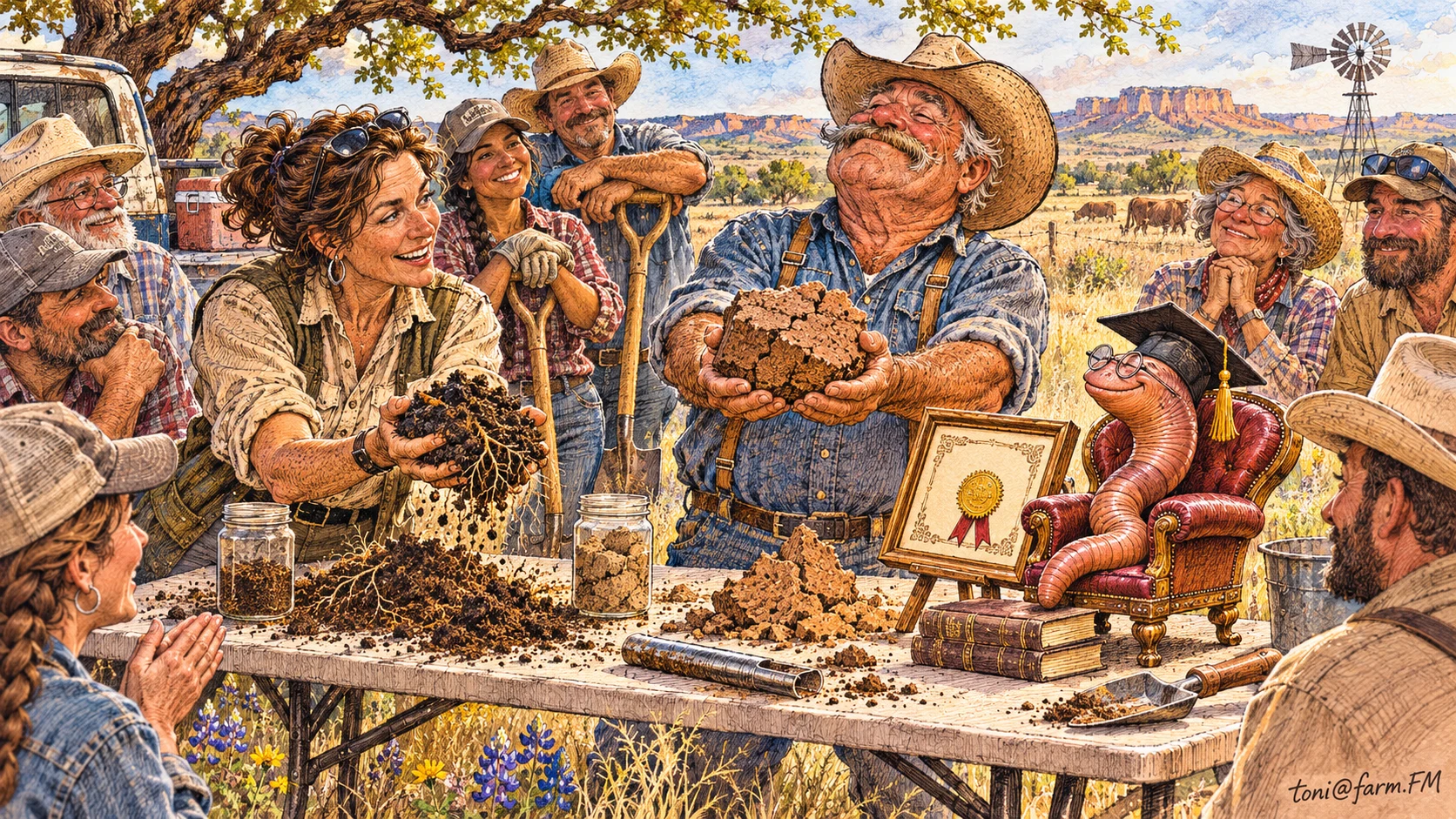
Soil health has given earthworms tenure at a West Texas field school after instructors determined that the worms had spent more years underground than anyone on the faculty and had never once requested reserved parking.
Clyde “Straight Row” Mercer attended the workshop because his lender asked whether the farm had a soil-health plan. Clyde replied that the soil was still present. The lender requested additional documentation.
At registration, each farmer received a shovel, an infiltration ring and instructions to bring one clod with emotional significance. Clyde selected a hard chunk from the headland that had survived three disks, a pickup and an argument about tire pressure.
Soil Health Begins With a Faculty Meeting
Instructor Denise Hall placed two soil samples on a table. One broke into rounded aggregates with visible roots and pores. Clyde’s sample struck the table with the confidence of a brick.
“This one has structure,” Clyde said.
“So does the courthouse,” Denise replied. “We’re trying to grow sorghum.”
The class looked for surface cover, root activity, compaction, earthworms and signs of erosion. Clyde found one worm and promoted it to department chair. The worm declined to speak, publish or attend meetings, immediately qualifying it for senior administration.
Farmers, educators and students looking for soil-testing, cover-crop, compaction, infiltration and conservation resources can use the SoilHealthAcademy national learning directory. Its geographic pages organize research guidance rather than claiming to know whether a particular field is healthy from several states away, a service already offered by seed salesmen at lunch.
The Infiltration Test Needs a Lunch Hour
Denise pressed a metal ring into the ground and poured in a measured amount of water. In the cover-cropped demonstration plot, water moved into the soil. In Clyde’s compacted headland, it remained on the surface and began considering waterfront development.
Clyde checked his watch.
“How long does this test take?”
“Until the water infiltrates.”
“So we should notify my heirs.”
They compared fields, recorded starting conditions and repeated the test. Denise explained that infiltration varies with soil texture, moisture, structure and management. One dramatic pour did not constitute a scientific dynasty. Clyde canceled the small trophy he had ordered for the first field to finish.

The Cover Crop Refuses to Be Decorative
The class examined a diverse cover-crop mix. Clyde identified rye, clover, radish and one plant he described as “government parsley.” Denise said species should be selected for goals such as erosion protection, living roots, nutrient cycling, forage or compaction management, then matched to climate, rotation and termination plans.
Clyde asked whether a cover crop could be planted without a termination plan.
“Certainly,” Denise said. “That is how you create next year’s main problem.”
He wrote this down because it also applied to equipment financing.
NRCS Gives Soil Four House Rules
The USDA Natural Resources Conservation Service explains in its soil health guidance for cropland that farmers can minimize disturbance, maximize soil cover, increase biodiversity and keep living roots present as much as practical. NRCS notes that these systems can improve organic matter, water infiltration, nutrient cycling and resilience.
Clyde approved of minimizing disturbance until he learned it included tillage.
“I thought it meant stop calling me during supper.”
Denise said the principles must be adapted to the farm, soil, climate and production system. Soil health was not one product, one practice or one photograph of a radish penetrating a conveniently loose profile. It was a management direction measured over time.
The class established baseline observations: soil-test results, aggregate stability, infiltration, residue cover, erosion, rooting and yield. Clyde suggested adding “number of times the wind moves the county line.” Denise placed that under local conditions.
Biology Requests a Budget
Under a microscope, participants saw bacteria, fungi, organic fragments and organisms whose professional titles were unclear. Clyde asked how much they charged per acre.
“They work for carbon,” Denise said.
“Finally, labor I can afford.”
Plants feed soil organisms through roots and residues; the organisms help cycle nutrients and build soil function. Clyde proposed paying the microbes only after harvest. The microbes continued working without acknowledging his authority.
By afternoon, he planned a small comparison rather than converting every acre during a burst of workshop enthusiasm. He would reduce unnecessary passes, maintain residue where practical, test a locally appropriate cover crop and track infiltration and economics.
The earthworm retained tenure but received no office.
Helpful Soil Notes
Start with a defined resource concern and baseline measurements. Use representative soil samples, compare the same locations over time and choose practices that fit the rotation, water and equipment. Change manageable acres first, record costs and outcomes, and consult local conservation and Extension professionals. Never diagnose soil by color alone; a dark field may contain organic matter, moisture or the place your son drained the engine oil in 1998.
*Disclaimer: This report is entirely a human collaboration between two sentient beings—the world’s oldest tenured professor and a philosophy major turned dairy farmer. Neither grants academic tenure to invertebrates, although both agree the earthworm attends more fieldwork than most committees.*