
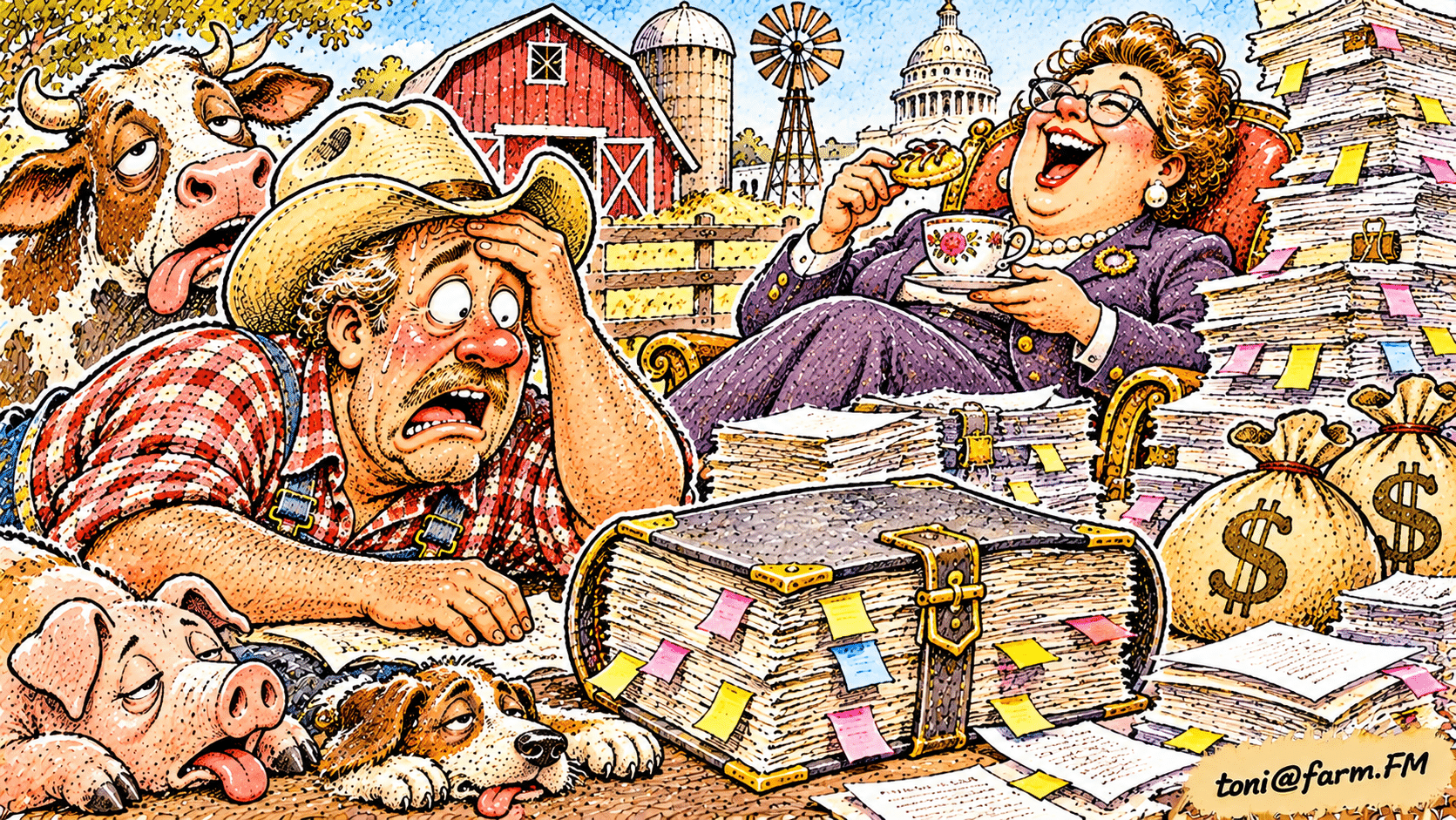
USDA Announces Record Farm Assistance; Farmers Ask Why Record Help Requires Record Suffering
Washington celebrates historic agricultural payments while farmers investigate the possibility of making money without government assistance.
WASHINGTON, D.C. – Federal agriculture officials are celebrating an extraordinary success after announcing approximately $13.8 billion in Agriculture Risk Coverage and Price Loss Coverage payments for the 2025 crop year.
The USDA Farm Service Agency announcement identifies the payments as the largest annual payout since those programs were established.
Farmers immediately raised an uncomfortable question.
“If the safety net is paying more money than ever,” asked Kansas wheat farmer Clyde Haskins, “does that mean we’re doing better, or falling farther?”
Officials requested that he submit the question in writing.
Preferably after the press conference.
Record Assistance Meets Record Confusion
The federal farm safety net exists partly to cushion producers against low commodity prices and revenue shortfalls.
Farmers understand the purpose.
They also recognize the contradiction of celebrating record financial assistance as though it were evidence of record prosperity.
“That’s like a hospital celebrating because the emergency room is full,” Haskins explained.
An agricultural economist called the comparison unfair.
“Hospitals measure health outcomes,” he said. “Agricultural programs measure eligible payments.”
Haskins asked whether the economist had ever planted wheat.
The economist replied that he had once purchased bread.
Washington Invents a New Farm Business Model
At an agricultural policy conference, consultants proposed that farmers stop thinking of themselves primarily as food producers.
Instead, they should consider becoming professional participants in federal agricultural programs.
The new business model involves several stages.
First, grow a commodity.
Second, experience financial difficulty.
Third, document the difficulty.
Fourth, submit the documentation.
Fifth, wait for federal administrators to determine how much assistance is available.
Finally, repeat the process.
“That’s not a business model,” Haskins objected. “That’s a scavenger hunt where the prize is part of your own money.”
Consultants were impressed.
They added his phrase to their next presentation.
The Crop Doesn’t Care About the Press Release
USDA economists forecast direct government farm payments of $47.4 billion in 2026, covering several programs and forms of assistance.
That does not mean every farmer receives a proportionate check, nor does it establish that assistance exceeds farmers’ actual losses.
Haskins understands both points.
He also understands that a federal payment doesn’t lower the price of fertilizer, repair a broken combine, or persuade the wheat market to pay more.
His preferred agricultural policy would allow producers to earn dependable profits from productive farming.
“Imagine that,” he said. “A farmer sells wheat, pays his expenses, and has money left.”
A Washington consultant described the concept as radical.
Another warned it might reduce demand for agricultural consultants.
Farmers Propose a New Measurement
Haskins suggested that Washington stop evaluating agricultural success by the number of dollars distributed through assistance programs.
Instead, policymakers might consider how many producers can remain financially viable without extraordinary intervention.
The suggestion generated considerable concern.
If farmers became sufficiently profitable, there might be fewer emergencies to administer.
The conference ended without adopting his proposal.
Haskins returned to Kansas, where his tractor had developed a mysterious knocking sound.
He estimated the repair would consume much of his expected payment.
“Well,” he concluded, “at least somebody is making money from agriculture.”
The mechanic agreed.
Note from Farm.FM: The $13.8 billion in ARC and PLC payments is real; Clyde Haskins, the economist who once purchased bread and the scavenger-hunt business model are here for laughs. This is farm satire. Rural areas need it because when the headlines call a bad year a record, farmers deserve a voice that reads the press release the way they do, from the tractor seat.