
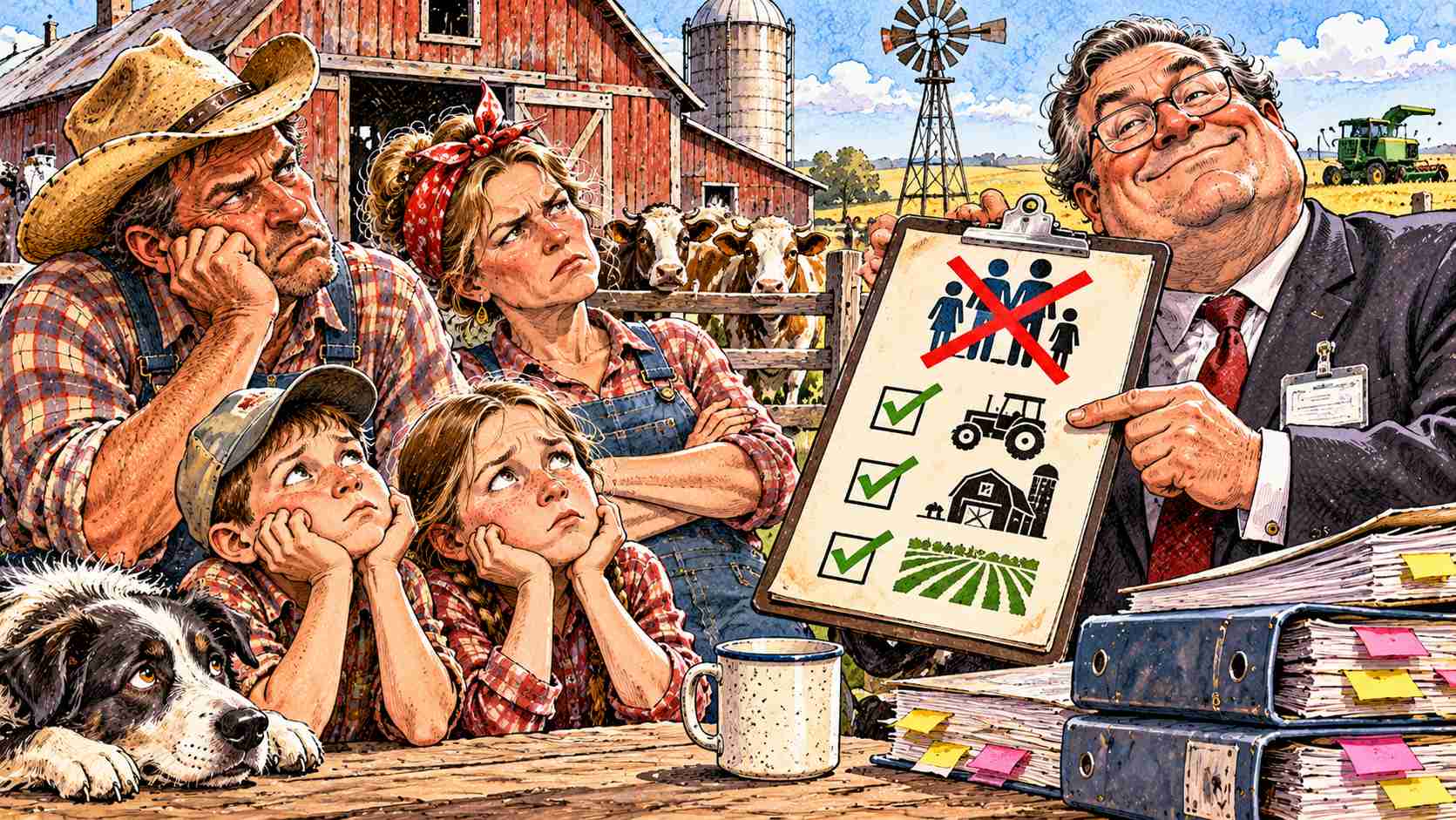
Washington’s Rural Plan: Sell the Land, Skip the Farmer
WICHITA FALLS, Texas (Farm.FM) — America’s family farms are facing an unusual succession problem: grandparents want to retire, parents can’t afford to retire, and their children have discovered that working in an air-conditioned office comes with health insurance and considerably fewer encounters with angry livestock.
Washington has developed an innovative solution.
Instead of making family farming financially sustainable, officials will encourage younger generations to pursue careers elsewhere while wealthy investors buy the land their grandparents spent decades paying for.
The program has been informally dubbed Saving the Family Farm by Eliminating the Family.
Young Farmers Find Inheriting Land Isn’t the Same as Affording It
North Texas rancher Walter Blevins recently asked his son whether he wanted to become the fourth generation to run the family property.
“Absolutely,” his son replied. “How much does it pay?”
Walter explained that income depended on cattle prices, rainfall, feed costs, equipment expenses, interest rates and whether something expensive died unexpectedly.
“So it’s gambling?”
“No, son. Gambling has better hours.”
The son requested health insurance, paid vacations and weekends off.
Walter offered him a pair of gloves.
Extension Service Study: One in Five Farm Kids Plans to Farm
A study of 640 farm and ranch families by the Rolling Plains Agricultural Extension Council found that 21 percent of adult children said they planned to take over the family operation. Of those, 62 percent said they planned to do so “in addition to a full-time job in town.” Nine percent said they planned to do it “out of spite.”
Lead author Marcy Tolliver said the spite category was not in the original survey. Respondents wrote it in.
USDA Statistics Show the Number of Farms Shrinking
According to the USDA’s 2025 Farms and Land in Farms report, the United States had approximately 1.865 million farms, down 15,000 from the previous year.
Meanwhile, the USDA’s 2026 farmland valuation analysis places average American farm real estate at approximately $4,500 per acre. The Census of Agriculture tracks the same trend from the other direction: fewer farms, bigger operations, older operators.
Economists describe rising land values as evidence of agricultural wealth.
Farmers describe it as owning something extremely valuable that refuses to generate enough cash to pay for its own equipment.
“It’s wonderful being land-rich,” Walter observed. “Unfortunately, my fertilizer dealer won’t accept a beautiful sunset as payment.”
Farmland Investors Discover Farming Pays Better Without Farmers
Investment firms increasingly view agricultural property as an asset class.
Family producers tend to view the same land as their livelihood, family history and the place where Grandpa accidentally drove a tractor into the creek in 1974.
An investment consultant explained the difference.
“We purchase agricultural land for long-term capital appreciation.”
Walter nodded.
“I purchase it to raise cattle.”
“How quaint.”
“And what do you produce?”
“Quarterly reports.”
Walter admitted that quarterly reports were probably easier to feed.
County Auction Notice Posted at the Courthouse
A public notice posted at the Wichita County courthouse lists an upcoming sale of ranch equipment belonging to a family two miles down the road from the Blevins place. Items include one 1998 baler, one stock trailer “with minor structural opinions,” 140 round bales and a family-size dinner bell.
Under “Terms of Sale,” the notice says “cash, certified funds or tears.”
The sale is scheduled for the first Saturday of the month. Walter said he plans to attend, as he does every time.
Text Messages: A Father and Son Discuss the Future
Walter shared the text exchange he had with his son the night the loan officer position came through. He asked that it be reproduced as written.
SON: got the job
WALTER: what kind of job
SON: reviewing farm loans
WALTER: so you decide who gets to farm
SON: kinda
WALTER: dental?
SON: yes dad dental
Walter said he had asked about the dental plan.
Congress Announces New Rural Career Opportunities
Washington’s proposed agricultural transition strategy offers displaced farm children exciting employment possibilities.
Former cattle producers can become agricultural consultants.
Former wheat farmers can lead food-security seminars.
Former dairy farmers can advise corporations about sustainability while explaining that cows produce milk every day, including federal holidays.
Walter’s son eventually accepted a position reviewing agricultural loan applications.
His starting salary exceeded what his father had earned during several difficult farming seasons.
“Congratulations,” Walter told him. “You’ve finally found a way to make money from farming.”
His son smiled.
“Without actually farming.”
Walter surveyed the family property, the aging barn and the cattle waiting impatiently for breakfast.
“That’s the American agricultural economy,” he said. “Everybody can make a living off the farmer except the farmer.”
Washington reportedly celebrated the successful rural employment transition.
The cows remained unimpressed.
They still needed feeding.
And nobody in Congress had volunteered.
Five Observations on Saving the Family Farm
- Saving the family farm by eliminating the family. That’s like saving a restaurant by getting rid of the food. The place looks great, nobody’s eating.
- “Gambling has better hours.” Honestly, it has better odds too. At least a casino gives you a free drink before it takes everything.
- Land-rich and cash-poor. That’s a guy sitting on a gold mine who can’t afford a shovel. And the shovel is, by the way, $4,500 an acre.
- Nine percent said they’d take over the farm out of spite. That’s the most reliable workforce in America. You can’t buy that kind of motivation. You can only raise it.
- A kid gets a job deciding who gets to farm and the first thing his father asks is about dental. Walter’s not worried about the land. Walter’s worried about the molars.
Last Updated on November 1, 2026 by Alan Nafzger