
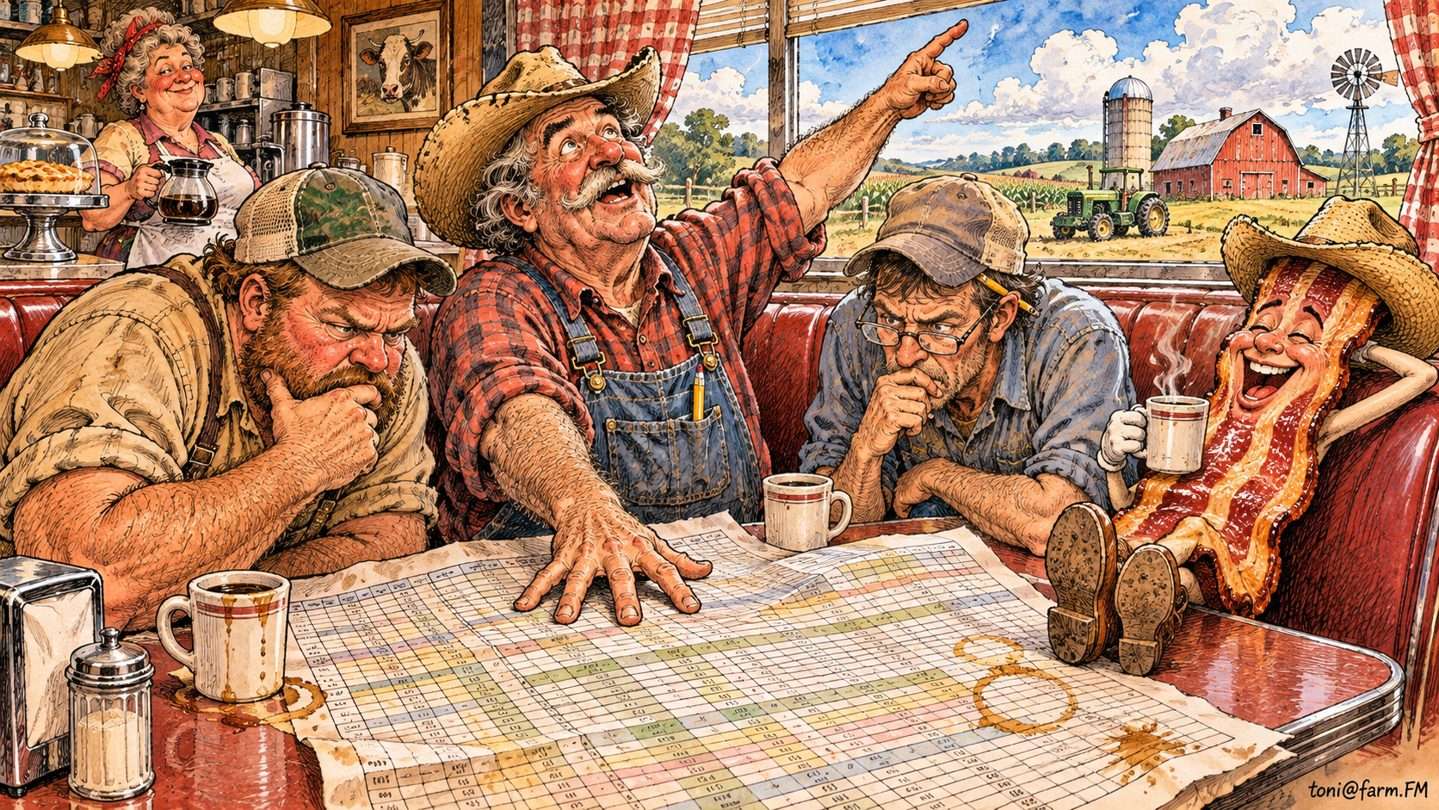
OTTUMWA, Iowa — Hog producer Ellis Wynn has examined the USDA’s daily hog purchase matrix and found no column for the price his neighbor heard at breakfast. He has asked the government to consider adding one. His wife says it should go immediately to the right of the column labeled What Did He Actually Sell?
“I heard a number I could live with,” Wynn said. “By the time I got home, the number had moved two counties away and we couldn’t agree on whether anybody had been paid.”
Hog Purchase Matrix Meets Coffee-Shop Reporting
The USDA’s daily direct negotiated hog purchase matrix organizes reported negotiated purchases into comparable ranges. Wynn went looking for the figure mentioned by a regular who ordered a second cup before giving his source. The regular said it came from a fellow who bought breakfast on Tuesdays. Somebody at the table asked whether the price applied on Tuesday. The regular said he could absolutely confirm that the man bought breakfast on a Tuesday.
Wynn’s wife, Rosa, conducted a small audit. She wrote down the reported price, the unit, the date and the terms. The unit remained blank. The date was debated. The terms amounted to a recommendation that Ellis get to the cafe earlier next week when the man with the most reliable information still had a fresh newspaper.
Hog producer Iris Flynn keeps a running record of the figures she can actually compare with her own settlement. She says the strongest evidence at the cafe is often a napkin with surprisingly precise handwriting and a coffee ring exactly where the source should be.
“I know it was a good price,” Flynn said. “The man who heard it repeated it three times and still wouldn’t tell me who got it.”

Start With the Unit Before You Circle the Number
A published report can describe transactions in a defined market category. An individual load can have different specifications, delivery timing, adjustments or other terms. Wynn checks whether the figures share a basis before treating them as a direct comparison. Rosa’s simpler test is to ask whether a number was on a settlement. If it was on a napkin, she can still use it to get the coffee off the table.
Producer Lester Boone says he sometimes reads market information before breakfast specifically to avoid getting cheered up by somebody who drove a pickup better than his. He is also willing to share his own records if a neighbor wants a fair comparison. He finds that very few neighbors do.
“I asked the fellow what his freight ran,” Boone said. “He told me it didn’t matter, because he’d only heard about the hogs and hadn’t driven near them.”
Wynn brought the matrix to the cafe the next morning. The regular read it carefully and said there were a lot of numbers on the page. Then he asked whether Wynn had heard what somebody got for an old grain truck. Wynn ordered another cup before asking who.
Farm.FM satire disclaimer. The coffee shop’s top price remains available for discussion and has never been available for delivery.