
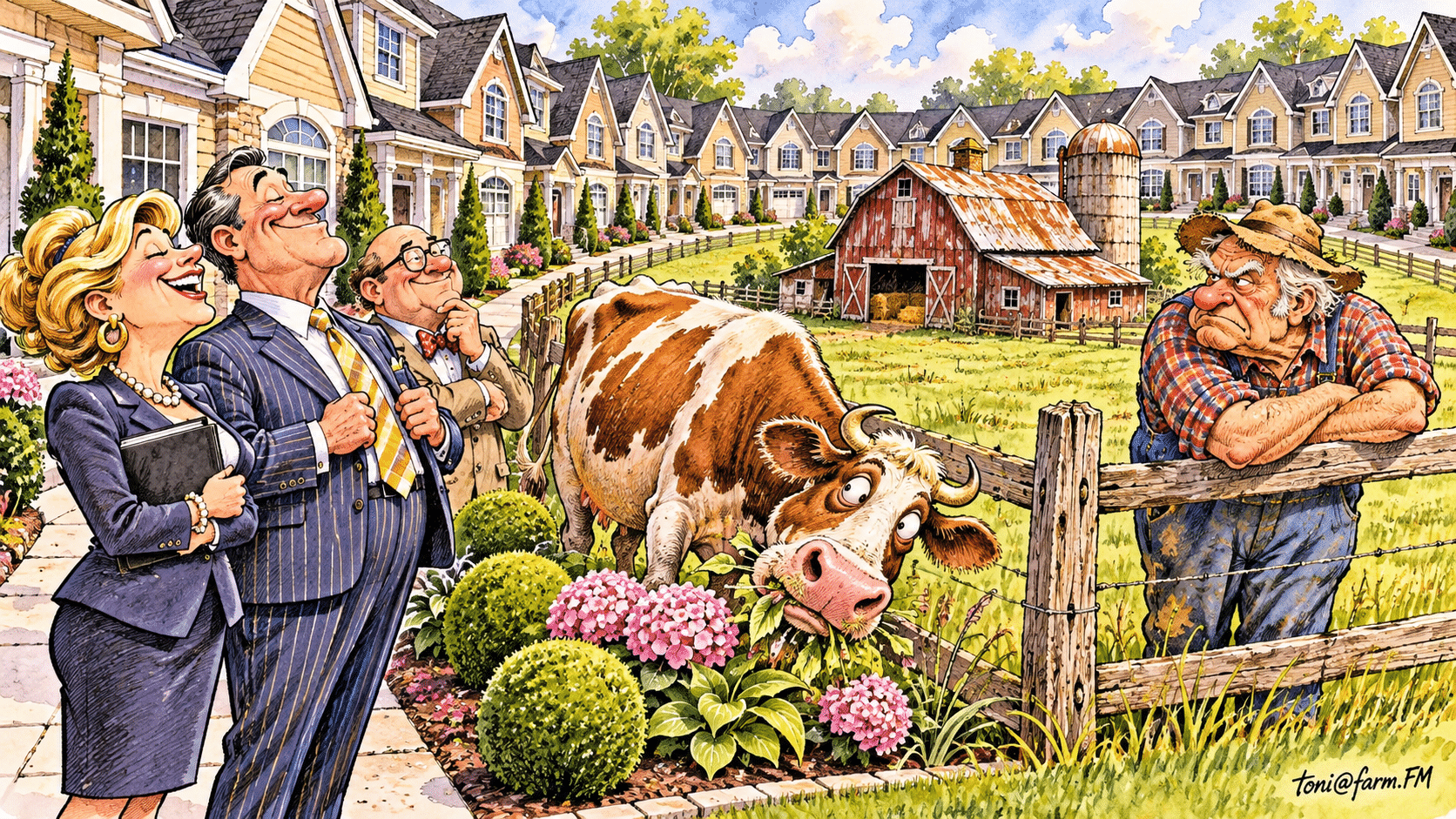
NORTH TEXAS. Old MacDonald had a farm. E-I-E-I-Oh, never mind. It is now a gated subdivision with 146 identical houses, three decorative windmills and one actual cow who keeps being reported to neighborhood security for failure to observe quiet hours.
Developer Preston Chalk calls the project a triumph of agricultural preservation. “We saved the barn,” he announced, pointing at a former equipment shed squeezed between two three-car garages. “And every purchaser receives a complimentary photograph of what the prairie looked like before we improved it.”
The Family Farm Is Now a Family of Forty-Seven Homeowner Committees
Retired farmer Earl McDonald still occupies the original homestead, now designated Lot 81, Phase Four. His tractor is too wide for the new traffic circle. His pickup requires architectural approval. The property association has fined him $125 because the cow “does not complement the Mediterranean landscaping palette.”
“They named the subdivision Heritage Pastures,” Earl said. “Then they paved the pasture and told me the heritage had to be painted beige.” His wife, Mavis, says the remaining chicken coop has been classified as a nonconforming accessory dwelling. “The rooster is appealing the decision, loudly, at 5:14 every morning.”
A Real USDA Census Makes the Punch Line Less Comfortable
The USDA Economic Research Service reported 1,900,487 U.S. farms in the 2022 Census of Agriculture, down about 7% from 2017. Those are real national figures, not Earl’s neighborhood poll, which asked sixteen residents if they knew what a hay baler was. Eleven believed it was an expensive kind of lawn furniture.

Meanwhile, American Farmland Trust’s Farms Under Threat research warns that under a business-as-usual scenario another 18.4 million acres could be converted to developed land uses between 2016 and 2040. The local preservation society welcomed this information by ordering additional commemorative pavers.
Homeowners Demand Authentic Country Living Without Any Country
A resident complained that cattle smell like cattle. Another requested that sunrise be postponed because a tractor started before nine. The subdivision marketing brochure promises “rustic tranquility,” which the association defines as looking at a barn from a climate-controlled kitchen without having to meet anyone who works in it.
The HOA conducted a survey with a 98% satisfaction rate, excluding the farmer, his wife, the farmhands, the cow and the family whose children discovered manure does not originate in a garden store. The remaining respondents praised the community’s authentic agricultural atmosphere and asked when the farm animals would be removed.
Farm Preservation Begins With Preserving Something That Farms
Preserving working agriculture means protecting useful land, access, water, equipment routes and viable operations, not merely keeping one antique plow beside the entrance. Residents can support local producers, learn the realities of farm work and accept that a cow is more than a landscaping feature.
At the ribbon cutting, Preston presented Earl with a plaque thanking him for safeguarding rural tradition. Earl asked whether tradition included a place to park the tractor. The board referred his request to its Historical Farm Equipment Aesthetic Subcommittee, which meets quarterly beside the pickleball courts.
Disclaimer: Entirely human collaboration between the world’s oldest tenured professor and a philosophy major turned dairy farmer. No cows voted for annexation.