

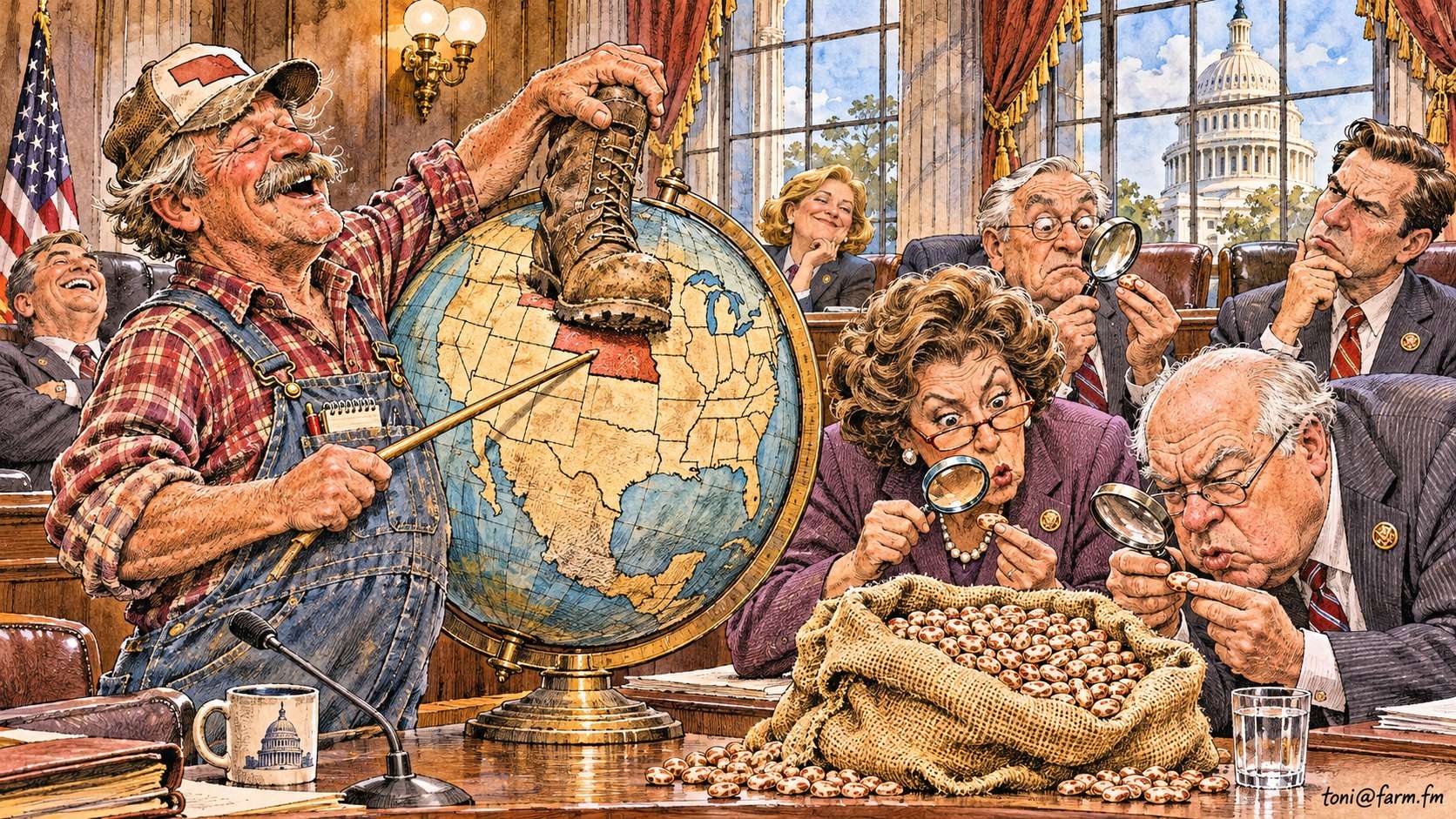
Fifteen observations from the bean belt
- Apparently food becomes foreign when someone else gets to eat it.
- Nebraska has been hiding inside the United States in plain sight.
- A bean can travel overseas faster than an explanation can cross a committee room.
- Washington discovered the supply chain by stepping on the first link.
- Farmers grow crops; officials grow distinctions.
- A passport is easier to obtain than a reliable purchase order.
- The grain elevator was surprised to learn it practices international relations.
- Geography gets complicated when the invoice comes home.
- The fertilizer dealer accepts neither patriotism nor geopolitical nuance.
- A truck leaving Nebraska does not automatically become foreign spending.
- The dog understood the map before the committee did.
- Beans have excellent storage life, unlike campaign explanations.
- Somebody should have drawn the supply chain on a napkin.
- Washington wants domestic prosperity with the customers removed.
- The state has requested a name tag at the next America First meeting.
SCOTTSBLUFF, NEBRASKA — Washington’s campaign to cut foreign food aid encountered an unexpected domestic obstacle after a Nebraska farmer informed officials that the beans involved had never been foreign, spoke no foreign languages, and had spent their entire childhood within shouting distance of a grain elevator.
The discovery prompted an emergency geography briefing, during which several aides expressed confidence that Nebraska was either a strategic partner or something near Iowa that required further study.
“We were told the spending was overseas,” said committee liaison Everett Binder, studying a map upside down. “Nobody mentioned the purchase order started here. That creates a very complicated situation for a slogan that was already printed on the bus.”
Farmer Walt Haskins offered to simplify matters by drawing a bean, a truck, and a check on the back of a seed invoice. The committee requested a digital version and funding for a consultant to determine whether the arrow between the bean and the check represented a partisan position.
Foreign food aid meets an American loading dock
The underlying issue is less mysterious than the briefing suggests. CNN’s reporting on American farmers and food aid cuts describes how reduced aid purchases have squeezed domestic growers. Congress cut Food for Peace funding by roughly 25%, while a Center for Global Development analysis cited by CNN found commodity spending about 55% below 2024 levels.
Haskins read the report at his kitchen table and concluded that his beans had become involved in international affairs without receiving diplomatic immunity from his operating loan.
“When they said foreign aid, I pictured a fellow carrying a suitcase full of dollars,” he said. “Turns out sometimes it’s me carrying beans. I should have dressed better.”
His wife, Marlene, said she had suspected the farm was globally connected when their fuel bill became sensitive to events thousands of miles away. She had not expected Washington to discover the connection only when it reached their sales ledger.
The local grain elevator already possessed extensive evidence of Nebraska’s location, including property taxes, truck registrations, and the fact that every employee complained about the same wind. Officials nonetheless requested proof that its loading dock was within the national interest.
The international incident in Bin Four
Elevator manager Rita Beck escorted the delegation to a bin of dry beans. One aide asked whether the product became American again if nobody bought it.
“It remains American,” Beck explained. “It just becomes American inventory. That’s the version where I pay to keep it here while somebody explains how much money we’ve saved.”
She defined a supply chain as a sequence of people whose bills become somebody else’s problem when the customer at the end disappears. The definition was not approved for the official glossary because it contained an identifiable consequence.
Binder proposed solving the confusion by describing future purchases as Domestic Agricultural Appreciation With an International Delivery Address. Haskins asked whether the longer name would fit on a check. Binder said the check was still under review, but the branding had considerable momentum.
Marlene observed that a restaurant does not become foreign aid merely because a tourist orders supper. The aides found this analogy compelling until someone pointed out that restaurants generally prefer customers who pay.
A map is cheaper than a rescue package
For context, USDA’s Food for Peace program uses American agricultural commodities in overseas assistance. The program continues to operate. The argument concerns its funding, execution, and disrupted demand, which is more complicated than shouting either “everything is gone” or “everything is fine” across a sack of beans.
Haskins favors reviewing costs. He reviews costs every time a tractor part arrives in a box large enough to contain hope and small enough to contain a washer.
“If a shipping contract costs too much, fix the shipping contract,” he said. “When my pickup needed a tire, I didn’t improve efficiency by removing the road.”
The visiting delegation agreed that accountability was essential and asked Beck whether she could provide a five-year forecast. Beck asked whether they could provide a five-month purchasing schedule. Both sides then experienced the uncomfortable silence that occurs when a request for certainty reaches the people responsible for creating uncertainty.
At the cafe, patrons conducted an informal survey by raising their hands if they preferred selling a crop to explaining why they could not sell it. Everyone raised a hand except one man who had been asleep. The waitress counted him as undecided, maintaining a methodological standard considerably higher than the conversation required.
No scientific claim was made for the survey. It did establish that the breakfast crowd understood revenue without needing a panel discussion.

Nebraska applies for domestic recognition
The county proposed a practical remedy: invite every policymaker discussing American farm markets to spend an afternoon following one invoice. Start with the seed dealer. Visit the irrigator. Stop at the elevator. Meet the trucker. Finish at the bank, where a person with a calculator will explain why the word “foreign” does not cancel a local due date.
Binder said the itinerary sounded educational but asked whether it could be completed from an airport lounge. Haskins offered to mail him a bean, provided somebody first clarified whether the postage would count as international assistance.
Meanwhile, the fertilizer dealer rejected a proposal to accept improved national positioning as partial payment. The dealer said positioning mattered, but mainly when a truck was backing toward his warehouse with money attached.
Marlene suggested that Washington give Nebraska a brightly colored name tag at the next meeting about putting America first. It would say the state was already here, had been here throughout the speech, and would appreciate being included when officials counted the economic benefits of removing its customers.
By late afternoon, the committee had correctly located Nebraska, although it declined to speculate about the implications. An aide photographed Haskins beside a bin and described the visit as a productive dialogue with the agricultural community.
Haskins described it as a productive dialogue with a group that had consumed six coffees, two doughnuts, and no beans.
He offered to fill their trunk before they left. Binder said procurement rules would require another review. The farm dog, who had followed the entire visit without credentials, picked up the seed invoice and carried it directly to the truck.
“He’s been doing that all day,” Marlene said. “We may send him to Washington. He understands where things start, where they need to go, and when it’s time to stop talking.”
The delegation departed with a corrected map. The beans remained American. The bill remained due.
The next morning, the local schoolteacher offered to bring her classroom map to the elevator. She said her students routinely learned that goods could be grown in one place and consumed in another without either place changing nationality. Binder asked whether the lesson came with an executive summary.
Haskins proposed an even shorter version: the farm was here, the buyer was elsewhere, and the sale connected them. If the connection changed, the farm noticed. Nobody needed to support every existing contract to understand the sequence. They simply needed to follow the arrow before cutting it.
Marlene packed the visiting staff a sandwich for the road. She pointed out that feeding a person who was leaving town did not make the bread foreign. The staff accepted the sandwich immediately, demonstrating that the basic distribution model could work when the beneficiary stood close enough to the committee.
The teacher marked that as progress. Haskins said he would mark it as progress when understanding reached the purchasing office. Until then, he planned to keep the napkin diagram beside the scale, where all the important things eventually had to acquire a weight.
Farmhouse disclaimer
The farm dog is not an accredited trade representative, and this article is not a geography certification. This story is entirely a human collaboration between two sentient beings: the world’s oldest tenured professor—the nation’s only agriculture professor who actually needs tenure—and a philosophy major turned dairy farmer. Neither can locate a missing purchase order by pointing harder at a globe.
Read more Farming coverage at Farm.FM.
Last Updated on November 28, 2026 by Chloe Summers