
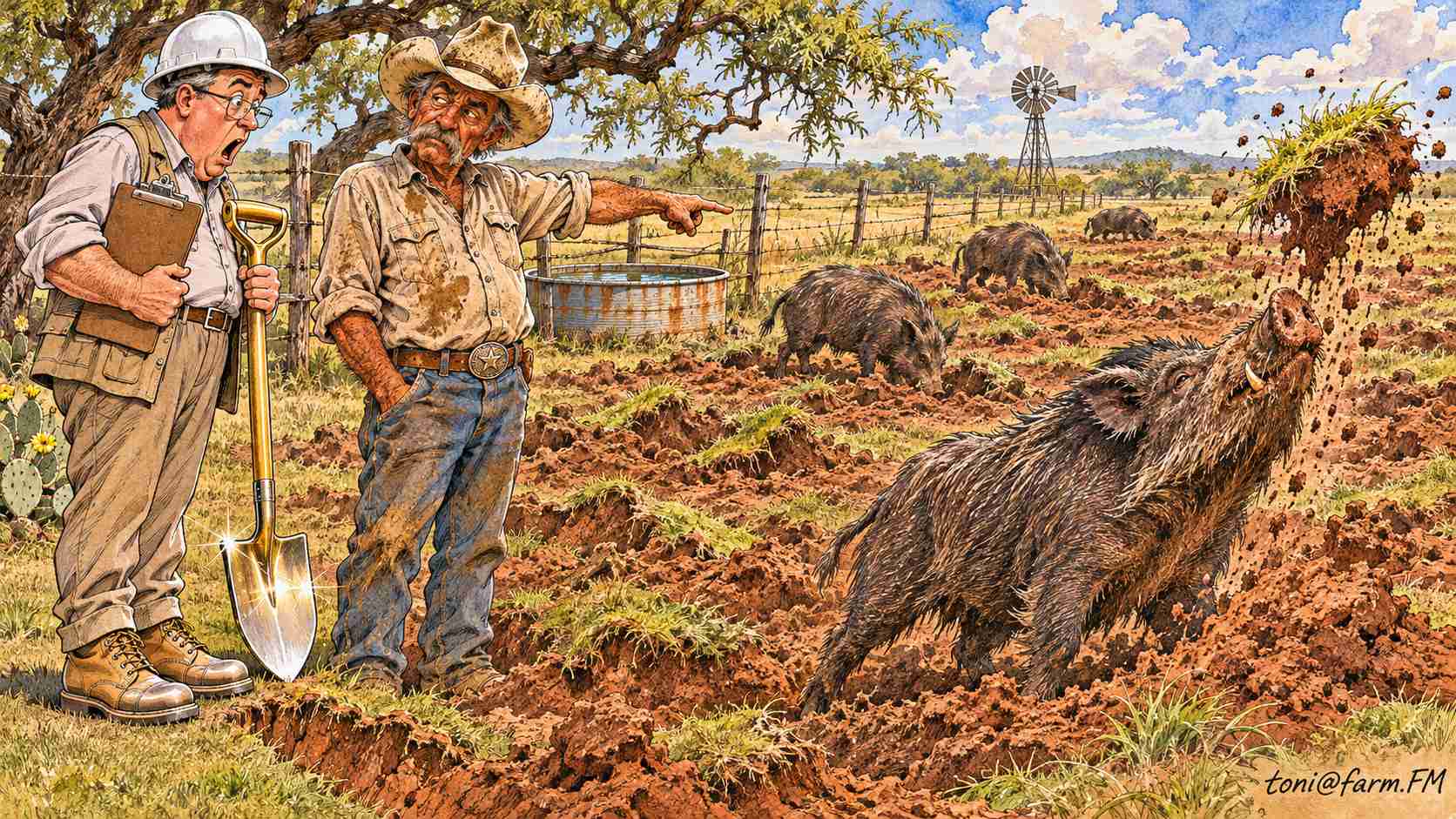
PALESTINE, Texas — Rancher Joe Nettles offered officials a tour of a pasture after hearing the USDA awarded money to combat feral swine. He had planned to call the visit a groundbreaking until his wife pointed out that, from all visible evidence, the groundbreaking had already occurred. Nettles settled on a tour and asked visitors to bring shoes they could afford to lose.
“I’ve got a place you can see from the county road,” Nettles said. “I used to call it a pasture. The hogs seem to be building the part of a golf course where nobody wants to hit the ball.”
Feral Swine Damage Gets a Field Visit

The USDA Natural Resources Conservation Service announcement describes $51.9 million for 29 partnership projects in 13 states. The program addresses damage to agriculture and other resources. Nettles has sent his own before-and-after photographs to the neighbors, although some older examples are difficult to place because they lack the landmarks the hogs have since removed.
His wife brought a clipboard on the tour. He brought a shovel, thinking someone would ask whether he had attempted repairs. She asked what he thought he would accomplish with the shovel before dinner. He said he could establish the seriousness of the situation by carrying it around and looking at whatever remained of the pasture.
Neighbor and rancher Ellen Hargrove takes pictures from the same spot to record what has changed. She says the hardest part is identifying which spot she used last time when the only landmark was a reasonably flat piece of ground.
“I told my husband to take a picture before he leveled it,” Hargrove said. “He said he was recording progress. I asked whether he meant ours or the hogs’.”
Write Down Where the Damage Starts and Stops
Nettles keeps the approximate location, date and photographs together when reporting damage and checking what assistance is available. He also talks to neighbors and local agricultural or wildlife officials. The hogs have shown no interest in staying inside one boundary, though several people at the coffee shop have volunteered to explain which side of the fence the problem ought to belong to.
Rancher Tom Reeve said sharing useful details made more sense than recycling estimates from the road. One neighbor described six acres of damage until Reeve asked which six. The neighbor said he was talking about what it felt like while he was mowing, which turned out to be the one acreage measurement they all understood.
“I don’t mind a consultant measuring the ruts,” Reeve said. “I just want somebody to tell the hogs they’re approved for a project in somebody else’s county.”
The tour ended beside a clean patch of grass. Nettles told his visitors this was the place to take a picture if they wanted a before shot. They asked when he expected an after shot. He said he hoped to be wrong, but he’d be available in the morning.
Farm.FM satire disclaimer. The hogs submitted neither drawings nor a request to begin work.