
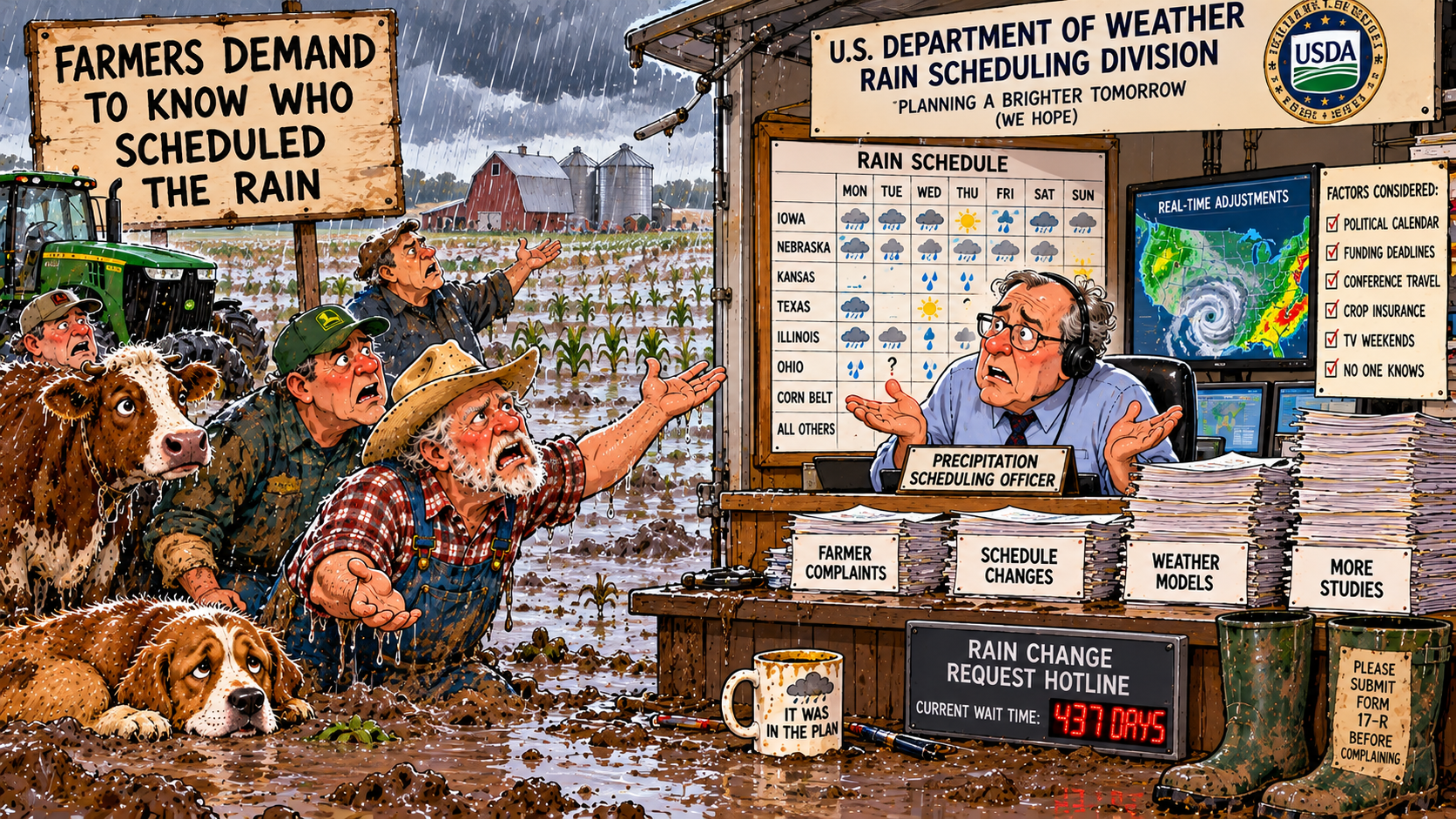
Midwest Agricultural Community Accuses Mother Nature of Gross Mismanagement After Discovering Rainfall Arrives Whenever It Pleases
AMES, IOWA – America’s corn farmers have formally complained about the timing of autumn rainfall after discovering that the nation’s weather system continues operating without consulting anyone responsible for harvesting approximately 16 billion bushels of corn.
The USDA’s latest Crop Progress report shows the national harvest only 44% complete as of October 18, eight points behind its five-year average.
Recent rains and unfavorable field conditions have slowed work in parts of the Corn Belt, although conditions vary considerably across the country.
Farmers have accused Mother Nature of demonstrating the management skills of a federal government agency.
She reportedly declined to comment.
Mother Nature Receives Her First Performance Review
An entirely satirical agricultural oversight committee has recommended conducting annual evaluations of the weather.
Sunshine received satisfactory marks.
Moderate spring rainfall was praised for supporting crop development.
Summer drought received a written warning.
October rain received an immediate disciplinary hearing.
A Nebraska farmer described the problem.
“I need rain in June. I need sunshine in October.”
A congressional consultant suggested submitting a seasonal moisture request.
“How far in advance?”
“Six months.”
“Will it work?”
“We’ll know after the feasibility study.”
The farmer requested that the consultant return to Washington before he accidentally suggested something more expensive.
The 2026 Harvest Calendar Crisis
In Iowa, only 26% of corn had been harvested by October 18, compared with the five-year average of 50%.
Michigan reached 13% compared with its average of 31%.
Meanwhile, Illinois was ahead of its historical pace, demonstrating that nationwide harvest figures conceal substantial regional differences.
Agriculture is not one enormous field with identical weather.
Farmers manage different soils, crop varieties, moisture levels and equipment schedules.
The USDA tracks this variation because it matters for production and marketing.
Washington politicians occasionally treat the statistics as evidence that the weather requires better leadership.
A satirical senator proposed appointing a National Director of October.
The nominee would oversee falling leaves, declining daylight and the movement of cold fronts.
The position would pay $240,000 annually.
Farmers requested that the money be spent repairing rural bridges instead.
Rain Declared an Agricultural Scheduling Violation
An openly satirical national survey asked 600 farmers whether autumn rain should require 72 hours’ advance notice.
Ninety-one percent supported the proposal.
Six percent requested seven days.
Three percent asked whether Mother Nature could also provide repair parts for combines.
Agricultural meteorologists explained that weather forecasts involve uncertainty because the atmosphere is a complex physical system.
Farmers accepted this explanation.
Politicians requested a simplified version.
The meteorologists explained that clouds do not follow political instructions.
Congress demanded to know whether the clouds had been properly briefed.
The Cost of Waiting
A delayed harvest is not merely an inconvenience.
Farmers may face drying expenses, additional labor demands, increased risk of crop losses and compressed time for planting or field preparation.
Large equipment cannot always enter saturated fields without causing damage.
The financial consequences can be serious.
A satirical agricultural accountant calculated that the average farmer loses money whenever a combine sits idle for reasons beyond the farmer’s control.
His revolutionary conclusion was awarded the National Agricultural Prize for Explaining the Obvious.
A farmer suggested that the accountant also investigate why wet socks are unpleasant.
Mother Nature Rejects Federal Oversight
Weather has challenged farmers since agriculture began.
Ancient civilizations prayed for rain.
Modern farmers check radar.
Both remain subject to atmospheric decisions that ignore human convenience.
Technology has improved forecasting, equipment performance and crop management.
But no machine can guarantee that a muddy field becomes suitable for harvesting on schedule.
A fictional Iowa producer offered a practical suggestion.
“Somebody tell Mother Nature we appreciate the rain.”
He pointed toward his cornfield.
“But she could’ve mailed it in July.”
A thunderstorm appeared on the horizon.
Washington announced that talks with the atmosphere remained constructive.
The farmer shut the barn door.
Mother Nature had apparently scheduled another meeting.
Last Updated on July 2, 2021 by Alan Nafzger